
The Super Free Case: Three Quasi-Rape Convictions, a 14-Year Sentence for the Leader, and the Creation of a Group-Rape Offence
The Super Free case involved three sexual assaults committed in December 2001 and April and May 2003 by members and associates of a large university event circle. The Tokyo District Court found that women were deliberately made heavily intoxicated and then sexually assaulted by multiple men. The circle's representative was convicted of three counts of quasi-rape and sentenced to 14 years in prison in November 2004. His sentence became final when the Supreme Court dismissed his appeal on 1 November 2005. Fourteen people were convicted in the wider proceedings. The 2004 group-rape offence was enacted after the charged acts and was not applied retroactively.
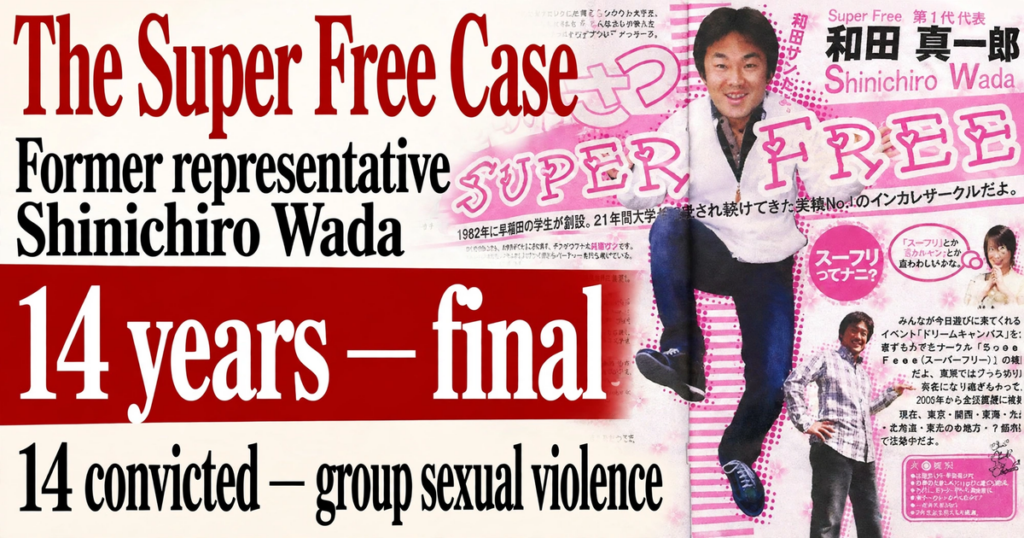
A university event circle became the centre of a criminal case
Super Free began as a university event circle that organised parties, dance events and trips. It expanded under its representative, attracting large crowds and developing branches beyond Tokyo. The criminal case that became public in 2003 was not simply a dispute about alcohol at student events. The Tokyo District Court found that members and associates repeatedly used drinking gatherings to make women extremely intoxicated and then sexually assaulted them in groups. The organisation's ordinary event activities provided access to participants and places where the offences could be carried out. The court examined the structure and culture of the group because those features helped explain the repeated conduct and the representative's responsibility.
The three offences charged against the representative
The representative was prosecuted for three offences of quasi-rape under the Penal Code then in force. The first occurred on the night of 19 December 2001 and continued into the early hours of 20 December. The victim was 19. The second occurred on 27 April 2003 and involved an 18-year-old woman. The third took place on 18 May 2003 and involved a 20-year-old woman. In each case, the court found that the women were made heavily intoxicated and rendered unable to resist before multiple men sexually assaulted them. The ages and dates are taken from the district court judgment, not from later summaries that may use broader descriptions.
The court found a repeated method, not an accidental misuse of alcohol
The judgment described a pattern in which high-strength alcohol was served in large quantities, sometimes in a way that concealed how strong the drinks were. Women were moved to places where others could not easily intervene. Multiple participants took turns, while others helped prevent friends from interrupting or alerting outsiders. The court did not treat intoxication as consent. A person who has been made unconscious or incapable of resisting has not agreed to sexual activity. The judgment also found that the practice had been repeated for years before the three charged offences. The three counts were the offences prosecuted against the representative, not a claim that only three women were harmed by the wider pattern.
The representative's influence over the group was central to the sentence
The representative had joined the circle while at university and later became its leader. By the time of the offences, he had remained in the position for years and exercised strong influence over event planning, staff rankings and the organisation's expansion. The court found that he had made statements approving the group assaults and encouraging participation. It did not find that he maintained a formal system of punishment for every staff member who refused to take part. That distinction matters: the judgment relied on his repeated encouragement, status and influence, not on an unsupported claim that every member was forced to participate. The court treated his leadership as a major aggravating factor.
The district court imposed 14 years in November 2004
On 2 November 2004, the Tokyo District Court sentenced the representative to 14 years' imprisonment. The sentence reflected the three charged offences, the repeated nature of the conduct, the role of the representative and the effect of the group environment. The court also considered the wider context of similar assaults within the circle. The sentence was unusually severe for the time and became a focus of public debate. Other defendants were prosecuted separately. In the wider proceedings, 13 people besides the representative received prison sentences ranging from two years and four months to ten years. The total of 14 convicted persons refers to court outcomes, not everyone who had ever attended a Super Free event.
The Tokyo High Court and Supreme Court left the sentence in place
The representative appealed, but the Tokyo High Court dismissed the appeal on 2 June 2005 and maintained the 14-year sentence. On 1 November 2005, the Supreme Court dismissed the further appeal. The sentence therefore became final. The Supreme Court's action was a procedural decision rejecting the appeal, not a new trial with a new set of witnesses. The other 13 defendants' sentences had also become final in their separate proceedings. The legal result should be described precisely: the representative received 14 years, and the wider criminal proceedings produced 14 convictions.
The 2004 group-rape offence was enacted after these crimes
The case became an important example in debate over the criminal law, and the 2004 amendment to the Penal Code introduced the offence of group rape and a related offence involving death or injury. The House of Representatives' Justice Committee discussed Super Free by name and referred to the representative's 14-year sentence and the prison terms imposed on other defendants. The amendment reflected wider concerns about serious crime and sexual violence; it should not be described as a law created solely because of this one case. Most importantly, the charged offences occurred in 2001 and 2003, before the new group-rape provision existed. The defendants were tried under the law applicable when the acts occurred.
The later law changes did not erase the historical judgment
The group-rape offence was later removed as the Penal Code's sexual-offence provisions were reorganised in 2017. In 2023, the law was again revised and the offence of non-consensual sexual intercourse was introduced. These later changes should not be projected backward onto the Super Free judgment. The correct historical description is that the representative was convicted of three counts of quasi-rape under the former law. The case's continuing significance lies in the court's findings about repeated group violence, the misuse of alcohol to incapacitate victims, the representative's influence and the legislative debate that followed.
The victims' participation in events was not consent
The district court rejected the idea that the women had assumed the risk of sexual assault by attending events or drinking alcohol. Participation in a party is not consent to sexual activity, and drinking does not remove a person's right to bodily autonomy. The court examined how the women were made unable to resist and how the group members acted. This point is essential to an accurate English account because older legal terms such as quasi-rape can sound unfamiliar or may be confused with modern statutory language. The translation explains the historical offence while making clear that the conduct was sexual violence, not a misunderstanding or a consensual encounter.
Original Japanese record: スーパーフリー事件|3件の準強姦で代表に懲役14年、14人有罪と集団強姦等罪の新設
Last updated:
Related articles
Case record
The Bucky Video Production Case: Consent, Collective Violence and the Producer's Responsibility

Case record
The Thunderbird Case: Three Women Assaulted on Trains and at a Station, an 18-Year Sentence

Case record
The Shimbashi Stalking Murders
Case record