
The Isesaki Junior-High-School Girls Murders: Robbery, Arson and a Death Sentence
Two 13-year-old second-year junior-high-school students were killed in a house in Isesaki, Gunma Prefecture, on April 1, 1976. Ujigawa, then using the surname Tamura, entered the neighbouring home intending to steal valuables, killed the girls and set fire to the house. His death sentence was upheld by the Supreme Court on December 8, 1989. He died in custody in 2013 while seeking a retrial; he was not executed.
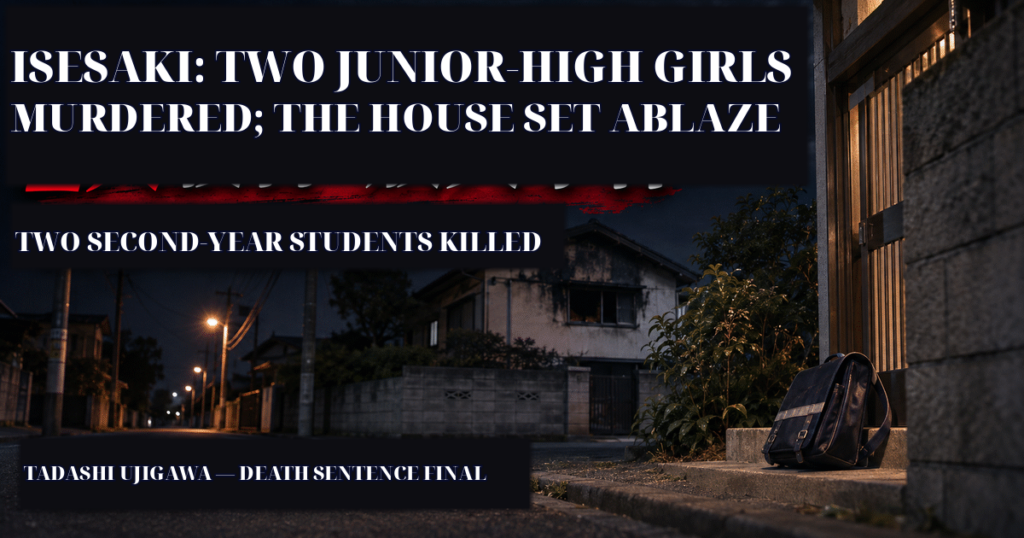
Two students were at home during the spring holiday
At approximately 1:30 p.m. on April 1, 1976, two second-year junior-high-school students were inside a home in Sanwa, Isesaki City, Gunma Prefecture. Both girls were 13. One was the daughter of the household and the other was her cousin. Their families were away at work and other activities. The date fell during the spring school holiday. The girls were not outside in a public place or travelling alone; they were inside a neighbouring home when the offender entered. This setting is important to understanding why the prosecution treated the intrusion as a robbery planned in advance rather than an encounter that unexpectedly escalated.
The offender lived next door and entered with a weapon
Ujigawa, who used the surname Tamura at the time, lived next door to the victims. The Supreme Court judgment found that he concealed a kitchen knife and entered the house with the purpose of taking valuables. The fact that he lived nearby meant he already knew the location and did not need to search for a target elsewhere. The court treated the entry as part of an intended robbery. It did not find that he entered innocently and only later decided to steal property. The pre-existing purpose to take valuables was central to the conviction for robbery-murder.
The two girls were killed and valuables were taken
Ujigawa killed both girls inside the home and took jewellery and other valuables. The prosecution and courts treated the deaths and the taking of property as connected acts in a robbery-murder. The victims were both young teenagers and were in a home where no adult family member was present at the time. The archive does not identify the girls by name in its public narrative, and this English account does not add names or details beyond what the record supports. The number of deaths was two. The later arson did not create additional victims.
The house was set on fire after the killings
After taking the valuables, Ujigawa poured kerosene on the bodies and set fire to the house. The Supreme Court treated the fire as an attempt to conceal the crime. The charge included arson of an occupied building, in addition to robbery-murder. The fire damaged the scene and formed part of the criminal conduct considered at trial. The sequence matters: the court found that Ujigawa entered with a robbery purpose, killed the two girls, took property and then used fire in an effort to hide what he had done. These were not unrelated offences assembled after the fact.
Other arson offences were also considered
The case against Ujigawa included earlier incidents involving theft followed by fires. The Supreme Court's review referred to two offences of arson involving unoccupied buildings and one attempted arson involving an occupied building. These earlier offences were part of the broader criminal record before the court and were considered in the sentencing analysis. They should not be confused with the two deaths on April 1, 1976. The number of victims in the Isesaki case remained two. Including the earlier offences helps explain why the sentencing record covered more than the single fatal incident at the neighbouring house.
Mental capacity was disputed during the proceedings
The defence raised questions about Ujigawa's mental condition and whether he had diminished responsibility at the time of the robbery-murders and arson. A history of stimulant use does not by itself establish legal insanity or diminished capacity under Japanese law. The issue is whether the defendant's ability to understand the wrongfulness of the act or to control conduct was substantially impaired at the relevant time. The Tokyo High Court found that Ujigawa was not in a state of diminished capacity when he committed the robbery-murders and arson. The Supreme Court accepted that assessment after reviewing the record.
The district and high courts imposed and upheld death
The Maebashi District Court sentenced Ujigawa to death on March 15, 1979. The judgment covered the robbery-murders of the two girls, the arson of their home and the earlier arson and attempted-arson offences. Ujigawa appealed. The Tokyo High Court dismissed the appeal on November 17, 1983, maintaining the death sentence. The high court considered the factual findings, his mental condition and the appropriate punishment. The appeal process therefore involved a substantive review by the high court, rather than an appeal withdrawn by the defendant.
The Supreme Court finalized the sentence in 1989
On December 8, 1989, the Supreme Court's Second Petty Bench dismissed Ujigawa's final appeal. The death sentence became final. The Supreme Court considered the robbery purpose, the concealed knife, the killing of two students, the theft of valuables, the subsequent fire and the earlier arson offences. It also accepted the high court's finding that the defendant had full criminal responsibility. This was the conclusion of the ordinary appeal process, not an execution. The legal status of a final death sentence must be kept distinct from the later question of whether the sentence was carried out.
Ujigawa died in custody while seeking a retrial
Ujigawa remained in detention after the death sentence became final. He continued to seek a retrial, but the conviction was not overturned. On November 15, 2013, he died at the Tokyo Detention House at the age of 62. The archive reports that he had been receiving treatment for lung cancer. His death occurred in custody; he was not executed. A retrial application is a request to reopen a final conviction under specified legal conditions, not an automatic suspension or reversal of the sentence. No posthumous acquittal is recorded in the public article.
Original Japanese record: 伊勢崎女子中学生殺人事件|中学2年生2人を強盗目的で殺害・放火、宇治川正の死刑確定
Last updated:
Related articles
Case record
The Osaka Private Video Booth Fire: Sixteen Deaths, a Final Death Sentence and a Second Retrial Denial
Case record
The Maruyo Wireless Robbery-Murder-Arson: A Death Sentence Final Since 1970 and a Seventh Retrial Appeal

Case record
The Kiyoshi Okubo Murders: Eight Women Killed in Forty-One Days
Case record