
The Iizuka Case: A Death Sentence, an Execution and Continuing Retrial Petitions
Two seven-year-old girls disappeared on their way to school in Iizuka, Fukuoka Prefecture, on February 20, 1992, and were found dead the following day. Michitoshi Kuma was convicted on circumstantial evidence, sentenced to death and executed in 2008. His family has pursued retrial proceedings after his death. A second retrial request was rejected in 2024 and its immediate appeal was dismissed in February 2026; a special appeal was pending, while the defence announced preparations for a third request in September 2026.
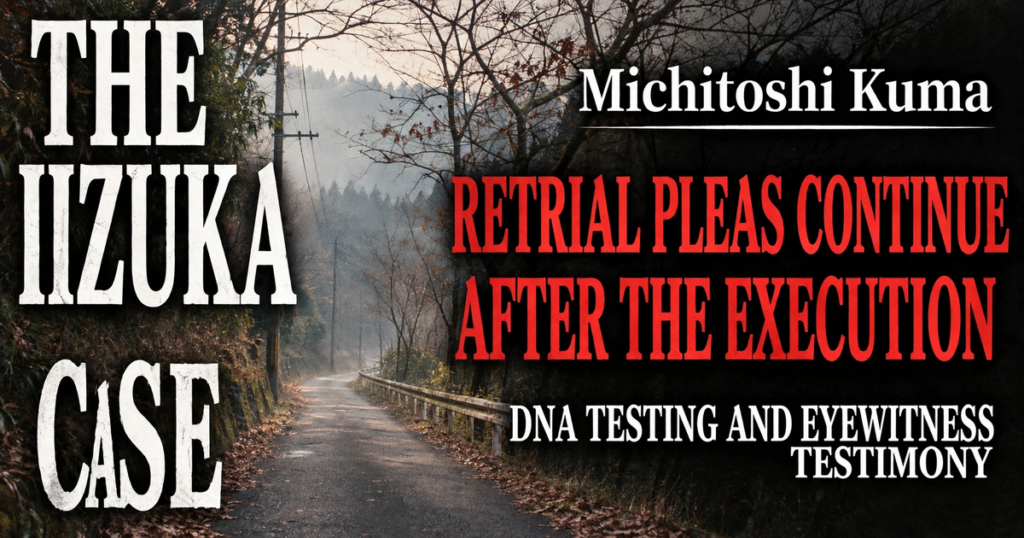
Two first-grade pupils disappeared on their way to school
On the morning of February 20, 1992, two seven-year-old girls who attended the same elementary school disappeared while travelling to school in Iizuka, Fukuoka Prefecture. Their families and the local community searched for them. The following day, February 21, their bodies were found in a wooded area in the mountains near the former city of Amagi, now part of Asakura. The investigation became a major child-murder case. The girls were taken from their ordinary route to school, and the prosecution later alleged that they had been abducted, killed and abandoned in the mountains.
Michitoshi Kuma was arrested more than two years later
The police did not arrest Michitoshi Kuma immediately after the girls were found. In September 1994, he was arrested in connection with the disposal of the bodies, and in October he was arrested on the murder allegations. He was later indicted for kidnapping or abduction, murder and abandonment of the bodies. Kuma consistently denied involvement. His case was not built around a confession by him. The prosecution relied on a combination of circumstantial evidence, including descriptions of a vehicle, witness accounts, fibre evidence and forensic testing of biological material.
The trial examined several strands of circumstantial evidence
The prosecution argued that a vehicle resembling Kuma's Mazda station wagon had been seen in circumstances connected with the girls' disappearance and the discovery of evidence. Fibres found on the girls' clothing were said to be consistent with material used in the seats of the same model of vehicle. Blood and other biological traces were also examined. The National Research Institute of Police Science conducted blood-group and DNA-type testing, including the MCT118 method used at the time. The court assessed these strands together rather than treating any single item as independently decisive.
The death sentence was upheld on appeal and later executed
On September 29, 1999, the Fukuoka District Court sentenced Kuma to death. The Fukuoka High Court dismissed his appeal on October 10, 2001. The Supreme Court dismissed the final appeal on September 8, 2006, and the death sentence became final on October 8, 2006. Kuma was executed on October 28, 2008. The execution occurred before the later retrial applications had run their course. No retrial court has issued an acquittal, and the original conviction has not been set aside.
The first retrial request was rejected through all available stages
Kuma's wife filed the first retrial request on October 28, 2009. The defence challenged the reliability of the old DNA testing and the credibility of witness evidence, relying on expert opinions and developments in forensic science. The Fukuoka District Court rejected the request on March 31, 2014. The Fukuoka High Court dismissed the immediate appeal on February 6, 2018, and the Supreme Court dismissed the special appeal on April 21, 2021. The first retrial proceedings therefore ended without a retrial being ordered.
A second request focused on new witness accounts
A second retrial request was filed on July 9, 2021. The defence submitted statements from people who said they had seen two girls resembling the victims in a vehicle on the day of the disappearance, and from a witness who challenged an earlier statement used in the original trial. The Fukuoka District Court heard evidence from witnesses and examined whether the new accounts undermined the original findings about the vehicle and the timeline. The court rejected the second request on June 5, 2024, concluding that the new material did not meet the legal threshold for reopening the case.
The High Court rejected the immediate appeal in February 2026
The family challenged the 2024 decision. On February 16, 2026, the Fukuoka High Court dismissed the immediate appeal and left the district court's rejection in place. The High Court found that the new witness evidence did not make the original assessment unreasonable. The defence announced that it would seek review by the Supreme Court through a special appeal. In a statement to the Diet on June 2, 2026, the government confirmed that the special appeal was pending and that no retrial had been ordered in either of the two requests.
A third request was being prepared, not yet granted
On September 24, 2026, reports said the defence team was preparing a third retrial request based on a new examination of photographs and negatives associated with the DNA testing conducted in the original investigation. The defence's expert interpretation was that the material might show a mismatch between Kuma's DNA type and the type attributed to the offender. That is a defence claim and a proposed new item of evidence; it has not been accepted by a court. As of the latest archive update on November 14, 2026, the team had announced preparations for the third request. The second request's special appeal remained a separate proceeding.
The legal position must not be confused with the family's claim of innocence
The Iizuka Case has two distinct and simultaneously important records. The original criminal judgment found Kuma guilty, imposed the death penalty and was carried out. His family and defence lawyers have continued to argue that the conviction was wrong and have sought retrial on new evidence. A rejected retrial request does not amount to a new trial, while the filing or preparation of a retrial request does not itself establish innocence. At the same time, the execution means that any future proceedings cannot restore Kuma's life. Accurate reporting must state the status of each application and must not describe him as acquitted or the conviction as overturned.
Original Japanese record: 飯塚事件|久間三千年の死刑執行後も続く再審、DNA型鑑定と目撃証言をめぐる争い
Last updated:
Related articles

Case record
The Fukuoka Serial Robbery Murders: Two Victims, a Handgun Network and a Final Death Sentence
Case record
The Kudo-kai Four Civilian Attacks: The Death Sentence Overturned and the Supreme Court Appeals Still Pending
Case record
The Kitakyushu Hospital Director Abduction-Murder: 950,000 Yen Stolen, a 20-Million-Yen Demand and Two Executions

Case record