
The Himeji Pachinko Business Murders and Confinement Deaths
A series of confinement and death cases around Himeji between 2009 and 2011 left three men dead. Chen Shunkon received life imprisonment after one murder count was rejected, while Takashi Uemura received a final death sentence for two murders and a separate confinement-related death.
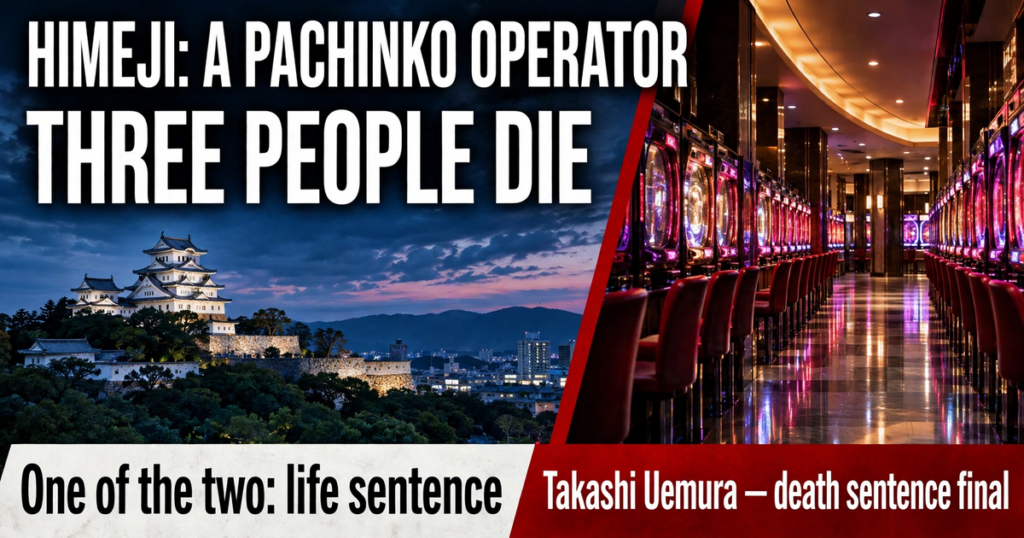
Three deaths emerged from a series of confinement cases
Between 2009 and 2011, a series of confinement and death cases occurred around Himeji City in Hyogo Prefecture. Three men died. The criminal proceedings did not produce one identical finding against every participant. Chen Shunkon, also known by the name Nakamura Harune, was treated as the organizer of the broader plan. Takashi Uemura was described as the central operative among the people who carried it out. Chen ultimately received life imprisonment after one murder count involving a former advertising-company president was rejected. Uemura received a final death sentence for two murders and a separate confinement-related death. The difference between their sentences arose from the facts found in each defendant's own trial.
The three deaths did not all amount to murder convictions
The Supreme Court's judgment in Uemura's case treated the three deaths under different offences. The shooting of a former company president and the killing of a 37-year-old man were treated as murders. A 57-year-old man died during a kidnapping and confinement episode, and Uemura was convicted of kidnapping for the purpose of harming life or body and causing death through unlawful confinement. That third death was not classified as murder in the judgment. The distinction matters because the fact that three people died does not mean that all three deaths were legally attributed to the same intent or offence. The Japanese source describes two murders and one confinement-related death in Uemura's case.
A former company president was held in a narrow enclosure for about 14 months
The first major episode involved a former advertising-company president who had a financial dispute with Chen. Uemura acted with Chen and confined the man in a narrow enclosure built inside an apartment for approximately one year and two months. The confinement controlled the man's daily life and subjected him to repeated degrading treatment. The Supreme Court described the treatment as an assault on the man's dignity and an attempt to make him absolutely obedient. Uemura then shot the man twice at close range. The courts treated the shooting as an intentional killing, and the long confinement was part of the wider criminal conduct considered in sentencing.
A 57-year-old man died during a dangerous abduction and confinement
Another victim, aged 57, was believed by the group to have been connected with the death of Chen's father. Uemura and others abducted him with the purpose of causing harm to his life or body. They restrained his hands and feet, taped his mouth and placed him inside a sleeping bag in a vehicle. The Supreme Court described the method of confinement as extremely dangerous. The man died as a result of the unlawful confinement. The legal classification was kidnapping for the purpose of harming life or body and causing death by unlawful confinement, rather than murder. This identifies the offence the court actually found proved.
A 37-year-old former worker was killed after escaping an earlier abduction
The second murder concerned a 37-year-old man who had previously been convicted in a case involving the death of Chen's father and had served a prison sentence. Uemura's group first abducted the man, but he escaped. The Supreme Court found that the offenders then prepared equipment, including an incinerator, to conceal evidence before attacking him again. The victim was restrained and unable to resist. His neck was compressed and he died from suffocation. The court considered the renewed attack after the first escape to be persistent and planned, and found a strong intent to kill.
The wider series also included a month-long confinement of another employee
The criminal conduct extended beyond the three deaths. An employee who had escaped from a pachinko business operated by Chen was confined for approximately one month in a small room inside a warehouse. That episode formed part of the offences for which Uemura was convicted. The Supreme Court therefore examined not only the fatal incidents but also the broader pattern of kidnapping, confinement and control. A description that focuses only on three dead men would omit a significant part of the conduct considered in Uemura's case. The proceedings concerned an ongoing structure of coercion, not isolated acts.
Chen's life sentence reflected a different set of findings
Chen was prosecuted in relation to the three deaths, but the court did not find every allegation proved. At the Kobe District Court's Himeji branch on 8 November 2018, Chen received life imprisonment, although prosecutors had sought death. The murder charge concerning the former advertising-company president was rejected. On 12 October 2022, the Supreme Court dismissed Chen's appeal, and the life sentence became final. The result should not be described as a finding that Chen was responsible for all three murders. The source article emphasizes that one murder count was acquitted and that the final sentence was life imprisonment based on the remaining convictions.
Uemura was sentenced to death and the sentence was upheld
Uemura was sentenced to death by the Kobe District Court's Himeji branch on 15 March 2019. The court found him responsible for the deaths of three men, including two murders and the separate confinement-related death. The Osaka High Court dismissed his appeal on 19 May 2021. On 3 July 2023, the Supreme Court's Second Petty Bench dismissed his final appeal. The death sentence therefore became final. The Supreme Court described Uemura as the central operative under Chen's direction. It found that he organized preparations, instructed other participants, carried out killings and handled the disposal of bodies.
The two sentences cannot be explained by a simple hierarchy
Chen was described as the organizer, yet he received life imprisonment, while Uemura received death. The courts examined the particular charges, proof and conduct established in each separate trial. Chen was acquitted of one murder count and convicted on the remaining case. Uemura was found to have personally carried out two murders, participated in the confinement-related death and played a central role in preparations, instructions and disposal. The final legal outcomes are therefore life imprisonment for Chen and a final death sentence for Uemura. The translation preserves that distinction and does not treat all three deaths as murder convictions against both men.
Original Japanese record: 姫路パチンコ経営者3人死亡事件|陳春根の無期と上村隆の死刑を分けた事実認定
Last updated:
Related articles
Case record
The Ishinomaki Triple Attack
Case record
The Sakai Couple Murder: A Planned Robbery, Two Deaths and a Final Death Sentence
Case record
The Utsunomiya Confinement Murders: Two Deaths, Three Survivors and a Final Death Sentence
Case record