
The Fukushima Devil-Exorcism Murders
In a shared residence in Sukagawa, Fukushima Prefecture, repeated assaults described by the group as go-yō left six people dead between January and June 1995. The courts distinguished four murders from two deaths classified as injury resulting in death. Sachiko Eto was found to have led the group and directed the violence. Her death sentence became final in 2008 and was carried out in 2012.
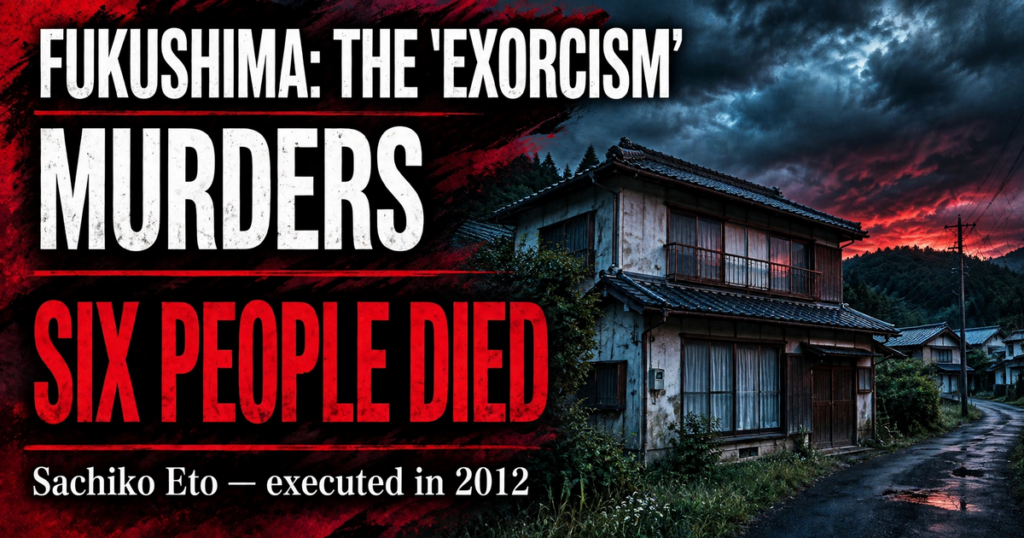
A shared household became the setting for repeated violence
From January through June 1995, people living together in a residence in Sukagawa, Fukushima Prefecture, were subjected to repeated assaults. Sachiko Eto was at the centre of the household and presented herself as a person with special spiritual power. She used explanations involving animal spirits and the need to remove them. The violence was described within the group as go-yō, a term used as though the assaults were necessary acts of purification. Six people died during the period. The events were a sequence of assaults, not one attack.
The word go-yō was used to give the assaults a spiritual explanation
Eto conducted prayers and supplied spiritual explanations for the difficulties experienced by people around her. Under her influence, physical assaults came to be treated as a necessary response to spirits believed to be attached to members of the household. The criminal case did not turn on whether a person was entitled to hold spiritual beliefs. It concerned the concrete acts of violence, the directions given to others and the deaths that followed. Religious language did not convert repeated physical assaults into lawful or non-criminal conduct.
Six deaths did not mean six murder convictions
The legal classification of the deaths was not uniform. The courts found that four victims had been murdered because the necessary intent to kill was established. The other two deaths were classified as injury resulting in death because the prosecution did not establish the same level of intent to kill. Under Japanese criminal law, the fact that a person died does not by itself determine whether the offence is murder or an offence involving injury that results in death. The final death sentence was based on the whole group of offences, including four murders and two such deaths.
A surviving victim and relatives helped bring the case to light
The violence took place inside a household where people lived together, and the full picture was not immediately visible from outside. The Japanese article reports that the investigation began to move in July 1995 after a surviving victim who had been hospitalised was questioned. A relative had raised concern that several bodies might be inside the residence. Police then examined the home and discovered evidence of multiple deaths. The survivor's account and the family's efforts allowed investigators to identify a series of events in the same household.
Eto's influence and the participation of others were examined separately
Eto did not act alone. Three other people were involved in the assaults, and the courts considered each participant's role rather than treating everyone as equally responsible. The article describes Eto as the central figure who formed the group and used her influence to direct others. Two co-defendants received life imprisonment and another received 18 years. Their legal responsibility depended on their positions, the conduct in which they participated and the extent to which they followed Eto's directions. The sentences should not be collapsed into one collective punishment.
The prosecution contested intent and criminal responsibility
At trial, Eto's defence disputed the intent to kill and the existence of joint criminal responsibility. It also argued that she had been in a state described as possession and therefore lacked criminal responsibility. Japanese law requires a court to examine whether a defendant could understand the nature and wrongfulness of an act and control conduct in accordance with that understanding. Spiritual beliefs or unusual statements do not settle the question by themselves. The courts reviewed Eto's conduct, her directions to others, the repeated assaults and her responses in different situations.
The district court imposed the death penalty in 2002
On 10 May 2002, the Fukushima District Court sentenced Eto to death. The judgment considered the six deaths, her central position in the household and the way she influenced others to continue the assaults. The sentences imposed on the co-defendants differed according to their roles. Eto appealed. The first-instance sentence was therefore not final merely because it was pronounced; the case proceeded to the Sendai High Court for review.
The High Court and Supreme Court maintained the sentence
On 22 November 2005, the Sendai High Court dismissed Eto's appeal and maintained the death sentence. The court again considered the claim that she had been in a state of possession, but found that she retained full criminal responsibility. On 16 September 2008, the Supreme Court's Third Petty Bench dismissed the appeal. The death sentence consequently became final. The Supreme Court placed particular weight on Eto's leadership of the group and her use of influence to direct others to commit the violent acts.
The death sentence was carried out in 2012
On 27 September 2012, Eto's death sentence was carried out at the Sendai Detention Centre. The execution came four years after the sentence became final. The legal outcome therefore has two distinct stages: the death sentence became final in 2008 after the Supreme Court dismissed the appeal, and it was executed in 2012. It would be inaccurate to describe the 2002 district-court judgment alone as the final outcome or to omit the appellate proceedings.
Original Japanese record: 福島悪魔払い殺人事件|「御用」と称する暴行で6人死亡、江藤幸子の死刑執行
Last updated:
Related articles

Case record
The 1995 Tokyo Subway Sarin Attack: Victims, Criminal Trials and a Continuing Legacy
Case record
The Tateyama Family Arson Murders

Case record
The Osaka Dog-Lover Serial Murders: Five Victims and the Death Sentence of Yoshinori Ueda

Case record