
Dhaka JAL Hijacking (1977): Japan's Extra-Legal Decision
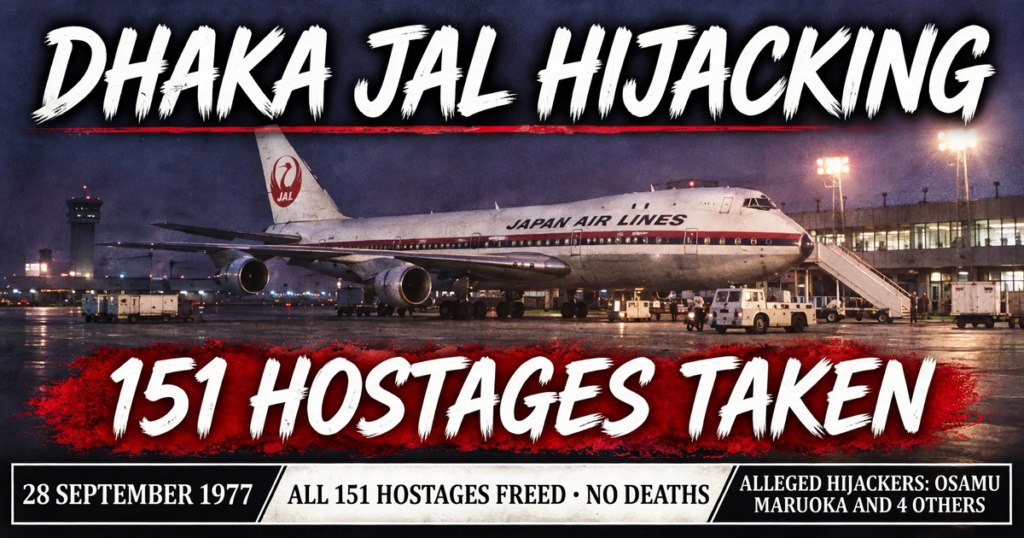
In 1977, the Japanese Red Army hijacked JAL Flight 472, taking 151 people hostage. Japan paid US$6 million and released six detainees through an extra-legal measure. All hostages were freed alive. Five people connected with the case remained internationally wanted as of July 2026.
Introduction: The government's extra-legal decision and its aftermath
The Dhaka Japan Airlines hijacking, which began on 28 September 1977, was an incident in which the Japanese government made an exceptional decision in response to a hostage crisis caused by the Japanese Red Army: it agreed to release people held in custody in Japan and to pay a ransom. Of the passengers and crew aboard Japan Airlines Flight 472, 151 became hostages. On 1 October that year, Prime Minister Takeo Fukuda declared, "One life outweighs the Earth," and decided on an extra-legal measure outside ordinary legal procedures. His words are also quoted in slightly different forms, including formulations referring to human life generally rather than one individual life.
Every hostage was eventually released, and none died. At the same time, as the resignation of the Minister of Justice and the opposition of the Prosecutor-General demonstrated, the government's decision left serious issues for Japan's domestic criminal justice system. Some of the six people released and of the Japanese Red Army members identified as having possible connections to the incident remained abroad for prolonged periods. International wanted notices consequently remained in effect for decades after the hostage crisis ended.
151 people were taken hostage and the release of nine detainees was demanded
Japan Airlines Flight 472, the aircraft involved, was an international service scheduled from Paris to Tokyo's Haneda Airport. Its captain was 高橋重男. There were 14 crew members and 142 passengers, making 156 people aboard. Five of the passengers were alleged to be members of the Japanese Red Army. The 151 hostages comprised the remaining passengers and crew. Negotiations over the incident centered on Dhaka, Bangladesh.
The Japanese Red Army demanded US$6 million in ransom, equivalent at the time to approximately 1.6 billion yen, and the release of nine individuals held in custody in Japan. Those named in the demand were Junzo Okudaira, Tsutomu Shirosaki, Ayako Daidoji, Yukiko Ekita, Hiroshi Sensui, Akira Nihei, Yasuhiro Uegaki, Isao Chinen and Toshio Omura. Beyond the financial demand, the demand for the release of people detained under the domestic criminal justice system made the government's response a matter extending beyond the rescue of the hostages on the aircraft.
The government reversed its initial refusal to release two ordinary criminal offenders
Not all nine of the people named in the release demand belonged to the Japanese Red Army. Hiroshi Sensui and Akira Nihei were members of a prisoners' union and were held in ordinary criminal cases rather than as Japanese Red Army members. Initially, the Japanese government intended to refuse the demand for the release of these two individuals. Its position was to distinguish among the people named in the demand according to their affiliations and the nature of their cases. Ultimately, however, both were included among those to be released.
The government's abandonment of that initial position reflected the conflict, during negotiations, between securing the hostages' freedom and preserving decisions made under the criminal justice system. The proposed distinction between the Japanese Red Army and ordinary criminal offenders arose from domestic criminal justice considerations. In responding to the hostage crisis, however, the government faced demands that were presented as a whole. Ultimately, its authorization of the releases went beyond the distinction it had originally drawn.
Prime Minister Takeo Fukuda prioritized human life and decided on an extra-legal measure
On 1 October, Prime Minister Takeo Fukuda stated, "One life outweighs the Earth," and decided on an extra-legal measure (chohoki-teki sochi). The statement expressed succinctly the government's position that the lives of the hostages lay at the center of its decision. Agreement to pay the ransom and release the detainees was a political decision to give priority to securing the hostages' freedom.
The expression extra-legal measure refers here to the exceptional handling, in response to the hostage crisis, of people whose detention would ordinarily have been governed by legal procedures. It was not an ordinary court-ordered release or an ordinary reassessment of the legal grounds for detention. The Code of Criminal Procedure is the Japanese statute governing criminal investigation, prosecution, trial and related procedures, including rules concerning detention. The emphasis placed on human life and the exceptional handling of criminal justice procedures were two aspects of the same government decision. The importance of protecting lives did not itself resolve the problems raised by departing from ordinary criminal procedure. The dispute over the merits of the decision arose from these two aspects.
The ransom payment concerned the use of public funds, whereas the release of detainees altered the custody of individuals held under the criminal justice system. Although both demands were accepted together, they presented the government with problems of different kinds.
The resignation of the Minister of Justice and the Prosecutor-General's opposition revealed a conflict with criminal justice authorities
After the decision to implement the extra-legal measure, Minister of Justice Hajime Fukuda resigned. Prosecutor-General Hisao Kamiya also opposed the government's action. Opposition to the prime minister's political decision thus came from officials responsible for criminal justice. The Minister of Justice is the cabinet member responsible for the Ministry of Justice, including the administration of corrections and public prosecution. The Prosecutor-General is Japan's highest-ranking public prosecutor and heads the Supreme Public Prosecutors Office. The minister's resignation in particular demonstrated that the government's decision was accompanied by serious disagreement within the cabinet itself.
In criminal justice, the custody of detainees is governed by legal procedures and the circumstances of their individual cases. The releases in the Dhaka incident were instead decided in order to resolve a separate hostage crisis. From the standpoint of the rule of law, the issue was that treatment under the criminal justice system had been altered in response to external demands. At the same time, the government had prioritized the lives of people actually being held hostage. Respect for human life and maintenance of the legal order were both public responsibilities; the resulting conflict went beyond an ordinary disagreement over policy.
Six people were released after three of the nine refused release
Even after the Japanese government accepted the demand, not all nine people named in it were released. Three, Yasuhiro Uegaki, Isao Chinen and Toshio Omura, refused release. The six actually released were Junzo Okudaira, Tsutomu Shirosaki, Ayako Daidoji, Yukiko Ekita, Hiroshi Sensui and Akira Nihei.
The difference between the number demanded and the number actually released resulted not from the government rejecting part of the demand, but from three of the individuals declining release. The scope of the government's acceptance and the scope of the actual releases were therefore different. Both Sensui and Nihei, whose release the government had originally intended to refuse, were among those freed. The criminal justice issues arising from the decision extended beyond people associated with the Japanese Red Army to the treatment of ordinary criminal offenders. The six releases did not follow a new judicial determination in the individual cases that had provided the legal grounds for custody; they were measures taken for the separate purpose of resolving the hostage crisis.
The hostage negotiations coincided with a military coup in Bangladesh
On 2 October, while the hostage crisis was continuing, a military coup occurred in Bangladesh. Eleven officers of the government forces died. Negotiations aimed at resolving the hostage crisis thus coincided with a major change in the political situation of the country in which the incident was taking place. The decision to adopt an extra-legal measure was made domestically in Japan, but securing the hostages' release also depended on negotiations abroad.
The Japanese government dispatched a special delegation to Bangladesh. Resolving the incident involved more than a political decision taken in Japan alone. The military coup in Bangladesh had resulted in loss of life, and Japan was engaged in addressing the hostage crisis against the background of a changing local political situation.
The approximately five-day hostage crisis ended with the release of everyone
On 2 October, some hostages were released, including pregnant women, people who were ill and passengers associated with a suspected case of cholera. Among the hostages were people whose health required particular attention during their continued confinement. The Japanese article dates the conclusion to 3 October, and all passengers and crew who had been held hostage were eventually freed. The supplementary fact memorandum records 118 passengers and crew released in Dhaka on 3 October, seven hostages released in Kuwait, ten in Damascus, and twelve hostages plus seven crew members in Algiers. These are the separately reported release figures, not an independently reconciled total. Published accounts of Japanese court judgments date the final release in Algeria to 4 October rather than 3 October. The hostage crisis lasted approximately five days according to the article's chronology. No hostage died.
The release of every hostage was the concrete outcome of the government's decision to place protection of life first. Nevertheless, their release did not end all the issues arising from the incident. The six detainees had been released, and questions concerning the subsequent securing of their custody and criminal trials continued for many years. The liberation of the hostages and the criminal justice consequences of the extra-legal measure thus unfolded over very different timescales.
Hiroshi Sensui and Tsutomu Shirosaki were detained again and later died in prison
Of the six individuals released, Hiroshi Sensui was detained in the Philippines in June 1986. An additional prison sentence of two years became final in March 1995. Approximately nine years had elapsed between his release in connection with the hijacking and his renewed detention. Sensui died at Gifu Prison on 27 March 2020, aged 83.
Tsutomu Shirosaki was detained in Nepal in September 1996. He subsequently received a 30-year prison sentence in the United States and was deported to Japan in February 2015. The Tokyo District Court sentenced him to 12 years' imprisonment on 24 November 2016 (the Japanese article gives December 2016, but the Public Security Intelligence Agency records the first-instance judgment on 24 November). Many years elapsed between his detention overseas and his trial in Japan, during which time he underwent criminal proceedings in the United States and was returned to Japan. Shirosaki died at Fuchu Prison on 20 July 2024, aged 76.
Yukiko Ekita's 20-year sentence became final and she completed her prison term
Yukiko Ekita was detained in Romania on 20 March 1995. More than 17 years had passed since her release in connection with the Dhaka incident. On 4 July 2002, the Tokyo District Court sentenced her to 20 years' imprisonment, and the sentence became final on 5 August 2004. She was released on 23 March 2017 upon completing her prison term, rather than on parole.
Sensui, Shirosaki and Ekita had all been released in 1977, but their subsequent legal histories were not identical. An additional sentence became final in Sensui's case; Shirosaki received sentences in the United States and Japan; and Ekita completed her 20-year term of imprisonment. Their release under the 1977 extra-legal measure did not exempt them from subsequent criminal liability. Following the single government decision to release six individuals, the subsequent detention and judicial proceedings concerning each person continued over a long period.
The life sentences of Osamu Maruoka and Jun Nishikawa became final
The five people named in accounts as alleged participants in the Dhaka hijacking are Osamu Maruoka, Jun Nishikawa, Haruo Wako, Norio Sasaki and Kunio Bando. There are conflicting accounts, however, as to whether Wako participated in the Dhaka incident, and no criminal case was brought against him for it. Life sentences became final for Maruoka and Nishikawa, whereas Wako was never tried for the Dhaka incident.
Osamu Maruoka was arrested in Tokyo on 21 November 1987. In December 1993 he received a life sentence, which became final in March 2000. On 29 May 2011, he died of heart disease at Hachioji Medical Prison, aged 60. Jun Nishikawa was arrested in Bolivia in November 1997, and his life sentence became final in September 2011. Maruoka's sentence became final approximately 22 years after the incident, and Nishikawa's approximately 34 years afterward. An arrest, an indictment formally bringing charges, a court's judgment imposing a sentence and the finality of that judgment after the ordinary avenues of appeal are exhausted or lapse represent distinct legal stages.
Haruo Wako received a life sentence in separate cases, while five people remained internationally wanted
Haruo Wako was arrested in Lebanon in February 1997 and transferred to Japan in March 2000. He was prosecuted in connection with the Hague and Kuala Lumpur incidents, not the Dhaka hijacking. His life sentence became final in October 2009, and he died in 2023. The finality of that sentence did not establish through a judicial finding that he had participated in the Dhaka incident.
Of the six people released, three — Junzo Okudaira, Ayako Daidoji and Akira Nihei — remained fugitives abroad and subject to international wanted notices as of 2025. Among the people alleged to have been involved in the hijacking itself, Norio Sasaki and Kunio Bando were also internationally wanted. These five people had different connections to the incident: the first three were released in response to the demand, while the other two were suspected participants. The supplied fact memorandum cites Jiji Press reporting dated 24 July 2026 identifying six fugitives in the wider Japanese Red Army cases, including these five. That figure covers a broader group than the five associated with the Dhaka case and is not interchangeable with it.
Japan established specialized police units and developed its international counterterrorism institutions
In 1977, the year of the incident, specialized police units intended to respond to hijackings were established within the Tokyo Metropolitan Police Department and the Osaka Prefectural Police. These units later became known as SAT, the Special Assault Team, a specialized police capability for responding to serious incidents such as hostage crises. An investigative officers' office was also established within the National Police Agency, the central agency responsible for coordinating Japan's police administration. That office was a predecessor of the later International Counter-Terrorism Division.
The government's response during the hostage crisis placed its emphasis on protecting the hostages' lives. In the institutional response following the incident, Japan developed both the police's specialized response capability and its investigative framework for international terrorism. The creation of specialized units and the organizational changes within the National Police Agency arose against the background of the same incident but served different functions. Responding to international terrorism was no longer a matter entrusted solely to negotiations in the country concerned or decisions by the government; it also became an issue of developing permanent institutional capabilities within the police.
The protection of human life and the questions concerning the legal order endured
Foreign countries criticized the Japanese government's response, with comments to the effect that Japan was exporting terrorism as well. Such criticism reflected the view that releasing individuals who had been held in Japanese custody had consequences extending abroad. A decision concerning domestic criminal justice had also become an international issue that could not be contained within Japan alone.
All 151 hostages in the Dhaka incident were freed, but the government's actions also prompted the resignation of the Minister of Justice, opposition from the Prosecutor-General and criticism from abroad. Securing the custody of people who had been released or who were alleged to have been involved, and bringing individual criminal cases through the courts, took decades. Some people remained subject to international wanted notices. After the conclusion of the incident, the government's 1977 decision continued to embody both a concrete outcome in the protection of human life and the unresolved questions surrounding maintenance of criminal justice principles in a state governed by the rule of law.
At a glance
Case: Dhaka Japan Airlines hijacking (Dhaka JAL hijacking). Date of incident: Wednesday, 28 September 1977. Conclusion: Monday, 3 October 1977, according to the Japanese article's chronology; published judicial accounts record the final release in Algeria on 4 October. Location: Dhaka, Bangladesh (Zia International Airport, as named in the Japanese article). Aircraft: Japan Airlines Flight 472, commanded by Captain 高橋重男 (romanization not verified for this individual). Hostages: 151; all released, with no hostage deaths. Demands: A ransom of US$6 million (approximately 1.6 billion yen at the time) and release of nine people held in custody in Japan. Government response: An extra-legal measure was decided on 1 October 1977; the ransom was paid and six detainees were released. Court outcomes: The life sentences of Osamu Maruoka and Jun Nishikawa became final. Haruo Wako's life sentence became final in separate cases; he was never indicted in the Dhaka case. International wanted notices: Junzo Okudaira, Ayako Daidoji, Akira Nihei, Norio Sasaki and Kunio Bando (2025 information; also identified in the supplied account of Jiji Press reporting dated 24 July 2026).
Original Japanese record: ダッカ日航機ハイジャック事件|「一人の生命は地球より重い」と超法規的措置、関係者5人の国際手配
Last updated:
Related articles

Case record
Korean Air Flight 858 Bombing: Death Sentence, Then Pardon
Case record
The Mitsubishi Heavy Industries Bombing and the East Asia Anti-Japan Armed Front's Corporate Bombing Campaign
Case record
The Yodo-go Hijacking: Red Army Faction Seizes Japan Airlines Flight 351 and Diverts It to North Korea
Case record