
The Teigin Bank Incident: Twelve Poisoned at a Bank — Sadamichi Hirasawa, the Death Sentence and a Retrial That Remained Unresolved 77 Years Later
On 26 January 1948, a man posing as a public-health official persuaded sixteen people at the Teikoku Bank's Shiinamachi branch to drink a liquid, killing twelve. Painter Sadamichi Hirasawa was arrested and sentenced to death; the judgment became final in 1955, but he died in 1987 without being executed. Disputes over the business card, eyewitness identifications, confession and poison continued through twenty retrial requests. The twentieth request ended in 2025 because the petitioner had died—not because a court examined and rejected the new evidence.
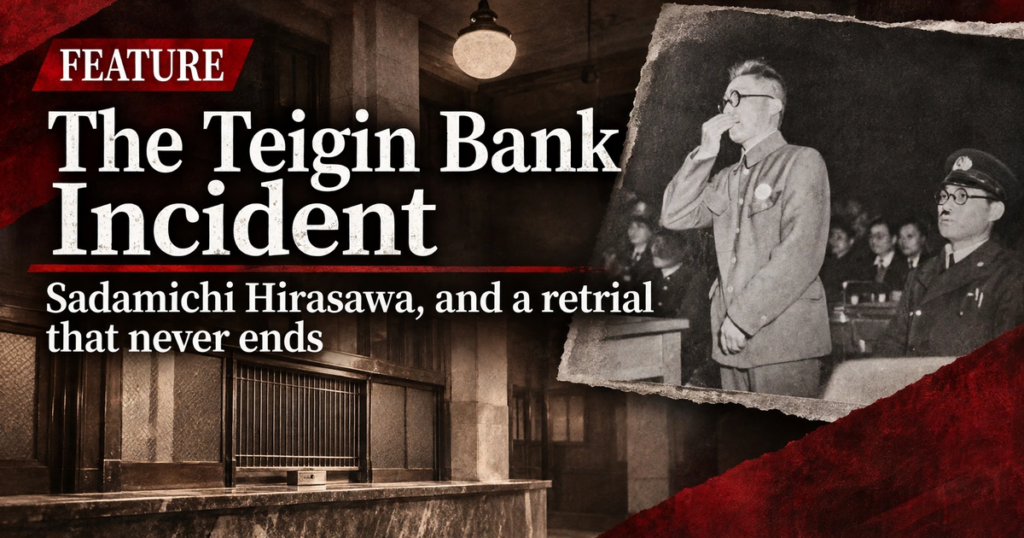
Introduction: A bank, sixteen people poisoned and twelve deaths
On 26 January 1948, after the day's business had ended, a man entered the Shiinamachi branch of the Teikoku Bank in Toshima Ward, Tokyo. He claimed to be connected with public health and disease prevention. Saying that dysentery had broken out nearby and that preventive medicine had to be taken on the instructions of the occupying authorities, he persuaded the people inside to drink a liquid.
Sixteen people, including bank employees and family members, drank it. Twelve died and four survived. In the confusion, the man took cash and cheques and disappeared. The crime did not rely on a gun or a knife. It exploited the fear of infectious disease in the immediate post-war period and the authority associated with public-health officials and the occupation forces.
The police eventually arrested painter Sadamichi Hirasawa. He was convicted and sentenced to death, and the sentence became final in 1955. He denied the crime in court and died in 1987 at the age of 95 without the sentence being carried out. His relatives continued to seek a retrial after his death.
The arguments have centred on the business card shown by the offender, eyewitness identification, Hirasawa's confession and the type of poison used. The twentieth retrial request ended in 2025, but the courts did not reach a substantive decision on the new evidence. The end of that procedure did not resolve the long-running dispute over what happened.
The offender's method: “This is preventive medicine”
The man told the people in the bank that there had been an outbreak of dysentery in the area and that, under instructions from the occupation authorities, they needed to take preventive medicine. He presented himself as a person with public-health authority and showed a business card. The employees and family members were persuaded to follow his directions.
The liquid was administered to sixteen people. Twelve died, while four survived. The offender then took money and cheques and left the bank. The speed with which the victims became incapacitated was one reason investigators suspected that the perpetrator had knowledge of poison.
The crime exploited the social conditions of the time. Infectious disease was a real concern, and people could be expected to trust someone who appeared to be acting under official instructions. The disguise and the use of a business card were not incidental details; they were part of the method by which the offender gained compliance without overt physical force.
There had been two earlier incidents
About three months before the Teigin attack, on 14 October 1947, a man used a similar public-health pretext at the Ebara branch of Yasuda Bank. He gave bank staff a liquid to drink, but no one died. The man handed the branch manager a business card bearing the name “Matsui Shigeru, Medical Doctor and Technical Official of the Ministry of Health.”
Matsui Shigeru was a real doctor. The card was not simply a fabricated identity belonging to a nonexistent person; it was a card that Matsui himself had used.
On 19 January 1948, a similar attempted offence took place at the Nakai branch of Mitsubishi Bank. The Teigin attack followed seven days later. Investigators therefore examined whether the same offender had been involved in the two earlier incidents and how he had obtained a real doctor's business card.
A record based on Diet testimony stated that 100 cards had been printed and the whereabouts of 66 were known. Tracing each card and its distribution might have seemed like a way to identify the offender. But finding a possible route by which a card circulated was not the same as proving who used it at the bank.
A search involving 2,168 people and memories from more than forty witnesses
On 26 March 1948, about two months after the attack, Metropolitan Police Superintendent-General Eiichi Tanaka explained the investigation to a committee of the House of Councillors. He said that police had questioned 2,168 people as suspects. They had also gathered information from more than forty people, including survivors at the bank and people connected with the two earlier incidents. These witnesses described the man's words, appearance, clothing and belongings.
The initial investigative headquarters had about 160 officers, later reduced to around seventy. The number of people questioned and the number of witnesses might suggest that the offender's identity could be narrowed down with confidence. Tanaka, however, also explained the limitations of human observation. A person's memory of a face or manner can differ from another person's recollection. He described such observation as looking through glass: a witness's view is not necessarily complete or precise.
The police did not initially focus only on a painter. Some investigative records considered people connected with former military research institutions or special agencies because of the way the poison appeared to have been handled and the method of the crime.
The business card, eyewitness accounts and poison therefore formed different investigative lines. They did not necessarily point to the same person. The later focus on Hirasawa would not erase the fact that the early investigation had considered other possibilities.
The painter Sadamichi Hirasawa came under suspicion
Sadamichi Hirasawa was born in 1892 in Hokkaido and worked as a painter, including in tempera. He was 56 at the time of the incident. Police became interested in him while tracing the circulation of the business card. They questioned him in June 1948 and arrested him in Otaru, Hokkaido, on 21 August.
Hirasawa was said to have admitted the crime during police questioning. When the trial began on 10 December, however, he denied the offence and argued that his confession had not been made of his own free will.
The trial involved more than the credibility of the confession. The court had to consider whether survivors and other witnesses had correctly identified the man they saw, what the business card showed about Hirasawa's connection to the offender and whether he had the knowledge of poison needed to carry out the crime.
A confession made after prolonged questioning raises questions about whose words it contains and how they were produced. Eyewitness identification also requires scrutiny: memories can be affected by fear at the time, later photographs and descriptions supplied by investigators. These issues would recur in the many retrial requests made over the following decades.
It is important, however, to distinguish a challenge to the reliability of evidence from a legal finding that the conviction was overturned. Hirasawa's death sentence remained legally final. No retrial had quashed it.
Thirty-two years under a final death sentence, but no execution
On 24 July 1950, the Tokyo District Court sentenced Hirasawa to death. The Tokyo High Court dismissed his appeal on 29 September 1951. On 6 April 1955, the Supreme Court dismissed his final appeal, and the death sentence became final on 7 May 1955.
The sentence was never carried out. Hirasawa continued to seek a retrial and also submitted requests for clemency. On 10 May 1987, he died at the Hachioji Medical Prison at the age of 95. About thirty-nine years had passed since his arrest and approximately thirty-two years since the death sentence became final.
There have been various explanations for why he was not executed, including his age and health, the repeated retrial requests and concerns about the possibility of a wrongful conviction. But no official government document has been confirmed that establishes one definitive reason. None of these explanations should be presented as a proven fact.
Hirasawa's death did not automatically close the route to a retrial. Certain relatives could become applicants, and requests continued after his death. Eventually the proceedings reached a nineteenth and then a twentieth request. The legal arguments over the evidence outlasted the person who had been convicted.
Was the poison potassium cyanide?
The offender administered a liquid to several people and incapacitated them in a short period. From the early stages of the investigation, there was speculation that the person responsible had specialist knowledge of poison.
The final judgment identified the poison as potassium cyanide. The defence supporting the twentieth retrial request challenged that conclusion. It submitted an expert report comparing experiments in which pigs were orally administered cyanide with data concerning blood and stomach contents from the Teigin victims. The defence argued that the results raised questions about the potassium-cyanide theory. A lecture record published in the 2025 bulletin of Meiji University's Peace Education Institute for the Noborito Research Institute Museum described the defence's explanation.
This was the defence's position. It does not mean that a court accepted a different poison or changed the finding in the final judgment. The twentieth retrial proceedings ended before the court examined the substance of the new evidence.
The type of poison matters because it can affect what knowledge the offender needed and how the substance might have been obtained. A question about the poison can therefore lead to a wider reconsideration of the offender's profile. But uncertainty about the poison does not prove that a particular person or organisation committed the crime.
The former military, the Noborito Research Institute and GHQ
The Teigin Incident is often discussed in connection with the former Imperial Japanese Army's Unit 731, the Noborito Research Institute and the Allied occupation authorities, including GHQ.
The Meiji University Peace Education Institute for the Noborito Research Institute Museum has introduced investigative notes from the spring of 1948. They record opinions that focused on military personnel, research institutions and special agencies because of the way the poison appeared to have been handled and the method of the crime. There are also records of investigators asking former military personnel about the effects of poisons and earlier research. Materials describe post-war questioning of former military research personnel by American forces.
These documents provide clues about the unusual conditions of post-war Japan and the directions in which the investigation developed. They do not establish that military personnel were the offenders. The fact that former military researchers were investigated is not proof that they committed the bank attack. Nor does a record of contact with GHQ prove that the occupation authorities obstructed the investigation or concealed the crime.
There is a substantial distance between examining the possibility that Hirasawa was not the offender and naming another person as the real killer. Claims about the military and occupation authorities should be read as historical arguments and investigative possibilities, not as established identification of the perpetrator.
People saw the man, but identification remained contested
Four people survived after drinking the liquid at the bank. Witnesses connected with the earlier attempted incidents had also seen the man. Their observations of his face, voice, clothing and movements were important to the investigation.
But the events took place under frightening conditions. The poison affected the victims, and memories could change over time. Later photographs and news coverage might also influence recollection. The retrial defence submitted material examining eyewitness identification from the perspective of psychology and challenged the probative value of testimony relied on in the final judgment.
That does not mean that every witness was mistaken. A general statement that memory can change is not enough to prove that a particular identification was wrong. The relevant questions concern the conditions in which each witness saw the man, how much time passed and how Hirasawa was presented to the witness during the identification process.
The case therefore required the court to consider the confession, eyewitness testimony, business card and poison separately. Each item had to be assessed for what it actually established, rather than allowing one uncertain item to reinforce another without independent examination.
The twentieth retrial request ended in 2025 without a decision on the evidence
On 24 November 2015, the twentieth retrial request was filed with the Tokyo High Court. The defence relied on new material concerning the poison and psychological analysis of eyewitness identification, among other evidence, and sought reconsideration of the final conviction.
The proceedings ended for a procedural reason. Hirasawa's grandson, who had filed the request, died on 1 January 2025. The defence argued that the proceedings should continue through the lawyers who had already been appointed. On 27 March, the Tokyo High Court ruled that the procedure had ended because the applicant had died. The defence filed a special appeal, but on 25 April 2025 the Supreme Court's Third Petty Bench dismissed it.
The court did not examine the new poison analysis and eyewitness material in detail and then decide that it was unreliable. The proceedings stopped because of the question whether the retrial process could continue after the applicant's death.
The opposite conclusion would also be wrong. The court did not accept the new evidence as correct. The twentieth request ended without a substantive decision on the evidence. This outcome highlights a difficulty in a retrial system: when an applicant dies, a procedure intended to examine a potentially wrongful conviction may end before the new evidence receives judicial consideration.
Twelve deaths and the questions left by the final judgment
The deaths of twelve people at the bank in 1948 are not in dispute. Hirasawa was convicted, and his death sentence became final. He was not acquitted, and the final judgment has not been quashed.
At the same time, Hirasawa denied the crime at trial, relatives continued to seek a retrial after his death, and the confession, eyewitness identifications, circulation of the business card and type of poison remained subjects of dispute. The twentieth retrial request ended in 2025 without a decision on the substance of the new evidence.
It would therefore be inaccurate to say that the evidence was all rejected, or that the courts recognised Hirasawa as innocent. The legal position remains that his conviction and death sentence are final. The unresolved question is whether the evidence on which that judgment rested would withstand a full examination of the new material.
The Teigin Incident continues to attract attention not only because of the scale and method of the poisoning, but because it asks what evidence is necessary to identify an offender and how a final judgment can be reconsidered after the convicted person has died. The case's long history is a reminder that the end of a procedure is not always the same as an answer to the underlying question.
At a glance
Incident: Teigin Bank Incident, at the Shiinamachi branch of the Teikoku Bank in Toshima Ward, Tokyo. Date: 26 January 1948. Victims: 16 people drank the liquid; 12 died and four survived. Suspect convicted: painter Sadamichi Hirasawa, born in 1892. Arrest: 21 August 1948 in Otaru, Hokkaido. Tokyo District Court death sentence: 24 July 1950. Tokyo High Court dismissed the appeal: 29 September 1951. Supreme Court dismissed the final appeal: 6 April 1955. Death sentence became final: 7 May 1955. Hirasawa died at age 95 on 10 May 1987 without execution. Twentieth retrial request: 24 November 2015. Applicant died: 1 January 2025. Tokyo High Court held the proceedings had ended: 27 March 2025. Supreme Court dismissed the special appeal: 25 April 2025. No substantive judicial decision was made on the new evidence in the twentieth request; the final conviction remains in force.
Original Japanese feature: 帝銀事件【特集】12人が毒殺された銀行――死刑囚・平沢貞通と、77年後も決着しなかった再審
Last updated:
Related articles
Same case · Case record
The Teigin Bank Poisoning: Twelve Deaths and a Conviction Challenged for Decades
Case record
The Kyoto Animation Arson Attack: 36 Deaths, Criminal Responsibility and the Disputed Appeal Withdrawal
Case record
The Maebashi Snack Bar Shooting: Four Killed, Including Three Uninvolved Customers
Case record