
The Ashikaga Case: How DNA Evidence and a Confession Reinforced Each Other — Why Did a Wrongful Conviction Last 17½ Years?
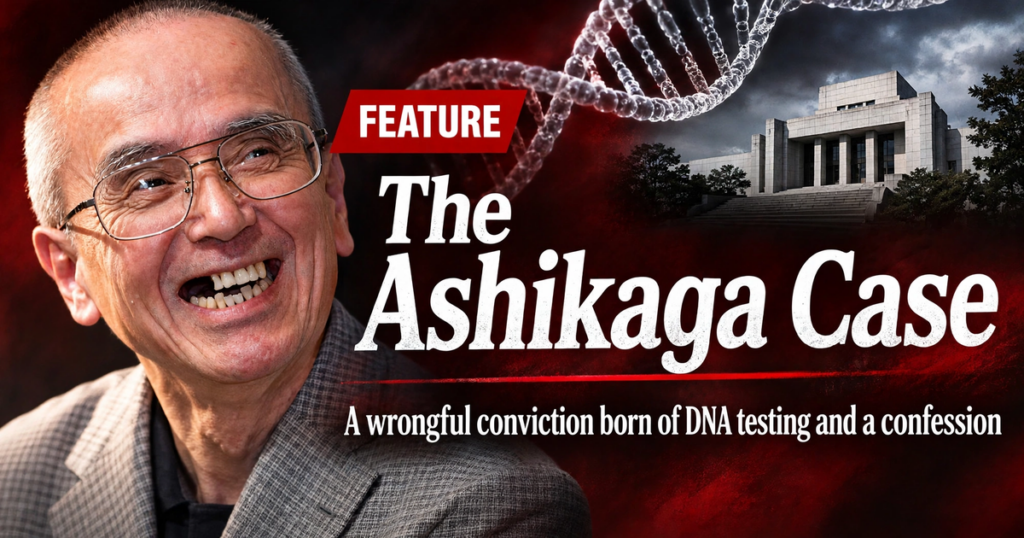
In May 1990, a four-year-old girl disappeared near a pachinko parlour in Ashikaga, Tochigi Prefecture, and was found dead the next morning. Toshikazu Sugaya was convicted after an early DNA test was treated as a powerful match and his confession was taken as corroboration. Later STR testing showed that the semen on the victim's underwear came from a different man. Sugaya was released in 2009 and acquitted at retrial in 2010. This feature follows the evidence, the changing confession, the official reviews and the 15-year limitation period that had already expired before the acquittal.
Introduction: Two pieces of evidence appeared to confirm each other
On 12 May 1990, a four-year-old girl disappeared near a pachinko parlour in Ashikaga City, Tochigi Prefecture. Her body was found the following morning on the bank of the Watarase River. The police investigation eventually focused on Toshikazu Sugaya. An early DNA test appeared to connect him to semen found on the victim's underwear, and Sugaya later confessed during questioning. Those two elements became the central supports for his conviction and life sentence.
The apparent agreement between the DNA result and the confession made the case look stronger than it was. But the two pieces of evidence were not independent. Investigators told Sugaya that the DNA matched. He understood that statement as meaning the science had identified him, and his confession followed. The confession was then treated as confirmation of the DNA result.
A new examination using STR technology later showed that the male DNA on the victim's underwear did not match Sugaya. He was released on 4 June 2009 and acquitted at retrial on 26 March 2010. He had spent about seventeen and a half years in custody. The case is not simply a story about an old scientific method being replaced by a newer one. It is also a warning about what happens when an investigative theory shapes a confession, and that confession is then used to make the theory appear independently proven.
The day a four-year-old girl disappeared
On the afternoon of 12 May 1990, the girl, Mami Matsuda, aged four, was seen near a pachinko parlour in Ashikaga. The 2010 retrial judgment reconstructed the alleged abduction at around 7 p.m. The next day, at approximately 10:20 a.m., her body was found in grass on the left bank of the Watarase River, about 400 metres from the parlour. Her short-sleeved undershirt and other clothing were found in the riverbed nearby.
The police began investigating a case involving abduction, murder and the abandonment of a body. Semen was found on the victim's undershirt. Investigators later compared it with semen on tissue paper recovered from a rubbish bag that Sugaya had discarded. A forensic examination reported that the two samples had the same DNA type.
DNA profiling was still a relatively new investigative tool in Japan. Its potential to identify individuals gave it considerable authority. In this case, the reported match became the principal scientific link between Sugaya and the crime. The importance attached to that result would shape not only the investigation but also the way Sugaya understood the questions put to him.
The old DNA test treated as the key to the arrest
The method used was the MCT118 DNA typing technique developed by the National Research Institute of Police Science. It examined a variable region on chromosome 1, where a sequence of sixteen DNA bases is repeated a different number of times. The test compared the semen on the victim's undershirt with semen on tissue paper recovered from Sugaya's rubbish.
Both samples were classified as the 16-26 type. The original report estimated that this DNA type occurred in about 8.3 people per 1,000 in the Japanese population. When blood-group information was also considered, the estimated frequency was about 1.2 people per 1,000. These were estimates of how frequently the combination might occur in a reference population. They were not a calculation that Sugaya had a 99.88 per cent probability of being the offender. A frequency figure for a genetic profile cannot, by itself, be converted into the probability that a particular suspect committed a crime.
The original estimate was based on data from only 190 Japanese individuals. By the time of the appeal proceedings, the reference sample had grown to 957 people. The estimated frequency of the 16-26 type changed from about 8.3 to about 35.8 per 1,000; when blood-group information was included, the estimate changed from about 1.2 to about 5.4 per 1,000.
The later figures mattered because the original rarity estimate had been presented as exceptionally powerful. The Supreme Public Prosecutors Office's review found that the prosecutor in charge had not adequately checked the sample size or the meaning of the frequency calculation and had overestimated the test's ability to identify the offender. The Police Agency's review also distinguished the scientific principle of MCT118 testing from the reliability of this particular examination. The method was not declared scientifically worthless as a whole. The problem was that the case-specific records were incomplete and the particular result could not later be fully checked.
From denial to confession
On 1 December 1991, police asked Sugaya to accompany them voluntarily to the station. According to the Police Agency's review, officers showed him a photograph of the girl at his home and approached him in a way that pressed him to apologise. Sugaya had planned to attend an acquaintance's wedding, but officers continued persuading him until he went with them.
At first, Sugaya denied the offence. He said that after shopping at a supermarket on the day in question he had not gone out again. Investigators did not adequately verify that account before repeatedly urging him to tell the truth. They also told him that there was scientific evidence, including bodily fluids, connecting him to the crime.
That evening, Sugaya admitted the offence. He was arrested in the early hours of 2 December and indicted on 21 December for abduction for the purpose of indecent acts, murder and abandonment of a body.
The retrial judgment identified the DNA explanation as the most important factor leading to the confession. Sugaya was told, in substance, that the semen at the scene matched his own. The Supreme Public Prosecutors Office later considered it quite possible that he had misunderstood the DNA result as a fingerprint-like identification of one person and believed there was no point in continuing to deny the crime. The Police Agency also noted that he had little previous experience of police questioning and found it difficult to resist forceful assertions. Officers had become convinced that he was the offender and did not seriously test his denials.
It is therefore incomplete to say only that Sugaya confessed because he was questioned for a long time. The claim that scientific evidence had already identified him created a particular pressure: if the science was said to be conclusive, he could feel that denial was futile.
A confession that changed repeatedly
Sugaya's account did not remain consistent from the first confession to the final acquittal. The record shows a sequence of reversals:
– 1 December 1991: He initially denied the offence after being taken to the station voluntarily, then admitted it that evening.
– 13 February 1992: At the first trial hearing, he admitted the charges.
– 22 December 1992: At the sixth hearing, he denied the charges.
– 28 January 1993: At the seventh hearing, he again admitted the offence.
– 31 May 1993: In a letter to his defence lawyer, he denied the charges.
– 24 June 1993: After the proceedings were reopened, he again denied the charges in full.
The 2010 retrial judgment records these changes. In the original proceedings, the fact that Sugaya had confessed during the investigation and had admitted the charges at one point in court was treated as supporting the confession's credibility. The retrial court examined a different question: why did his account change, which parts fitted objective evidence, and which parts could not be explained?
The number of times a person repeats a confession does not establish that it is true. Nor does a temporary return to an admission erase earlier denials. Each account must be tested against independent evidence and the conditions in which it was obtained.
Were the DNA test and the confession really independent evidence?
The original conviction rested mainly on two pillars: the DNA test and Sugaya's confession. They appeared to be separate forms of evidence. In reality, they were closely connected.
Investigators believed that the DNA types matched and became convinced that Sugaya was the offender. They told him about the result. Sugaya then accepted that his own DNA had been identified at the scene and confessed. The confession was subsequently treated as additional support for the DNA test.
This created a circular structure. The DNA result helped produce the confession, and the confession was then used to strengthen confidence in the DNA result. Two items of evidence can appear to point independently to the same conclusion even when one has influenced the creation of the other.
To avoid that circular reasoning, investigators and courts needed to ask whether objective evidence independent of the DNA test connected Sugaya to the crime, and whether the details of his confession matched the physical circumstances. Those questions were not adequately examined in the original investigation and trial.
A retrial request led to new testing
On 25 December 2002, Sugaya filed a retrial request at the Utsunomiya District Court. He argued that a DNA test using his hair produced a result different from the test relied on in the final conviction. The defence also argued that parts of his confession contradicted objective findings about the victim's body.
The District Court rejected the request on 13 February 2008. Sugaya's lawyers filed an immediate appeal, and the matter went to the Tokyo High Court. On 24 December 2008, the High Court ordered new DNA testing. The DNA result had been a central part of the original evidence structure, and DNA testing technology had advanced substantially since the first examination.
The new examination used standardised short tandem repeat, or STR, testing. Commercial kits were used to examine multiple DNA regions, and the profiles were analysed by capillary electrophoresis. The method was more standardised and allowed the underlying data to be retained and checked by other experts.
The new STR test showed that the DNA did not match
The new testing found that the male DNA recovered from the victim's undershirt did not match Sugaya's DNA. The retrial judgment reported differences at 14 of 16 autosomal STR loci and 12 of 16 Y-chromosome STR loci. Both samples were male in origin, but they did not come from the same man.
The court regarded the new result as reliable. The testing method was standardised, the experts were experienced, and the underlying data were attached so that independent reviewers could examine the work. The court also considered the location of the biological material on the undershirt and found it reasonable to regard the male DNA as originating from the offender's semen.
This was more than a disagreement over a statistical estimate. The new test showed that the DNA evidence used to identify Sugaya had attributed the material to the wrong person. It provided objective evidence that he was not the offender.
4 June 2009: Sugaya was released after seventeen and a half years
On 4 June 2009, the Tokyo High Public Prosecutors Office suspended execution of Sugaya's sentence and released him. On 23 June, the Tokyo High Court ordered a retrial. Sugaya had been arrested on 2 December 1991; by the time he was released, approximately seventeen and a half years had passed.
The release followed the new DNA result. It did not itself amount to an acquittal. The formal retrial proceedings still had to examine the old evidence, the new test and the reliability of the confession. Keeping those stages separate is important: suspension of a sentence and release, a decision to begin a retrial, and a final acquittal are different legal events.
The new examination exposed weaknesses in the old one
On 26 March 2010, the Utsunomiya District Court acquitted Sugaya. One issue was whether the original MCT118 result could be independently verified. The old test had amplified DNA, separated it by polyacrylamide-gel electrophoresis and used photographic negatives of the resulting bands in an image-analysis device to determine the type.
Experts who examined the electrophoresis photographs attached to the original report said that the images were too unclear to establish that the bands matched. Even the director of the National Research Institute of Police Science, who appeared as a prosecution witness, acknowledged that the photographs were unclear and that the test would ordinarily have needed to be repeated.
The examiner had explained that the negative film, rather than the printed photograph, had been entered into the analysis device. But the negative was not submitted either in the original trial or at the retrial. Only part of the analysis data remained. It was therefore difficult to verify later whether the original type determination had been correct. The retrial court found that doubts remained about the core process of distinguishing the samples and did not admit the old DNA report as evidence.
The ruling did not declare every MCT118 test invalid
A distinction is essential. In 2000, the Supreme Court had accepted the scientific principle of MCT118 testing and the particular method used at that time as admissible evidence. The 2010 retrial judgment did not declare that every MCT118 test was invalid. It considered the new STR result, the unclear electrophoresis photographs and the absence of the negative film and analysis data, and concluded that the specific report in Sugaya's case could not be admitted.
The Police Agency's review likewise accepted the general scientific principle of MCT118 testing while noting that the records in this case were fragmentary and did not permit a sufficient re-examination of the type determination.
The lesson is not that old DNA testing should always be rejected. It is that the samples, photographs, analysis data and laboratory records supporting an individual result must be preserved so that independent experts can verify it later. The limits of a test must also be explained accurately.
The retrial court rejected the confession as unreliable
Once the DNA mismatch was established, Sugaya's confession could no longer be reconciled with the physical evidence. The retrial court concluded that his statements during the investigation and in court were unreliable because the offender-derived DNA on the victim's clothing was not his.
The court also found that the officers' statement that the DNA types matched had been the principal factor behind the confession. It considered Sugaya's difficulty in resisting forceful questioning, the conditions of the interrogation and his explanation that he had reconstructed parts of the account from imagination and newspaper reports. The court concluded that the confession was false.
The Supreme Public Prosecutors Office's review identified a lack of objective corroboration. No one had been found who saw Sugaya at the pachinko parlour or nearby on the day of the crime. No witness had confirmed a man carrying a girl on a bicycle along the route he described. The victim's fingerprints were not found on the bicycle he said he had used. The shoes he described had not been corroborated, and the supermarket purchase he said he made after the offence could not be confirmed.
The confession also changed on important details, including the location and method of the killing, when the alleged sexual purpose arose and what footwear the girl had been wearing. It contained no clear revelation of a fact that only the offender could have known. Yet investigators treated the inconsistencies as possible memory errors because they believed the DNA and blood-group results were a match.
An unlawful interrogation during the trial
The retrial judgment addressed another issue beyond the DNA test and the confession's reliability. On 8 December 1992, while the first trial was underway, the prosecutor in charge questioned Sugaya at the detention facility about the Ashikaga case. The previous day, Sugaya had begun denying the offence during questioning about another matter, and the prosecutor questioned him again about whether he was the offender.
The prosecutor did not tell Sugaya of his right to remain silent, explain that he did not have to answer questions about a case already before the court, or tell him that he could consult his lawyer. The defence lawyer had not been notified in advance and had not consented.
The retrial court held that questioning a defendant outside court about the charged facts after the first hearing could undermine the adversarial and trial-centred principles of criminal procedure. Such questioning required a special need and careful safeguards. The court found no sufficiently strong need for the interview and concluded that the lack of notice and explanation made it unlawful.
The judgment did not, however, rule that this unlawful interview automatically made later statements in open court inadmissible. The in-court statements had been made before the judges and defence counsel. The court found the confession unreliable for separate reasons: it contradicted the new DNA result, the DNA explanation had been the main reason Sugaya confessed, and the content of the confession was unnatural. The distinction between an unlawful interrogation and the admissibility or credibility of a later courtroom statement must be preserved.
What the Police Agency acknowledged in its review
After the acquittal, the National Police Agency reviewed investigative and trial records and interviewed people involved in the original investigation. It published its review in April 2010.
The report found that officers had treated the DNA and blood-group match as exceptionally strong individual identification evidence and had developed a fixed belief that Sugaya was the offender. They did not adequately examine the meaning and limits of the DNA result. Instead of testing his denial, they repeatedly questioned him until they obtained the account they expected.
The report also found that officers did not sufficiently account for Sugaya's tendency to find it difficult to resist strong assertions. Because the chief investigator also conducted the interrogation, there was no effective independent check of the confession against the investigative materials and the results of corroborating inquiries. Other officers may also have found it difficult to challenge the chief investigator's assessment.
The investigation gave too much weight to similarities with other cases. The missing child had disappeared near a pachinko parlour and her body was left near the Watarase River, features that investigators regarded as linking this case to another incident. But there were differences in the way the bodies had been abandoned and about five years separated the incidents. The review criticised the failure to examine those differences carefully.
A strong theory can turn similarities into apparent confirmation while treating differences as unimportant. The Ashikaga investigation showed why both matching and conflicting facts must be examined.
What the Supreme Public Prosecutors Office identified
The Supreme Public Prosecutors Office also reviewed the prosecution's handling of the case in April 2010. It identified the central problem as an inadequate understanding and examination of the old DNA test. Because prosecutors overestimated its evidential value, they did not sufficiently scrutinise the confession and failed to detect that it was false.
The review noted that prosecutors understood the reported frequency of about 8.3 people per 1,000 but did not adequately check that the estimate had been calculated from only 190 samples or whether that sample size was sufficient. When the sample later increased to 957, the estimated frequency changed. Prosecutors should have considered the effect of that change on the weight of the evidence.
They also treated contradictions in Sugaya's statements as possible failures of memory rather than investigating why his account changed. Two witnesses may have seen a man walking with a child who resembled the victim. Because that did not fit Sugaya's statement that he had carried the girl on a bicycle, prosecutors assumed the witnesses had seen another child and did not question them directly. The review also said that the absence of concrete evidence of paedophilic behaviour in Sugaya's home and daily life required closer examination.
The problem was not simply that prosecutors failed to find more evidence supporting their theory. They did not sufficiently investigate the facts that might show the suspect was not the offender.
26 March 2010: Acquittal after the retrial
On 26 March 2010, the Utsunomiya District Court acquitted Sugaya. It found that the new DNA test showed a mismatch between his DNA and the offender-derived DNA on the victim's undershirt; that the old DNA report was inadmissible; and that his confession was unreliable and false.
The prosecution accepted the judgment and waived its right to appeal that same day. The acquittal therefore became final immediately. After pronouncing the judgment, the presiding judge and the associate judges apologised to Sugaya.
More than eighteen years had passed between his arrest and the final acquittal. He had spent about seventeen and a half years deprived of his liberty. A court decision could recognise that the conviction was wrong, but it could not return those years.
The wrongful conviction was overturned, but the real offender remained unknown
Sugaya's acquittal did not identify the person who killed the girl. The case was still unresolved, but the law of limitation meant that a criminal trial could no longer be brought against a newly identified suspect.
At the time of the 1990 offence, the limitation period for murder was fifteen years. A 2004 amendment extended the period for murder to twenty-five years, but transitional rules applied the former period to offences committed before the amendment. In 2010, the limitation period for murder was abolished. That abolition did not revive cases in which the limitation period had already expired.
The limitation period in the Ashikaga case expired on 12 May 2005, fifteen years after the crime. The 2010 abolition could not revive it. Thus, even after Sugaya's acquittal, the true offender could not be prosecuted for this murder. The wrongful conviction had not only deprived an innocent person of years of freedom; it had also consumed the legal opportunity to pursue the offender's criminal responsibility.
How investigative practice and DNA testing changed
The Police Agency's review set out measures intended to prevent false confessions, require more than one perspective when evaluating statements, base investigations on objective evidence and preserve forensic materials and records properly.
DNA testing also changed. STR methods were introduced, the number of loci examined increased and rules for managing DNA records were developed. The Police Agency's report records the introduction of STR testing at nine loci in 2003 and its expansion to fifteen loci in 2006.
In April 2009, a police interrogation-supervision system began. Supervisors who were not directly involved in the investigation were given a role in checking interrogation conditions. Written records of questioning were expanded, and trial use of audio and video recording was extended nationwide in 2009.
But new equipment and procedures cannot by themselves eliminate wrongful convictions. The case showed that investigators must understand the limits of scientific evidence, investigate facts that point away from the suspect and assess a confession independently rather than allowing it to confirm a pre-existing theory.
What counts as reliable evidence?
The wrongful conviction in the Ashikaga case did not arise from one laboratory error alone. First, investigators and prosecutors treated the estimated frequency and individual-identification power of the DNA type as much stronger than the data justified. Second, Sugaya confessed after being told that the DNA matched, and the confession was then treated as support for the DNA result. Third, changes in his account, inconsistencies with witness information, the absence of corroborating conduct and the lack of a genuine revelation of secret facts were not adequately examined. Fourth, the negative film and analysis data underlying the original test were not preserved in a form that allowed later verification.
Scientific testing is an important investigative tool, but it is not an answer that can be accepted without question. Its method, the condition of the sample, the analysis process, the basis for frequency estimates and the possibility of independent verification all matter. A confession is not proof of guilt merely because it exists. Investigators must ask how it was obtained, whether it matches objective facts and whether the suspect was adapting an account to what investigators expected.
The DNA test and confession in this case were treated as mutually reinforcing evidence. When both failed under retrial scrutiny, the foundation of the final conviction collapsed. The case remains a warning that scientific evidence and confessions must both be examined critically, and that a criminal-justice system needs safeguards capable of challenging its own assumptions.
At a glance
Incident: The murder of four-year-old Mami Matsuda in Ashikaga, Tochigi Prefecture. Disappearance: 12 May 1990. Body discovered: 13 May 1990, at approximately 10:20 a.m., on the Watarase River bank. Person convicted: Toshikazu Sugaya. Arrest: 2 December 1991. First-instance life sentence: 7 July 1993. Tokyo High Court dismissed the appeal: 9 May 1996. Supreme Court dismissed the final appeal: 17 July 2000; the life sentence became final on 27 July 2000. Retrial request: 25 December 2002. Released after suspension of sentence: 4 June 2009. Retrial ordered: 23 June 2009. Acquitted: 26 March 2010; the prosecution waived appeal that day. Limitation period: completed on 12 May 2005, before the 2010 abolition.
Original Japanese feature: 足利事件【特集】|DNA鑑定と自白が互いを裏付けた――17年半の冤罪はなぜ見抜けなかったのか
Last updated:
Related articles
Same case · Case record
The Ashikaga Case: How DNA Evidence and a False Confession Led to a Wrongful Conviction
Case record
The Himi Case: A Wrongful Conviction, a Prosecutor's Retrial Request and an Acquittal
Case record
The Koto Memorial Hospital Case: A Twelve-Year Sentence Overturned by Retrial, and a Death Not Proven to Be Homicide

Case record