
The Wakayama Curry Poisoning: Where Did the Arsenic in the Curry Come From? — A Final Death Sentence and the Battle over Scientific Evidence
At a summer festival in Wakayama in July 1998, arsenic was mixed into curry served to residents. Four people died and sixty-three others suffered acute arsenic poisoning. The Supreme Court upheld the death sentence against Masumi Hayashi in 2009, relying on several strands of circumstantial and scientific evidence. Scientific criticism has continued, and a third retrial request remains under examination. The debate over an expert analysis is not itself a judicial finding that the conviction was wrong.
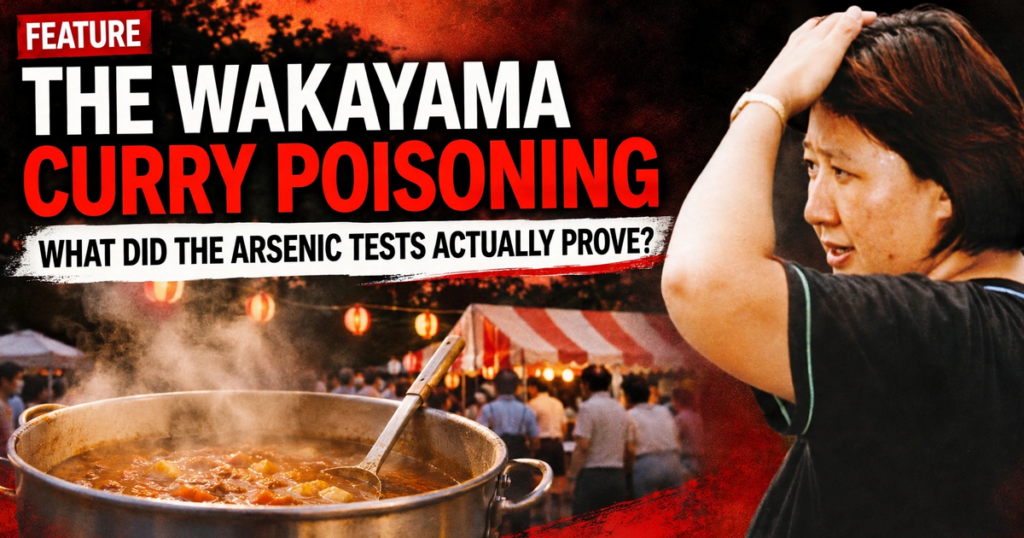
Introduction: Four people died after arsenic was mixed into festival curry
On 25 July 1998, residents gathered for a summer festival in Sonobe, Wakayama City. Curry was prepared for the event. After people ate it, many became ill. Four people died and sixty-three others suffered acute arsenic poisoning.
The investigation initially encountered a confusing toxicology picture. Early testing indicated cyanide, but later testing detected arsenic compounds. The Food Safety Commission's report records that arsenic was identified as the principal cause of the poisoning. The fact that an early test reacted to cyanide does not establish that cyanide was the main poison or that a third party committed the offence.
Masumi Hayashi was prosecuted and convicted. On 21 April 2009, the Supreme Court dismissed her appeal and the death sentence became final. The judgment did not rely on one scientific test alone. It considered the composition of the arsenic found in the curry and other samples, arsenic detected in Hayashi's hair, her opportunity to approach the curry pot and witness evidence about her conduct.
The scientific evidence has nevertheless remained controversial. Researchers have published different views about the X-ray fluorescence analysis, and Hayashi's side has continued to challenge the hair analysis and the comparison of arsenic samples. A third retrial request was filed in 2024 and remained under examination as of the latest information checked for this feature.
The central question is not whether the word "science" appears in a judgment. It is what a particular test measured, what inference was drawn from it, how the court evaluated it alongside other evidence, and whether new evidence is sufficient to reopen a final conviction.
The early cyanide reaction and the later identification of arsenic
The initial investigation had to distinguish between an early reaction to cyanide and the substance ultimately identified as the principal cause of the mass poisoning. The Food Safety Commission's 2004 report describes the early cyanide reaction and the later detection of arsenic compounds. Its overall assessment identified arsenic compounds as the principal cause.
The established basic facts are that arsenic was mixed into the curry served at the festival, sixty-seven people suffered acute arsenic poisoning and four died. The initial test result does not, by itself, show that cyanide was the main poison. Nor does it establish that someone other than Hayashi committed the crime.
This distinction later became relevant to the retrial proceedings. Hayashi's side argued in the second retrial request that cyanide compounds detected in victims' blood and vomit suggested a different poison and the possibility of a third-party offender. The courts examined whether those materials were new evidence and whether their concentrations supported the claimed inference.
The Supreme Court relied on three connected strands of evidence
On 21 April 2009, the Supreme Court's Third Petty Bench dismissed Hayashi's appeal. The judgment identified three main circumstances supporting the finding that she had mixed arsenic into the curry.
First, the arsenic in the curry shared compositional characteristics with arsenic discovered at Hayashi's home and elsewhere. Second, a high concentration of arsenic was detected in her hair, and the pattern of deposition was considered consistent with her having handled arsenic or a related substance. Third, Hayashi had an opportunity to approach the curry pot at the festival, and witnesses described suspicious behaviour, including opening the lid of the prepared curry pot.
The Court did not simply list three pieces of evidence and treat each as conclusive in isolation. It considered the composition of the arsenic, the hair examination, the opportunity and the observed conduct together. It concluded that the evidence established Hayashi's responsibility beyond reasonable doubt.
The judgment also addressed the fact that the specific motive for poisoning the curry had not been established. The Court did not claim that the motive had been solved. It stated that the absence of an identified motive did not overturn the assessment of the other evidence. In a criminal trial, proof of motive is not an independent legal prerequisite for conviction. The question is whether the evidence as a whole establishes the defendant's guilt beyond reasonable doubt.
Why scientists disagreed about the SPring-8 analysis
The X-ray fluorescence analysis conducted using the SPring-8 synchrotron facility became a central scientific issue. The researchers who performed the analysis published an account explaining the importance of high-energy synchrotron radiation X-ray fluorescence analysis in forensic examination. They argued that trace-element patterns could help distinguish arsenic samples.
Other researchers criticised the method and the interpretation of the data. In a 2012 paper, Jun Kawai of Kyoto University discussed problems with using the analysis as courtroom evidence. In a 2013 paper, he re-examined raw fluorescence spectra used in the Nakai analysis and argued that light-element patterns, not only heavy-element patterns, should be compared. His analysis concluded that the sample from Hayashi's home and the sample on a paper cup were different.
In a 2020 paper, Kawai and Makoto Iwai examined antimony fluorescence intensity and the variation in measurements of arsenic trioxide samples. They argued that the quantitative accuracy of synchrotron radiation X-ray fluorescence analysis was problematic. Their abstract noted that measurement variation could make samples with similar concentrations appear either the same or different.
These publications show that experts have disagreed about measurement conditions, data interpretation and the reliability of particular comparisons. They do not, by themselves, establish that the Supreme Court's judgment was wrong. The researchers' criticisms were not adopted wholesale by a court as a new finding. Conversely, the existence of papers written by the analysts does not mean that all scientific debate has ended.
To understand the dispute, it is necessary to ask who wrote each paper, what data were re-examined, which analytical step was criticised and what conclusion the authors actually reached. A scientific paper is an expert opinion; it is not automatically a judicial ruling.
What did the arsenic in Hayashi's hair establish?
The Supreme Court also relied on the high concentration of arsenic detected in Hayashi's hair. It considered the pattern of deposition and concluded that she could be inferred to have handled arsenic or a similar substance.
But the fact that arsenic was detected in hair is not identical to proof that a person added arsenic to the curry on the day of the festival. Hair analysis can support an inference of contact or handling; it does not record the precise date or act. The Court did not treat the hair result as a stand-alone demonstration of the poisoning. It assessed it together with the comparison of arsenic samples and the circumstances at the festival.
In the third retrial request, Hayashi's side again challenged the hair analysis. Wakayama Broadcasting's February 2024 report said that the defence argued that both the hair examination and the analysis treating arsenic on the paper cup as the same as arsenic found at her home were flawed. An interview report published by the Innocence Project Japan in December 2025 also introduced defence concerns about the hair examination and witness testimony.
Those are arguments made by the defence and reported by an advocacy organisation. They are not new findings by a court or an independent institution. Their source must remain clear when they are described.
The witness evidence concerned opportunity and behaviour, not a direct view of poisoning
The chemical analysis and hair examination were considered alongside evidence about Hayashi's opportunity to approach the curry pot. The Supreme Court's final judgment found that she had an opportunity to mix arsenic into the curry on the day of the festival. It also referred to witnesses who had seen her behaving suspiciously, including opening the lid of the prepared pot.
This does not mean that a witness saw the poison being poured into the curry. The evidence concerned access to the pot and conduct around it. The Court assessed that testimony together with the scientific evidence and other circumstances.
The defence has challenged the reliability of the sighting. A report by the Innocence Project Japan in December 2025 described arguments that the witness had initially said the scene was viewed from the first floor of a home but later said it was seen from the second floor. The defence also argued that a tree obstructed the view when the location was reconstructed.
These are defence criticisms, not a judicial finding that the witness was unreliable. In 2009, the Supreme Court assessed the witness evidence as part of the overall body of circumstantial evidence and upheld the conviction. A retrial must consider whether new evidence is sufficient to undermine the final judgment.
The death sentence became final even though the motive remained unknown
The specific reason for poisoning curry served at a local summer festival was never fully established. In its 2009 judgment, the Supreme Court expressly recognised that the motive had not been clarified and held that this did not prevent it from finding Hayashi responsible on the basis of the other evidence.
The Court considered the fact that four people had died and sixty-three had suffered acute arsenic poisoning, exposing a large number of residents to indiscriminate harm. It also considered the manner of the offence, the families' and victims' feelings about punishment, and the broader social impact. The absence of a prior criminal record and the finding that the intent in the curry case was conditional or indirect were also considered, but the Court maintained the death sentence imposed at trial.
Hayashi's proceedings included other charges involving insurance fraud and attempted murder. Some counts in those separate cases resulted in acquittals. The Supreme Court considered the overall criminal responsibility and sentence, but it did not infer that Hayashi had committed the curry poisoning merely because she had been convicted of other offences. The finding in the curry case was based on the evidence relating to that incident.
Three retrial requests raised different issues
The retrial proceedings must be kept separate because each request raised different evidence and reached a different procedural result.
The first request was filed in July 2009. It challenged the arsenic comparison and hair analysis. The Wakayama District Court rejected it on 29 March 2017, and the Osaka High Court rejected the immediate appeal on 24 March 2020. Hayashi's side withdrew the special appeal on 20 June 2021, making the rejection final.
The second request was filed in 2021. One issue was cyanide compounds detected in victims' blood and vomit. The defence argued that cyanide had been used as the poison and that a third party could have been responsible. The Wakayama District Court rejected the request on 31 January 2023. On 27 January 2025, the Osaka High Court rejected the immediate appeal. It held that the appeal was procedurally improper because the reasons had not been filed within the required period, and it also discussed the merits in supplementary reasoning.
The Osaka High Court noted that the cyanide-related material had already been submitted in the original trial and was not newly discovered evidence. The cited material showed that cyanide concentrations in blood or serum were mostly in the single-digit parts per billion, with a maximum of 17.6 ppb in the cited samples. The Court compared those levels with concentrations associated with toxicity and with the possibility of naturally occurring cyanide in blood plasma. It concluded that the material did not sufficiently support the claim that cyanide had been used as the poison. The Supreme Court's Second Petty Bench reportedly dismissed the special appeal in the second request on 11 November 2025. That result concerned the second request only.
The third request was filed with the Wakayama District Court on 5 February 2024. Hayashi's side argued that the analysis equating arsenic on a paper cup at the festival with arsenic found at her home was flawed, and also challenged the hair analysis. Reporting on 25 July 2026 said that the third request remained under examination at the Wakayama District Court. In the public material checked for this feature, no decision granting a retrial had been announced by 5 November 2026.
A scientific criticism is not automatically a ground for retrial
A retrial request must do more than express doubt about a final judgment. Under the Code of Criminal Procedure, the applicant must present new evidence or another ground that meets the statutory requirements for reopening the case.
The Osaka High Court's January 2025 decision on the second request examined whether the material amounted to new and clear evidence under Article 435, item 6. It concluded that evidence already presented at the original trial, or material insufficient to create reasonable doubt about the final judgment, did not satisfy the retrial standard.
That legal distinction also matters to the third request. The fact that an expert has published a paper criticising a forensic analysis is not the same as proof that the paper or a later re-analysis constitutes new evidence sufficient to start a retrial. A court must assess whether the material is genuinely new, whether it is identified with enough precision and whether it is capable of undermining the findings in the final judgment.
At the same time, the existence of a final conviction does not make scientific criticism irrelevant. Measurement reproducibility, testing conditions, sample selection, interpretation of elemental patterns and the assessment of arsenic deposition in hair are legitimate subjects for examination. The issue is how the new material affects the specific findings on which the conviction rests.
The distance between a scientific match and a finding of guilt
The final judgment did not identify Hayashi as the offender on the basis of SPring-8 analysis alone. It considered the composition of the arsenic, the hair examination, her opportunity to approach the curry pot and witness evidence about her conduct. The Court treated the evidence as a combined body of circumstances.
At the same time, different expert views about the analytical method and data interpretation have continued to be published, and Hayashi's side has challenged the evidence in the third retrial request. The existence of a final judgment does not mean that every scientific question has disappeared. But the existence of critical academic papers does not mean that a court has judicially recognised the conviction as erroneous.
A careful review must distinguish what the analysis measured, what inference was drawn from the measurement, how the court connected it to the other evidence, and what new material has been submitted in the retrial proceedings. The name of a famous facility or a technical method cannot decide the case by itself.
As of the information checked for this feature, Hayashi's death sentence remained final while the third retrial request continued before the Wakayama District Court. The next legal question was whether the new material could satisfy the statutory standard for a retrial, not whether the existence of scientific disagreement automatically erased the judgment.
At a glance
Incident: 25 July 1998, summer festival in Sonobe, Wakayama. Victims: 67 people suffered acute arsenic poisoning; four died and sixty-three were injured. Principal poison: arsenic compounds, identified after an early cyanide reaction. Defendant: Masumi Hayashi. Supreme Court: appeal dismissed on 21 April 2009; death sentence became final. Evidence considered: arsenic composition comparison, high arsenic concentration in hair, opportunity to approach the curry pot and witness evidence about conduct. The motive was not established. First retrial request: filed July 2009, rejected, special appeal withdrawn in June 2021. Second request: filed 2021, rejected; special appeal reportedly dismissed on 11 November 2025. Third request: filed 5 February 2024 and still under examination as of the information checked on 5 November 2026. No retrial-opening decision had been confirmed by that date.
Original Japanese feature: 和歌山毒物カレー事件【特集】|カレーのヒ素はどこから来たのか――確定死刑判決と科学鑑定の攻防
Last updated:
Related articles
Same case · Case record
The Wakayama Curry Poisoning: Four Deaths, a Final Death Sentence and a Third Retrial Petition
Case record
The Osaka Private Video Booth Fire: Sixteen Deaths, a Final Death Sentence and a Second Retrial Denial
Case record
The Nabari Poisoned Wine Case: Five Deaths, a Reversed Acquittal and the Eleventh Posthumous Retrial Request
Case record