
The Kyoto Animation Arson Attack: Shinji Aoba Had Abandoned a Mass-Killing Plan at Omiya Station One Month Earlier — The “Plagiarism Delusion” and Responsibility for Choosing the Crime
One month before the Kyoto Animation arson attack, Shinji Aoba bought six knives and went to Omiya Station intending to kill passers-by, but abandoned the plan because there were too few people. On 18 July 2019, he set fire to Kyoto Animation's First Studio, killing 36 people. The Kyoto District Court recognised a delusional disorder but found full criminal responsibility. Aoba withdrew his appeal in January 2025; the Osaka High Court ruled the withdrawal valid in March 2026, and the defence filed an objection on 23 March. The later objection's final disposition remained unconfirmed in the latest public information checked.
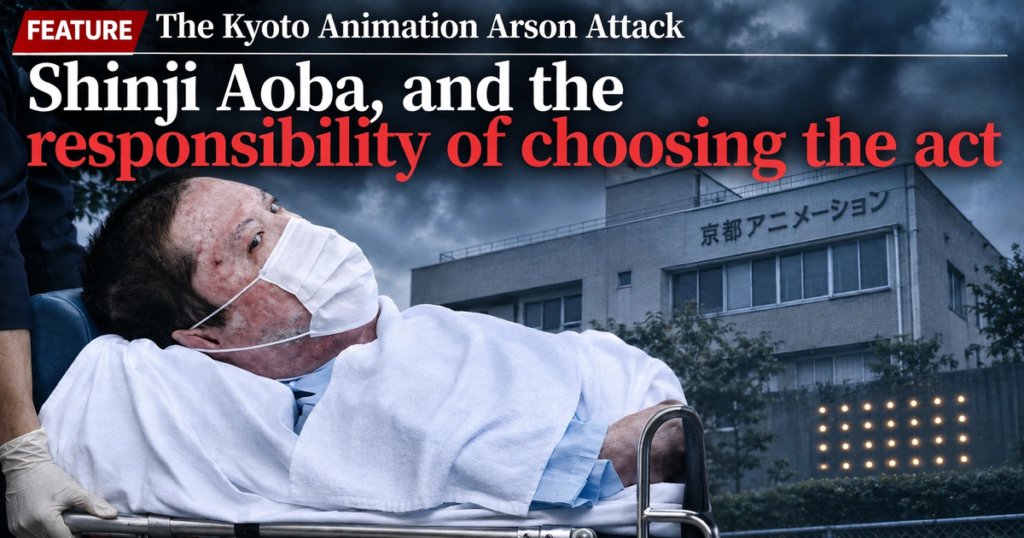
Introduction: One month before the Kyoto fire, another city had been selected
Exactly one month before Kyoto Animation's First Studio was set on fire, Shinji Aoba bought six knives and went to the area in front of Omiya Station in Saitama Prefecture. He intended to kill a large number of unrelated passers-by. He did not carry out the plan there. The reason was not that he reconsidered the morality of murder. He decided there were too few people to achieve the scale of killing he wanted. The Kyoto District Court's 2024 judgment recorded this episode, later referred to as the Omiya incident.
On 18 July 2019, 36 people died in the Kyoto Animation attack. To understand it, the earlier decision to abandon a mass-killing plan in Omiya is important. Aoba went to the city with six yanagiba knives bought that day and intended to attack an unspecified number of pedestrians. The judgment found that he was conscious of the 2008 Akihabara indiscriminate attack and had felt sympathy for its offender.
He did not proceed because there were too few pedestrians at the scene. The court's account therefore shows a person who formed a plan, observed the situation and decided not to carry it out on that occasion. This does not prove that he could necessarily have stopped himself a month later. Omiya and Kyoto involved different dates, places and intended targets. But the court considered the Omiya episode important when assessing his criminal responsibility.
If we look only at the Kyoto attack, it may seem to have been a sudden eruption of anger. In fact, there had been an earlier plan for mass murder that was abandoned at one location before another target was selected. Aoba's conduct was not only an instantaneous loss of control: it involved considering a target, choosing a method and deciding whether to act.
18 July 2019: Seventy people were at work
Kyoto Animation's First Studio in Fushimi Ward, Kyoto, was a workplace for people involved in creating animation. At about 10:30 a.m. on 18 July 2019, seventy employees were inside. Aoba entered the building and set it on fire using gasoline. Thirty-six people died. A further 34 people were victims of attempted murder, and 32 of those people were injured. This breakdown appears in the Kyoto District Court judgment and the later Osaka High Court decision.
The figures “36 dead and 32 injured” are widely known, but they cannot capture everything that was lost. In its sentencing reasons, the Kyoto District Court described the victims as experienced staff who had passed on technical skills since the company's early years, mid-career employees who had joined a company they admired and were training younger colleagues, and young workers who had finally obtained the jobs they wanted after a demanding selection process. Each person had skills and experience that they shared with others.
Kyoto Animation's statement after the attack described the loss of young people who had come from across Japan with dreams and of employees who had worked together on productions for many years. The company also asked the media to refrain from approaching bereaved families and employees. It was a painful request to treat the people behind the works with care.
The attack cannot be fully described through the offender's life story. For Aoba, the First Studio may have been a building belonging to a company he believed had harmed him. For the people who worked there, it was a place where they built their lives and careers. The gap between those perspectives cannot be bridged.
The young man who graduated from high school with perfect attendance
Aoba was born in 1978 in what was then Urawa City, Saitama Prefecture. According to the life history recognised in the Kyoto District Court judgment, he experienced physical and psychological abuse by his father during childhood and changed schools after moving. He later stopped attending school and went to a free school.
If that part of his life is isolated, it can become a simple story that an unhappy childhood created a killer. His later history was more complicated. Aoba entered a part-time high school and graduated after four years with perfect attendance while working part-time. He also attended a vocational school related to music. Periods in which he tried to continue working and periods in which he developed conflict with others both formed part of the same life.
The court found that his experience working at a convenience store strengthened three beliefs: that discussion was pointless, that he should retaliate when he felt harmed and that the excuse “I did not know” should not be accepted. From his own perspective, he felt that others were shirking their duties, increasing his workload and treating him unfairly. The judgment recorded actual workplace conflicts and occasions when he acted aggressively toward colleagues. It did not simply label every workplace experience as delusion.
That distinction matters. The existence of real friction does not justify later serious violence. Aoba later committed theft and assault offences and received an actual prison sentence for a convenience-store robbery in 2012. After leaving prison in 2016, he received public assistance and at times had contact with psychiatric care, home nursing and employment support. The judgment does not present a simple picture of a person whom society failed to rescue; it also records a history of turning perceived grievances into hostility and harmful conduct.
Past abuse and hardship are relevant background, but they cannot be described as making murder inevitable. Many people experience similar difficulties without attacking others.
“My novel was stolen”: The belief that grew from rejection
Aoba's connection with Kyoto Animation began with submissions to a writing competition. In 2016, he submitted both a short story and a longer work to a competition organised by the company. The short story failed the first screening. The longer work did not meet the submission requirements and was not accepted for consideration. That was the finding of the District Court.
The rejection was real. It is understandable that an author might feel disappointed when a work is not selected. The issue was what Aoba came to believe afterward. He became convinced that Kyoto Animation had stolen ideas from his novel and used them in its productions for profit. He also came to believe that the rejection itself had been deliberately arranged by someone. He connected these beliefs to a supposed relationship with a particular director and to the idea that an invisible organisation was monitoring him.
The word “plagiarism” here describes Aoba's claim, not an established fact that Kyoto Animation stole his work. The Kyoto District Court assessed these beliefs as delusions. It did not find that the company had actually taken Aoba's work.
Aoba is said to have tried at one point to cut off his connection with the novel and the company. But when he encountered new Kyoto Animation productions, he again became convinced that his ideas had been used. In 2018, according to the judgment, he began considering an arson attack against the company. His one-sided reasoning was that the company continued to harm him, that protesting would be pointless and that employees who claimed not to know what had happened should not escape responsibility. Understanding this reasoning does not mean accepting it as valid.
The doctors disagreed; the court had to assess criminal responsibility
When the trial began in 2023, the central issue was not whether Aoba had set the fire. The principal question was whether he had been in a condition in which he could be held criminally responsible at the time of the attack. The psychiatric assessments did not reach a single conclusion.
An assessment during the investigation diagnosed delusional personality disorder. Another assessment diagnosed a severe delusional disorder. The difference was not merely the name of a condition. The question was how much the delusions Aoba had held for years affected his real-world behaviour. The Kyoto District Court adopted the latter assessment and considered that the first assessment had not sufficiently examined his beliefs about a “dark organisation” and the actions based on those beliefs.
The court did not dismiss the existence of mental illness. It recognised that delusions existed and had affected his life and relationships over many years. But a diagnosis does not automatically result in acquittal or a reduced sentence. The court had to examine where and to what degree the disorder affected this particular offence.
Aoba believed that Kyoto Animation had stolen his work and was monitoring him. The District Court accepted that the delusional disorder influenced the development of his resentment and the selection of the target. It examined separately why he chose mass murder and why he chose arson. Aoba knew of earlier indiscriminate attacks and arson cases and selected mass killing as a method after learning about them. The judgment treated that choice as arising from his own thinking and knowledge.
The Omiya episode was one clue. Aoba had considered killing an unspecified number of people, assessed the scene and abandoned the plan. He later selected Kyoto Animation as a particular target. After arriving in Kyoto, he conducted surveillance, considered changing locations and tried not to attract attention. The court also found that he hesitated immediately before the attack. These facts did not mean he was completely calm. They showed that, despite delusions and intense anger, he understood the nature of his actions and had opportunities to refrain.
The District Court did not find that either his ability to distinguish right from wrong or his ability to act in accordance with that understanding had been substantially impaired. It left open the possibility that his ability to restrain himself had been somewhat diminished, but concluded that he was neither legally insane nor of diminished responsibility. It would therefore be wrong to summarise the judgment as saying that mental illness was irrelevant. The court recognised an influence on the motive while distinguishing it from the offender's choice of a method that killed unrelated people.
How resentment toward one person became supposed collective guilt
Aoba's anger concerned his rejection from the writing competition and his delusional belief that his work had been stolen. But his resentment was not directed only at the people who managed the competition. The court's findings described a belief that employees who knew nothing about his claims should also bear responsibility. Aoba had previously held that people should not be allowed to avoid responsibility by saying they did not know. He extended that belief to the company as a whole.
This was an extreme and unjustifiable leap. Most employees had no involvement in Aoba's novel and no way of knowing what he believed. The alleged plagiarism had not been established in the first place. Yet he grouped employees together solely because they belonged to the company and made them targets for killing.
The Kyoto District Court expressly stated in its sentencing reasons that the victims were not at fault. That was not a formality. It rejected, from the standpoint of fact and law, Aoba's imagined idea of collective responsibility. A feature that explores an offender's personality must explain his reasoning carefully without turning that reasoning into an accepted premise. What Aoba believed is relevant to understanding the crime; it is not proof that he was right.
The death sentence was not determined by the number 36 alone
On 25 January 2024, the Kyoto District Court sentenced Aoba to death. The judgment regarded the deaths of 36 people as an extremely grave result. It also considered that 34 people had been placed in danger of death, the injuries and psychological suffering, and the losses experienced by bereaved families. It gave weight to the planned nature of the attack, the fact that the victims had done nothing wrong and the one-sided nature of the grievance.
The death penalty is the most severe punishment and is not selected by mechanically counting victims. The judgment considered the nature of the crime, motive, method, result, feelings of bereaved families, social impact, the offender's age and prior record and circumstances after the crime. Aoba had also suffered severe burns and survived after receiving treatment. The defence raised his physical condition and issues related to execution, but the District Court did not treat them as grounds to change the sentence.
A judgment may provide a degree of legal closure to victims' families, but it cannot restore the lives that were lost. A lawyer who represented victims and their families wrote in a Kyoto Bar Association publication about the suffering expressed in court by bereaved relatives and surviving employees, and about how many people had to confront the attack again during the trial. The sentence should not be consumed as though it were the whole ending of the case. The 36 deaths represent 36 individual lives, not a number that could be replaced by 35 or 37.
After the appeal was withdrawn, the dispute over Aoba's understanding continued
After the death sentence, both the defence and Aoba himself appealed. On 27 January 2025, Aoba personally withdrew his appeal. The issue then became whether, despite his delusional disorder, he understood the meaning of withdrawing the appeal and could make that decision appropriately.
The defence argued that the withdrawal was invalid. Aoba strongly objected to his belief about plagiarism being treated as a delusion and felt that the same dispute would be repeated in any further proceedings. The Osaka High Court's decision examined his statements, mental state and exchanges with his lawyers before and after the withdrawal.
On 17 March 2026, the Osaka High Court ruled that the withdrawal was valid and that the appeal proceedings had ended on 27 January 2025. The defence filed an objection on 23 March 2026. In the latest public information located for this translation, no final ruling on that objection had been confirmed. The status should therefore not be described as a final Supreme Court decision on the substance of the death sentence. The question of criminal responsibility at the time of the arson and the procedural ability to decide whether to withdraw an appeal are also separate legal questions.
Beyond “Why Kyoto Animation?” lies another question
Even years after the attack, the reason Aoba became convinced that his novel had been stolen remains important to understanding the crime. But stopping at that question would show only half of the picture. Believing that one's work has been stolen and killing other people are separated by a decisive moral and legal boundary.
Aoba had abandoned a mass-killing plan at Omiya Station, later selected Kyoto Animation as a target, prepared for the attack and hesitated even immediately before carrying it out. The court traced those decisions, recognised the influence of the disorder and nevertheless found criminal responsibility. The employees of Kyoto Animation were not responsible for the competition's selection process or for the story of plagiarism and surveillance that Aoba had constructed in his mind.
In 2024, a memorial monument called “Connecting Our Aspirations” was installed in Uji, Kyoto Prefecture, a city closely associated with Kyoto Animation. A company statement the following year spoke of continuing the aspirations of those who had died by continuing to create works. What was taken from the First Studio was not merely a company's property or a number of employees. It was the time and skills of people who should have helped create future works.
At a glance
Incident: about 10:30 a.m. on 18 July 2019, Kyoto Animation's First Studio, Fushimi Ward, Kyoto. Offender: Shinji Aoba, aged 41 at the time. Victims: 36 employees killed; 34 people were victims of attempted murder, 32 of whom were injured. Earlier plan: on 18 June 2019, Aoba planned an indiscriminate mass killing in front of Omiya Station but abandoned it, as found by the Kyoto District Court. First instance: death sentence on 25 January 2024; the court recognised delusional disorder but found full criminal responsibility. Appeal: withdrawn by Aoba on 27 January 2025; the Osaka High Court ruled the withdrawal valid on 17 March 2026; the defence filed an objection on 23 March 2026. The latest disposition of that objection remains unconfirmed in the public information checked.
Original Japanese feature: 京アニ放火殺人事件【特集】|1か月前、大宮駅で大量殺人を断念していた青葉真司――「盗作妄想」と犯行を選んだ責任
Last updated:
Related articles
Same case · Case record
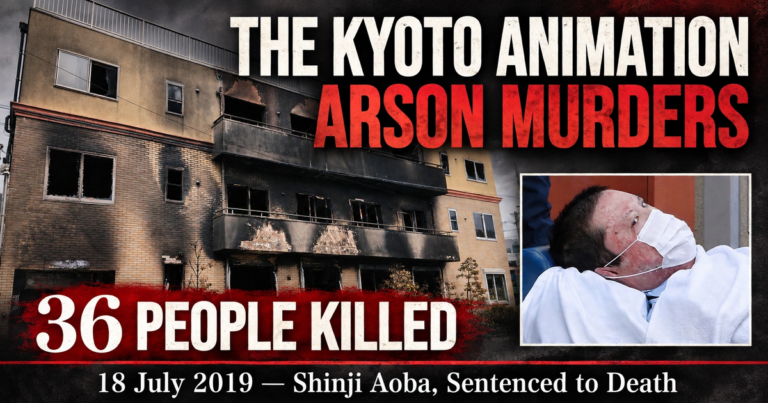
The Kyoto Animation Arson Attack: 36 Deaths, Criminal Responsibility and the Disputed Appeal Withdrawal
Case record
Sagamihara Care Home Attack: Third Retrial Petition Accepted
Case record
The Osaka Private Video Booth Fire: Sixteen Deaths, a Final Death Sentence and a Second Retrial Denial
Case record