
The Akihabara Street Attack: Why “A Man Driven to the Edge by the Internet” Is Not an Explanation — The Anger Examined by the Supreme Court
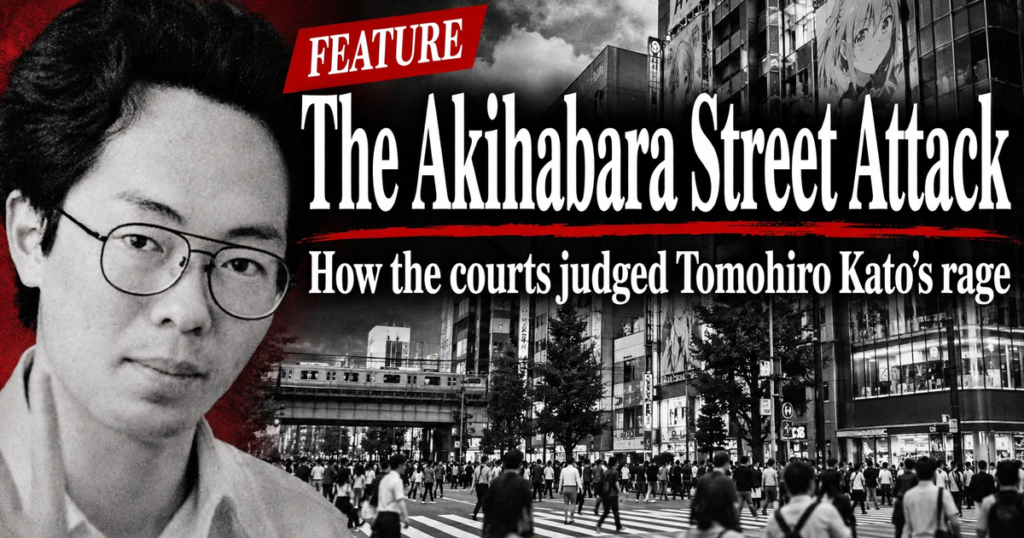
On 8 June 2008, Tomohiro Kato killed seven people and injured ten in Akihabara, Tokyo. The Supreme Court's judgment distinguished harassment Kato experienced on an online bulletin board from harassment at work that he believed had occurred. It also recorded that he directed his anger at strangers who had no connection to either. The Court dismissed his final appeal on 2 February 2015; his death sentence was carried out on 26 July 2022.
Introduction: “The internet caused it” leaves out the essential question
Kato believed he had been harassed on an online bulletin board. He also believed that people at his workplace were harassing him. But the people he attacked were not those he blamed. They were strangers walking through Akihabara. The Supreme Court's account of the 8 June 2008 attack, in which seven people were killed and ten injured, set out this sequence of motives. The important point is that the judgment did not treat the two alleged forms of harassment as the same fact.
When the Akihabara attack is discussed, the internet is almost always mentioned. A temporary worker moved between jobs, became dissatisfied with society, felt lonely, immersed himself in online interaction and became furious about harassment he believed he had suffered. Accounts of the crime are often written along those lines.
But reducing the event to “he committed indiscriminate murder because something unpleasant happened online” leaves out the most disturbing part. The people Kato believed had harassed him and the people walking in Akihabara on the day of the attack were not the same. He did not directly target those he blamed. He took the lives of unrelated passers-by in order to make his anger known to others.
A truck drove into a Sunday pedestrian zone
On Sunday, 8 June 2008, Akihabara was crowded with people visiting the pedestrian zone. Kato planned an indiscriminate killing and drove a truck into pedestrians. According to the Supreme Court judgment, this first act killed three people and injured two. Kato then left the truck and attacked people who were fleeing with a knife. A further four people were killed and eight injured. The total was seven deaths and ten injured.
The fear experienced at the scene cannot be reduced to those figures. But conversations and the final actions of individual victims should not be reconstructed without evidence. What is established is that people who were there to shop or go about their day were attacked despite having no connection to Kato's grievances.
The Supreme Court also found that Kato turned his knife on a police officer who tried to arrest him at the scene. This conduct formed part of the background to charges beyond murder and attempted murder, including obstruction of public duties. The truck collision and the stabbings after he got out of the vehicle were different methods within one continuing plan. The Court emphasised the preparation and firm intent to kill; this was not an accidental argument that escalated in the moment.
Workplace “harassment” and what Kato believed had happened
When people try to describe an offender, they often look for a simple cause. He moved between jobs, was lonely and was hurt by relationships. Put together, these details can become a story in which pressure accumulated until it exploded.
Kato's circumstances cannot be ignored. The Supreme Court referred to his growing dissatisfaction with society and loneliness as he moved between jobs as a temporary worker. It also recognised his immersion in online bulletin boards. But the judgment did not establish a general rule that people in insecure employment are likely to commit crimes. Countless people feel lonely, are dissatisfied with work or experience online harassment. The overwhelming majority do not attack others.
The Court found that harassment on the bulletin board, together with Kato's belief that he had also been harassed at the dispatch workplace, led to intense anger. It further found that he committed the attack to make the people he regarded as harassers understand that their conduct had produced serious consequences. This describes not only why he felt anger, but how he chose to express it.
Kato connected his understanding of who had hurt him with a decision about whose lives he could take. He tried to communicate his anger even at the cost of unrelated people's lives. That leap is at the core of the case. It is a structure drawn from the judgment, not an attempt to recreate a scene inside his mind.
Why did a wish to make others understand his suffering become murder?
Restating the motive recorded in the judgment, Kato wanted the people he regarded as responsible for harassment to understand how serious he believed their conduct had been. But attacking passers-by had no rational connection to that aim.
Feeling wronged and killing another person are separate matters. Even if a grievance is sincerely felt, it cannot justify harming people who had nothing to do with it. The Supreme Court's conclusion that the motive and circumstances offered no meaningful grounds for mitigation must be understood in light of that profound leap.
Two opposite errors should be avoided. One is to say that Kato was driven to the attack by work and the internet, as though those circumstances excused his conduct. That turns an analysis of dissatisfaction into an excuse. The other is to say that he was simply an abnormal person whose background need not be considered. That closes off any examination of how he interpreted his grievances, selected his targets and decided what he wanted to accomplish.
Understanding the background is not the same as accepting the offender's reasoning. Nor does analysis of his choices transfer responsibility to the people who were attacked.
“Anyone would do”: A phrase that can erase the victims' lives
The phrase “anyone would do” is sometimes used to describe indiscriminate attacks, meaning that the offender did not select particular victims in advance. From the victims' perspective, however, the phrase is painfully blunt.
Each pedestrian had a name and an ordinary life. Each had somewhere to go and somewhere to return to. The fact that Kato did not choose victims individually does not make the lives he took interchangeable. The Supreme Court placed the seven deaths and ten injuries at the centre of its sentencing assessment. The number of victims was not merely a statistic showing the social impact of the crime; it was a concrete basis for the criminal responsibility arising from irreparable harm.
We must not invent individual stories about the victims. But that does not permit us to treat them as numbers attached to the background of the offender's anger. The centre of the case is not only Kato's frustration. It is the seven lives lost, the ten people injured and the lasting effects on their families and communities.
What did the Supreme Court emphasise in 2015?
The Tokyo District Court sentenced Kato to death in 2011. The Tokyo High Court maintained the sentence in 2012. On 2 February 2015, the Supreme Court's First Petty Bench dismissed his final appeal and upheld the death sentence.
Three features of the judgment are particularly important. First, the attack was planned. Second, it caused irreversible consequences: seven deaths and ten injuries. Third, the motive and circumstances did not provide grounds sufficient to reduce the sentence. The Court also considered that Kato had no prior criminal record, but concluded that this did not change the appropriate sentence. The decision was unanimous.
The Supreme Court did not sentence “internet society” as a whole. The case concerned the specific conduct of Tomohiro Kato, not a judgment on online relationships or employment conditions in general. Social problems may form part of the background to a crime, but they do not automatically become the legal basis of the offender's responsibility. Reading the judgment makes that distinction clearer.
The death sentence was carried out, but the question of why remains
Kato's death sentence was carried out on 26 July 2022. The Ministry of Justice made the execution public and referred to it again at a ministerial press conference in June 2025. The criminal proceedings had reached their conclusion and the sentence had been executed, but the question of why Kato directed his anger at the lives of unrelated people remains.
It would be dangerous to provide one simple answer. Temporary employment, online bulletin boards and feelings of inferiority about appearance or relationships have all been discussed in connection with the case. None of these factors makes mass murder inevitable. The point that becomes clearer on rereading the short Supreme Court judgment is not merely that Kato was lonely or angry, but how he chose to act on that anger.
Even if someone believes they have been harassed and wants another person to understand their suffering, other people's lives cannot be used as a means of expressing that grievance. Kato made a connection of his own between his suffering and the deaths of strangers. Remembering the case only as the crime of “a man driven to the edge by the internet” hides the decisive choice between those two things. Examining the case means continuing to ask why he believed he could use other people's lives to express his anger—and keeping responsibility at the centre of the answer.
At a glance
Date: 8 June 2008. Location: Akihabara, Tokyo. Victims: seven people killed and ten injured. Offender: Tomohiro Kato. Method: a truck attack followed by knife attacks. Tokyo District Court: death sentence in 2011. Tokyo High Court: appeal dismissed in 2012. Supreme Court: final appeal dismissed on 2 February 2015. Execution: 26 July 2022.
Original Japanese feature: 秋葉原通り魔事件【特集】|「ネットに追い詰められた男」で済ませてはいけない――最高裁が見た加藤智大の怒り
Last updated:
Related articles
Same case · Case record
The 2008 Akihabara Attack: Seven Deaths and the Supreme Court's Sentencing Decision
Case record
The Ikeda Elementary School Attack: Eight Children Killed, a Death Sentence and Lasting Changes to School Safety
Case record
The Kakogawa Seven Murders
Case record