
The Zama Nine Murders: Why Nine Lives Cannot Be Explained Away as a Single “Wish to Die” — Trial Evidence and the Ethics of Reporting
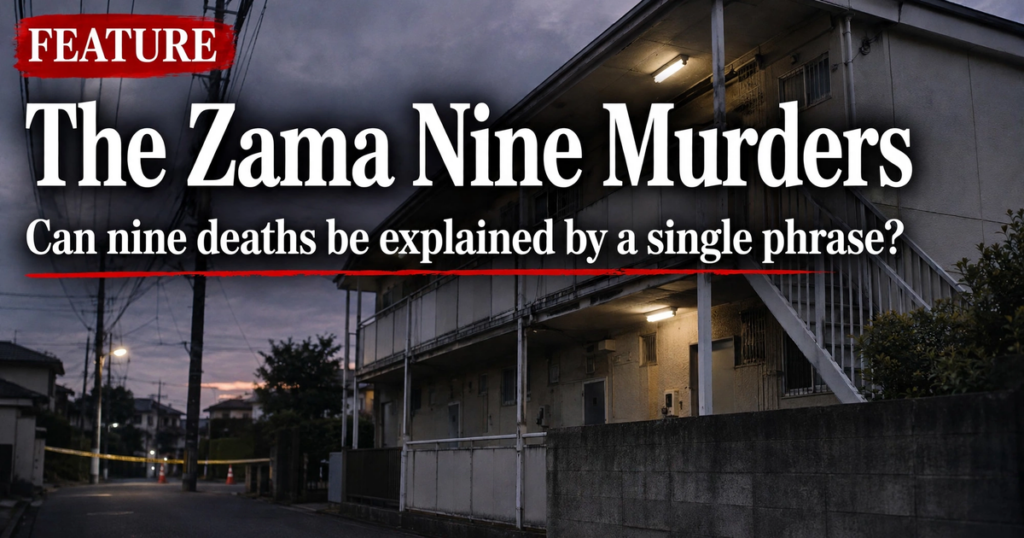
On 30 October 2017, nine bodies were found in an apartment in Zama, Kanagawa Prefecture. The victims were eight women and one man, aged 15 to 26. The investigation began with a search for a missing woman in Hachioji and led police to Takahiro Shiraishi. The trial rejected the claim that the victims had consented to be killed. Shiraishi's death sentence became final after he withdrew his appeal and was carried out on 27 June 2025. This feature examines the evidence, the survivors, the legal process and the duty to preserve each victim's dignity.
Introduction: The search for one missing person led to nine bodies
On 30 October 2017, nine bodies were discovered in an apartment in Zama City, Kanagawa Prefecture. The victims were eight women and one man, aged between 15 and 26. Police had reached the apartment while searching for a woman who had gone missing in Hachioji, Tokyo. Her brother followed clues from her social-media connections; as investigators traced the people she had contacted, their inquiry led to the apartment occupied by Takahiro Shiraishi.
Nine lives had been taken in the same room over a period of about two months. Public attention focused on how Shiraishi met the victims, why they went to his apartment and why no one stopped the crimes sooner. But a victim's distress must never be presented as though it caused the killing. Shiraishi chose and carried out the crimes.
At the 2020 trial, the defence made the victims' alleged consent to their deaths a central issue. Shiraishi himself acknowledged that the victims had not consented, and the court rejected the claim of consent. On 15 December 2020, the Tokyo District Court's Tachikawa Branch sentenced him to death. His lawyers appealed, but Shiraishi personally withdrew the appeal, and the judgment became final on 5 January 2021. On 27 June 2025, the Ministry of Justice announced that his death sentence had been carried out.
The number nine is not enough to understand the case. The story must be read through the social-media contacts, the financial and sexual motives established at trial, the existence of survivors, the actions of family members that led to the discovery, the dignity of the victims and the responsibility recognised by the court.
Nine people cannot be forced into one narrative
A summary saying that “people who posted about wanting to die became victims” describes one route of contact, but it does not explain what happened to each of the nine people. The male victim was reportedly connected to Shiraishi while trying to find an acquaintance; his circumstances and the offences against him were not identical to those involving the eight women. The court assessed consent in light of each person's actions and circumstances.
The important point of this feature is not simply the court's conclusion that consent was absent. It is the refusal to treat the victims as interchangeable before reaching that conclusion. Social-media posts, the offender's statements, conduct established in court and details about private lives reported by the press are different kinds of information. Keeping their sources distinct is the first step toward preserving the individuality of the victims.
1. Summer 2017: Social media became the route of approach
Shiraishi is said to have contacted people who had written on social media about suicidal thoughts or emotional distress. At the time, Twitter—now known as X—allowed strangers to exchange personal concerns and look for someone with whom to talk. Shiraishi searched for people through such posts and arranged meetings through private messages.
The platform itself did not kill the nine people. It provided a means of contact; the essential criminal conduct was Shiraishi's exploitation of the situations in which he found them. A person writing “I want to die” may be expressing severe distress. The post alone cannot tell us what that person actually wanted or what help they needed. It could never amount to permission for another person to take their life.
Reports and trial evidence repeatedly discussed how Shiraishi behaved as though he sympathised with the victims' anxiety and loneliness. That does not mean every victim heard precisely the same words or went to the apartment in the same state of mind. Their ways of meeting him and their lives were different. Identifying a recurring pattern in the reported contacts is not the same as forcing all nine into one template.
The use of social media also made it harder for people close to the victims to recognise danger. Unlike a partner known to family and friends, an online contact's real name, location and the depth of the relationship may not be known to others. Prevention requires more than blanket restrictions on young people's posts. It requires accessible routes to support and help in recognising dangerous approaches.
2. About two months of repeated crimes: The weight of nine deaths
From late August to late October 2017, Shiraishi repeatedly killed people in his apartment in Zama. The victims were eight women and one man. Early reports described the number of bodies before all identities had been established. Through DNA testing and other investigative work, all nine were eventually identified, and the public learned that each had a family and a life of their own.
Shiraishi faced charges including robbery-murder and murder involving sexual assault under the law applicable at the time. The offences cannot be adequately described by the everyday word “murder” alone. The court examined the taking of property, sexual conduct associated with the crimes, and the destruction and disposal of bodies. The question was not merely how many people had died, but what had been done to each victim and what criminal responsibility followed.
Some reporting has recreated the condition of the bodies in graphic detail to convey the horror of the case. What readers need to understand is how concealment enabled the crimes to continue. What happened to a victim after death can matter to an investigation and proof, but unnecessary description risks turning the victims into material for spectacle.
When the investigation began, police did not know that nine separate victims were involved. A search for one missing person focused attention on one apartment; what investigators found there led to the identification of others. We know the final number now and can be tempted to read the story backwards. At the time, each family was still trying to learn where its own missing relative was.
3. Family members followed social-media clues
The brother of a woman who had recently gone missing searched social media for clues that might lead to his sister. During that search, Shiraishi emerged as a person of interest. Police obtained assistance from a woman who had been in contact with him and traced his movements. On 30 October 2017, bodies were found in his apartment. Investigators initially proceeded on suspicion of corpse abandonment and then examined the series of killings.
The discovery is sometimes reduced to the simple contrast that “social media enabled the crimes but also solved them.” Online information did help the family search. But the result depended on several human decisions: the family continued looking, a person provided information and police identified the contact and entered the apartment. Technology alone neither enabled the crimes nor uncovered them.
Information shared publicly by one family can connect with another family's memories or with investigative material. But widening the public search can also expose private lives and relationships to people who have no connection to the case. It is easy, after learning the outcome, to say that the family should have searched sooner. The information available to them at the time was limited.
4. Money and sexual desire: Motives examined in court
At trial, Shiraishi described financial and sexual desires as motives. The Tokyo District Court's Tachikawa Branch found that he exploited the victims' psychological circumstances, gained their trust, brought them to his home and committed the crimes to satisfy his own desires. There was a profound gap between the appearance of an approach that seemed sympathetic and the offender's actual purpose.
We should not fill in, through imagination, the exact sequence of every thought Shiraishi may have had. His statements matter, but they are not the whole truth by themselves. His conduct, communications with the victims, evidence concerning property and the court's findings must be read together. A striking sentence from an offender can too easily replace the full explanation of a case.
The financial motive is not measured only by how much money he obtained. The evidence also showed a way of treating people according to whether they could be used, as objects for satisfying his desires. Rather than trying to rank sexual desire and financial gain as though one had to be the stronger motive, it is more accurate to see how both were connected to violence against the victims.
5. Women who left the apartment alive: Testimony that challenged a common assumption
At the sixth hearing on 12 October 2020, the court heard that two women other than the nine victims had entered Shiraishi's apartment and left alive. According to Kyodo News reporting from the trial, Shiraishi said he had not killed some women because he thought he might obtain money from them. One woman reportedly spent about ten days in his apartment in September 2017 before returning home.
This evidence challenged the impression that everyone who entered the apartment was killed. It does not mean, however, that only two people ever survived after visiting. Later proceedings also discussed another woman who entered the apartment and escaped. The two women first identified in the sixth hearing should not be confused with the full number of survivors mentioned during the trial.
Care is needed in interpreting Shiraishi's explanation. Even if he said that he believed he could obtain money, that statement does not establish every reason a woman was allowed to leave safely. Treating an offender's self-explanation as though it were a judicial finding can exaggerate how completely he calculated another person's actions. The evidence does, at least, show that he connected human relationships with the possibility of financial gain.
The fact that some people survived after visiting the same place and meeting the same man does not mean that they made better choices than those who died. The decision to commit the crime belonged to the offender. Survival should not be explained simplistically by a victim's caution, strength or judgement.
6. The defence argument of killing with consent
One important issue at trial was whether the victims had consented to be killed. The defence argued that the victims had wanted to die and sought a legal assessment different from ordinary murder. But writing about death on social media is not the same as freely consenting to be killed by another person.
Under Japanese criminal law, the offence of killing with consent is not established merely by showing that someone had made despairing statements. The question is whether the person understood the specific act of killing and genuinely consented to it. Words written by someone in distress cannot be reinterpreted to suit the offender as permission to kill. The court found no consent to the killings of the nine victims.
Shiraishi himself also stated at trial that the victims had not consented to being killed. There was therefore a difference between the defence lawyer's legal argument and the defendant's own account. In criminal proceedings, lawyers may construct legal arguments; it is wrong to treat those arguments as identical to the defendant's understanding or the court's findings.
When explaining that Shiraishi targeted people who had written “I want to die,” reporting must not imply that their vulnerability invited the crimes. The court rejected the logic that another person's expression of distress could serve as a licence to kill.
7. How much of a victim's background should be reported?
News coverage widely circulated the victims' names, photographs, schools, occupations and social-media posts. Such details may help explain the investigation and identify missing people. But making private information public nationwide—including information a person might never have wanted to share—raises serious concerns. In 2017, lawyers issued a statement addressing the reporting of victims' real names.
Reducing a victim's life to the single label “a young person with suicidal thoughts” distorts the meaning of the case. A period of depression cannot explain a person's entire life or relationships. Each family knew the victim before the crime; friends knew different sides of that person. The moment of contact with the offender was not the whole of the victim's life.
When publishing a person's earlier words, it matters when they were posted, to whom they were addressed and in what context. Fragments found in investigative materials do not prove that a victim continuously wanted to die. Reporting must distinguish the public image created by coverage from the facts that a court needed to determine.
8. Evidence accumulated at trial and the time required to reach judgment
The first hearing took place on 30 September 2020 at the Tokyo District Court's Tachikawa Branch. About three years had passed since the discovery of the crimes. The case involved nine killings and required the court to organise a large amount of evidence: the circumstances in which the bodies were found, communication records, transfers of money and the events before and after each victim's death. The lay-judge trial involved 24 hearings.
The court examined not only Shiraishi's statements but also his communications with the victims, testimony from investigators and forensic examinations of the bodies. Reports from individual hearings revealed new information over time, but testimony during the trial must not be confused with the court's final findings. What matters is how statements made at one hearing were assessed alongside later evidence and the judgment.
In a case with multiple victims, individual histories are often compressed to explain the overall picture. In court, however, the date, conduct, motive and evidence relating to each killing must be considered. The number nine fits into one case name, but the court had to make findings about nine separate lives.
9. 15 December 2020: The death sentence and the court's findings
On 15 December 2020, the Tokyo District Court's Tachikawa Branch sentenced Shiraishi to death. It rejected the argument that the victims had consented to their deaths and found that he had acted to satisfy financial and sexual desires. The repeated killings, the total of nine victims and the malicious nature of the course of conduct were reflected in the sentencing decision.
When reporting a death sentence, it is necessary to identify which court imposed it, on what date and at what procedural stage. The statement “he was sentenced to death” does not tell readers whether the judgment was a first-instance decision still open to appeal or a final sentence. In this case, the date of the sentence and the date it became final were different.
Contemporary reporting also said that Shiraishi appeared to accept the prospect of a death sentence. His personal attitude and the criminal-justice outcome are separate questions. The punishment was not determined simply because the defendant said he accepted it. The court established the offences from the evidence and selected the sentence under the law.
10. Withdrawal of the appeal: There was no Supreme Court judgment
On 18 December 2020, three days after the sentence, defence counsel filed an appeal. Shiraishi personally withdrew it on 21 December. After the appeal period expired, the first-instance death sentence became final on 5 January 2021. This sequence is essential to an accurate record of the legal proceedings.
The Tokyo High Court did not issue a substantive appellate judgment on guilt or sentence in this case. Nor did the Supreme Court uphold the death sentence. Saying that “the death sentence was confirmed by the Supreme Court” would invent proceedings that did not occur. The sentence became final because the appeal was withdrawn and the relevant period expired.
There is an important procedural distinction between the fact that defence counsel appealed and the fact that Shiraishi later withdrew that appeal himself. The defence's legal arguments were not fully litigated through an appellate judgment; the first-instance decision became final. This is easy to miss in a short chronology.
11. 27 June 2025: Execution and the official announcement
On 27 June 2025, the Ministry of Justice announced that Shiraishi's death sentence had been carried out. At an extraordinary press conference that day, the Minister of Justice referred to the gravity of a case in which nine people had been killed over a period of about two months. The official announcement confirmed that the sentence was executed more than four years after it became final.
Finality and execution are separate events. 5 January 2021 is the date on which the death sentence became legally final; 27 June 2025 is the date on which it was carried out. Together with the 15 December 2020 sentencing date, these three dates must be kept distinct. Under Japan's criminal-justice system, a period may pass between a final judgment and execution. Omitting that interval hides part of the legal process.
The execution ended Shiraishi's criminal proceedings. It did not end the victims' lives in the sense of restoring what had been lost, nor did it end the grief of their families. Execution completes a state legal procedure; it does not repair the lives taken. The continuing record matters not simply to report the offender's death, but to ensure that the nine people who died are not forgotten.
12. The danger of describing the case as a gathering of people who wanted to die
The Zama case is often reported in connection with social-media posts about suicide. Some explanations can leave the impression that the victims voluntarily gathered and were then killed as a consequence. The judgment instead found that the offender exploited the victims' circumstances, lured them to his home and killed them to satisfy his own financial and sexual desires. Their posts did not reduce his responsibility.
The words “I want to die” do not necessarily describe a concrete plan to end one's life. They may express a wish to escape a painful situation, to have someone understand the suffering or to stop enduring it alone. A person's true intentions cannot be determined from a short post. The court's rejection of consent is a basic boundary for anyone discussing the case.
If someone online says “Let's die together” or “I'll help you,” those words alone do not make that person a trustworthy source of help. Reports about Shiraishi's methods show how an approach disguised as rescue can become an entry point to control and violence. But warning about that danger must not turn into blaming people who publicly expressed distress. The focus must remain on the conduct and responsibility of the person who approached them with harmful intent.
13. Identifying the nine victims and their families: Time beyond the numbers
When the crimes came to light at the end of October 2017, the victims' identities were not established all at once. Police carried out forensic examinations and comparisons with family information; by November, all nine people had been identified. Some were minors. The information investigators needed to establish identities was not necessarily the same information that the media chose to publish.
For families who had been searching for someone with whom they had suddenly lost contact, confirmation of a body was an exceptionally painful message. We may mark the date of discovery as a point on a timeline. For a family, however, there was a different and much longer period: the day contact stopped, the time spent seeking information, nights of uncertainty and the moment police finally made contact. We should not invent those individual experiences, but should respect the words that families themselves have made public.
Coverage that published the names and photographs of all nine victims prompted debate about the wishes and privacy of their families. The fact that nine people died is established; deciding what information about each person should be made public is a separate question. Preserving public facts accurately and protecting human dignity must be pursued together.
14. Digital traces that mattered to the investigation
Social-media messages, device-use records and interviews with people connected to the missing persons helped investigators identify contacts and trace movements. Online records can show whom a person last spoke to. But communication histories do not prove events that are not recorded in them. There are limits to what can be inferred about a person's intentions from words on a screen.
Digital records mattered not only to the discovery of the crimes but also to the later criminal trial. By tracing contacts between victims and the offender, the dates and the content of their exchanges, investigators and the court could compare statements and identify inconsistencies. But it is necessary to establish the circumstances in which each message was sent, who was operating the phone and what part of the full conversation has been preserved.
Social-media accounts are also spaces controlled by private services. Posts may be deleted and accounts suspended after an incident, making long-term preservation difficult. Future missing-person searches and criminal investigations need lawful methods to preserve necessary evidence while protecting the secrecy of communications and the privacy of people who are not involved.
15. How to read the testimony of survivors without inventing why they survived
The existence of survivors discussed at trial makes the outline of the case more complicated. Not everyone who entered Shiraishi's apartment was killed. The two women first identified in the early hearings were not the only women mentioned in later proceedings. This is a reason to be careful when describing the number of people who survived after entering the apartment.
We must not use Shiraishi's statements alone to answer the question “Why was this person spared?” He said that he thought he might obtain money from some women, but that does not prove every decision he made on a particular day. The other person's actions, surrounding circumstances and chance may all have mattered; the public record does not reveal everything. A survivor's testimony was nevertheless important evidence about how Shiraishi interacted with people, what he said and what he sought to obtain from them.
Survivors should not be asked casually why they failed to recognise danger or why they did not contact police sooner. Someone may continue a relationship without knowing the other person's identity or criminal conduct, only to learn later that the person was a serious offender. It is unfair to judge what someone did before knowing the full picture from the perspective of someone who knows the outcome.
16. Lessons after the crimes: Not overlooking someone's request for help
The case brought public attention to dangerous approaches through social media and to the response to posts hinting at suicide. Who should reach out to someone describing distress? Where can danger be recognised when a minor is in contact with an unknown adult? The roles of families, schools, counselling services and online platforms all need consideration.
But prevention cannot be reduced to suppressing posts that mention suicide. If that is the only response, the very words through which someone asks for help may become harder to see. People facing serious distress need safe places to seek support. Connecting them with help without attacking or blaming them can coexist with warnings about malicious approaches.
It is also important that people seeking help do not become isolated after an online conversation begins. Continuing relationships with trusted family members, friends and professional services can make it less likely that the words of a dangerous stranger become their only source of support. But access to support is not determined by individual effort alone. Society must create accessible systems and environments in which asking for help does not bring disadvantage.
17. Rechecking the numbers and chronology
The established basic figures are nine victims: eight women and one man. The crimes came to light on 30 October 2017. The first hearing was held on 30 September 2020. The Tokyo District Court's Tachikawa Branch imposed the death sentence on 15 December 2020. Defence counsel appealed on 18 December; Shiraishi withdrew the appeal on 21 December; the sentence became final on 5 January 2021; and the execution took place on 27 June 2025.
These dates help keep the investigation and the judicial process separate. The 2017 arrest secured the suspect for investigation; the 2020 judgment was a first-instance judicial decision; finality in 2021 followed the withdrawal and expiry of the appeal period; and execution in 2025 was the carrying out of the sentence. The phrase “the case ended” can mean different things depending on which stage is intended.
The “two survivors” discussed at a hearing in October 2020 refers to the people mentioned at that stage. Later hearings referred to another woman who had entered the apartment. It would be wrong to conclude that only two people in total ever entered and survived. Nine is the established number of victims killed; the wider group of people who had contact with Shiraishi must be treated separately.
Conclusion: Do not compress nine lives into a single case label
Takahiro Shiraishi approached people who had written about distress on social media, used their words to draw them to his home and killed nine people to satisfy financial and sexual desires. The court rejected the claim of consent and imposed a death sentence. Shiraishi withdrew his appeal, the sentence became final and it was later carried out. That legal history can be stated clearly.
It does not mean that everything about the case is now known. The final thoughts of each victim cannot be reconstructed from the offender's statements or fragments of social-media posts. The public record also does not allow a definitive explanation of why some people who entered the apartment were not killed. Separating fact from inference does not soften the brutality of the crimes. It is necessary to preserve what can actually be established.
If the Zama case is remembered only through phrases such as “the dark side of social media” or “nine bodies,” the offender's abnormality becomes the centre of the story and the victims' lives are pushed into the background. The purpose of examining the case in detail is not to repeat the offender's words. It is to record accurately what he did, how the courts assessed it and what questions the case left for society.
At a glance
Period of crimes: late August to late October 2017. Discovery: 30 October 2017, Zama City, Kanagawa Prefecture. Victims: nine people, eight women and one man, aged 15–26 at the time. Offender: Takahiro Shiraishi. First hearing: 30 September 2020, Tokyo District Court, Tachikawa Branch. First-instance sentence: death, 15 December 2020. Appeal: filed by defence counsel on 18 December 2020 and withdrawn by Shiraishi on 21 December 2020. Sentence final: 5 January 2021. Execution: 27 June 2025.
Original Japanese feature: 座間9人殺害事件【特集】9人を一つの『自殺願望』で説明できない理由――公判証拠と報道倫理
Last updated:
Related articles

Same case · Case record
The Zama Nine Murders: Why the Court Rejected Claims of Consent
Case record
The Suicide-Website Serial Murders
Case record
The Tokyo–Saitama Child Abduction and Murder Case: Four Victims and a Long Trial Over Criminal Responsibility
Case record