
The Miike Coal Mine Explosion: 458 Dead, 839 with Carbon Monoxide Poisoning and Decades of Compensation Litigation
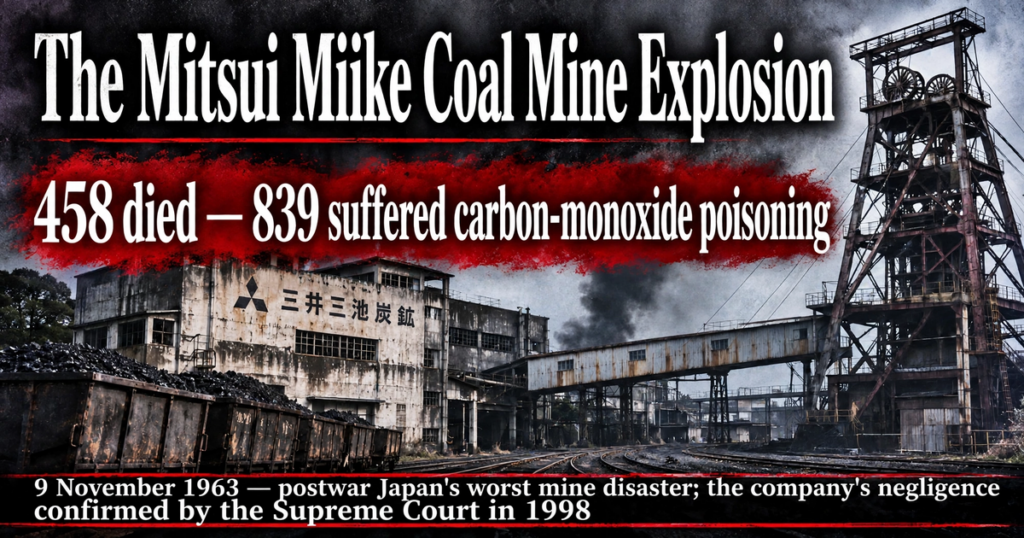
On 9 November 1963, a coal-dust explosion at the Miike Coal Mine's Mikawa Pit in Omuta, Fukuoka Prefecture, killed 458 people. A further 839 suffered carbon monoxide poisoning. The explosion occurred in an intake shaft, allowing toxic gas to spread through the mine. Criminal proceedings against 22 company executives never took place, while civil litigation later established the company's negligence in failing to prevent coal-dust accumulation.
Introduction: A coal-dust explosion that killed 458 people
At 3:12 p.m. on 9 November 1963, a coal-dust explosion occurred at the Mikawa Pit of the Mitsui Miike Coal Mine in Omuta, Fukuoka Prefecture. The disaster killed 458 people and left 839 with carbon monoxide poisoning.
The explosion occurred in the first inclined shaft, which served as an intake airway. Carbon monoxide spread through the mine, killing workers far from the initial blast. The disaster raised questions about production priorities, safety staffing, delayed rescue and the long-term treatment of survivors. No criminal trial of company executives took place, but civil litigation later found that the company had failed in its duty to prevent coal-dust accumulation.
Production expansion and the weakening of safety measures
The Miike coalfield extended across Omuta in Fukuoka Prefecture and Arao in Kumamoto Prefecture, with workings reaching beneath the Ariake Sea. The Mikawa Pit had two inclined shafts and monthly output of about 400,000 tonnes by 1963.
After the major Miike labour dispute of 1960, Mitsui Mining pursued higher production and reorganised its workforce. Safety personnel were moved into production work, reducing staffing intended to prevent coal-dust explosions. The Japanese source describes the pit as poorly protected against coal-dust accumulation and ignition.
A coal train broke apart and its rear eight cars ran away
The reported sequence began with a ten-car coal train travelling up the first inclined shaft. The coupling between the second and third cars separated. The rear eight cars ran down the incline, derailed and struck conveyor-support equipment. Sparks from the derailment and collision ignited coal dust.
The explosion occurred about 1,600 metres from the shaft entrance, with approximately 1,400 people underground. The precise source of the combustible dust cloud remains disputed. The Japanese account records both dust already accumulated in the roadway and coal on the conveyor as possible sources; neither should be presented as conclusively established.
The explosion occurred in an intake shaft
The first inclined shaft brought fresh air into the mine. Because the explosion occurred in this intake airway, carbon monoxide generated by the blast entered the ventilation flow and spread into underground working areas.
The total death toll was 458. The Japanese article attributes 20 deaths to the explosion itself and 438 to carbon monoxide poisoning. A further 839 people suffered CO poisoning. These figures describe different outcomes: the 839 poisoning cases must not be confused with the number of deaths.
Rescue operations were delayed
The explosion occurred at 3:12 p.m.; Mitsui Mining became aware of it at about 3:40 p.m. The first 23-person rescue team from the Mikawa Pit arrived at 5:28 p.m., more than two hours after the blast. The last rescue team, from the Yotsuyama Pit, arrived about seven hours after the disaster began.
The source records underground carbon monoxide concentrations of around six per cent for five to six hours. About 3,000 people eventually took part in rescue work. The scale of the later response did not remove the consequences of the delay before rescuers reached the underground workers.
The injuries continued long after the survivors left the mine
Survival did not mean recovery. Many people who suffered carbon monoxide poisoning experienced lasting neurological problems, including memory impairment and other higher brain-function difficulties. Some could not return to their former work or daily lives.
The source reports that more than eighty people were still receiving treatment in 2013, fifty years after the explosion. Survivors also faced stigma, including the discriminatory label “gas patients.” The disaster's effects continued in families and communities long after the rescue operation ended.
Twenty-two company executives were not prosecuted
The Fukuoka District Public Prosecutors Office considered criminal charges against Mitsui Mining executives. After changes in the personnel handling the case, the new team concluded that the evidence was insufficient for prosecution.
All 22 executives were not prosecuted. There was no criminal trial in which a court examined their guilt or innocence. Non-prosecution for insufficient evidence is not an acquittal. Families and survivors therefore pursued civil claims concerning the company's safety obligations.
A partial settlement in 1987 did not end the litigation
On 20 July 1987, 454 plaintiffs accepted a settlement proposal presented by the Fukuoka District Court. The total settlement was approximately 910 million yen. Thirty-two people and four families did not accept the proposal and continued their cases.
The settlement resolved the claims of those who accepted it, but it did not end every dispute. The remaining plaintiffs continued to seek a judicial determination of the company's responsibility for the safety failures and resulting injuries.
The 1993 civil judgment recognised the company's negligence
On 26 March 1993, the Fukuoka District Court found that Mitsui Mining had a duty to prevent coal dust from accumulating and had breached that duty. The court recognised the company's negligence and ordered compensation. The judgment became final at the Supreme Court in 1998.
This civil finding is distinct from the criminal non-prosecution of the 22 executives. No criminal court convicted them. The civil proceedings established the company's responsibility for breaching its safety duty.
The mine closed, but the disaster remains part of the region's history
The Miike Coal Mine closed on 30 March 1997. Memorials and annual commemorations have continued to remember those who died and those who suffered lasting injuries. A memorial service was held at the former Mikawa Pit in November 2023, the sixtieth anniversary of the explosion.
The history includes the runaway coal cars, the intake shaft that carried carbon monoxide, the delayed rescue and the long-term injuries. It also includes two separate legal outcomes: no criminal trial against executives and a civil judgment recognising the company's negligence.
At a glance
Incident: Mitsui Miike Coal Mine explosion at the Mikawa Pit, Omuta, Fukuoka Prefecture. Date and time: 9 November 1963, 3:12 p.m. Deaths: 458. People with carbon monoxide poisoning: 839. Twenty-two company executives were not prosecuted; no criminal trial took place. A partial civil settlement was reached in 1987. The Fukuoka District Court recognised company negligence on 26 March 1993, and the judgment became final in 1998. The mine closed on 30 March 1997.
Original Japanese record: 三井三池炭鉱爆発事故|保安軽視と遅れた救援、CO中毒後遺症と長期の補償裁判
Last updated:
Related articles

Case record
The Kanemi Yusho Poisoning: PCB-Contaminated Rice Oil and a Relief System Still Operating Decades Later
Case record
The Kyoto Gion Runaway Van Crash: Seven Pedestrian Deaths, a Driver's Medical History and Changes to Driving-Licence Rules
Case record
The Kabukicho Building Fire: Forty-Four Deaths, an Unidentified Fire-Setter and the Failure of Fire Management
Case record