
The Toyoake Mother-and-Three-Children Murders: Four Deaths in a House Fire and an Investigation Still Open
In the early hours of 9 September 2004, a house in Kutsukake-cho, Toyoake City, Aichi Prefecture, was set on fire after four members of the household had been attacked. The victims were 38-year-old Riyo Kato and her three children, aged 15, 13 and 9. No suspect has been identified or prosecuted. The house was demolished in 2006, but police continue to seek information, and the abolition of the limitation period for capital offences means the investigation is not barred simply by the passage of time.
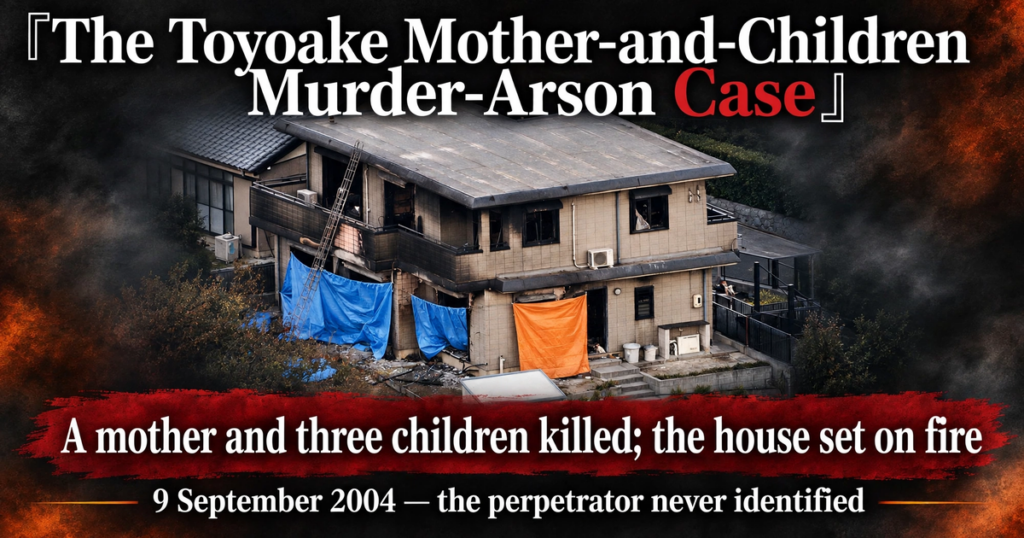
A house fire exposed the killing of a mother and her three children
At about 4:25 a.m. on 9 September 2004, a two-storey house in Ishihata, Kutsukake-cho, Toyoake City, Aichi Prefecture, caught fire. Firefighters extinguished the blaze and investigators found the bodies of four members of the household: 38-year-old Riyo Kato and her three children. The police treated the deaths as a murder and arson case, not as a family lost in an accidental residential fire. The four had apparently been attacked before the house was set alight. The incident occurred in a residential neighbourhood, and the scale of the crime shocked the local community.
The victims were Riyo Kato and her children
The victims were Riyo Kato, her eldest son Yuki, aged 15, her daughter Rina, aged 13, and her younger son Shogo, aged 9. The children were still at school age, and Shogo was close to his ninth birthday. The family's home was completely destroyed by the fire. The Aichi Prefectural Police notice identifies the four as the wife, eldest son, eldest daughter and younger son who lived in the house. Their names and ages are part of the public appeal for information, but the police have not identified a suspect or publicly established why the family was targeted.
The husband was away from home, but a separate case must not be confused with the murders
Riyo's husband, Hiroto Kato, was not at home when the fire began; he was working overtime at his workplace. The source article notes that he was later arrested and convicted in an unrelated fraud case involving his former employer. That separate prosecution does not amount to a conviction for the murders or arson of his wife and children. No one has been arrested or indicted for the killing of the four family members. The distinction is important because speculation about the surviving family member has circulated over the years, but the unsolved murder case has not produced a judicial finding against him.
Reports described different injuries among the four victims
Contemporaneous reporting cited in the Japanese article described Riyo and Rina as having injuries believed to have been caused by a bladed weapon, while Yuki and Shogo were reported to have suffered blunt-force injuries to the head and chest. Reports also said that kerosene had been spread at the scene. These descriptions help explain why investigators treated the fire as a deliberate attempt to conceal a prior attack. They should nevertheless be attributed to reporting and investigative information, not described as findings from a criminal trial. No trial has taken place, and the precise weapon, number of offenders and route by which the offender entered the house have not been publicly established.
The house was demolished, but the investigation continued
The house where the four were killed was demolished in September 2006, according to Aichi Prefectural Police. The disappearance of the building did not end the investigation. The police maintain a dedicated case notice and continue to receive information through the special investigation headquarters at Aichi Police Station. The passage of time makes it harder to recover memories of people, vehicles, sounds or unusual activity in the neighbourhood, but those details may still be compared with evidence and statements already held by investigators. The authorities continue to ask for even small pieces of information that might become meaningful when considered alongside other material.
The offender, motive and method of entry remain unknown
Aichi Prefectural Police has not publicly determined how many people took part, what motive lay behind the attack, what relationship—if any—the offender had with the family or how the house was entered. At different times, media reports and public discussion have raised possibilities such as a grudge or the involvement of more than one person. Those possibilities have not been established in court. The safe factual description remains that four family members were killed and the house was set on fire, while the person or people responsible have not been identified. An unsolved case should not be filled out with an imagined motive simply because the known facts leave difficult questions unanswered.
The abolition of the limitation period means the case can still be prosecuted
In 2010, Japan amended its Code of Criminal Procedure and abolished the limitation period for certain offences causing death that are punishable by death. The Toyoake case therefore did not become legally unprosecutable simply because many years had passed. If a suspect is identified and sufficient evidence is obtained, criminal proceedings can still be considered. The change did not create new evidence or guarantee that the offender would be found. It did, however, remove the time bar that would otherwise have prevented prosecution after a fixed period, giving investigators and the family a continuing legal route to seek accountability.
The twentieth anniversary brought the family back to the scene
In September 2024, a memorial gathering took place at the former site of the house, marking twenty years since the killings. Family members and police officers laid flowers. Toyoake City also displayed photographs of the family with their dog and drawings made by the children. Riyo's elder sister, Toshi Amami, continued to speak publicly about the four victims and to ask anyone who remembered something to come forward. The city bulletin recorded her appeal that the children should not be forgotten and that even a small piece of information might help resolve the case. Such events do not represent a new investigative breakthrough; they are efforts to keep the case in public memory.
The family and police continue to seek information
More than two decades after the fire, the Aichi Police special investigation headquarters continues to ask for information. The police appeal is not limited to people who witnessed the attack itself. A person may remember a vehicle, a visitor, an unusual sound or something said at the time that only later appears significant. The former house no longer stands, but the location, the public record and the memories of people who lived nearby remain available for comparison. The case remains unsolved: no suspect has been identified, no one has been tried for the four deaths, and the reason the family was attacked has not been established.
Original Japanese record: 豊明母子4人殺害放火事件|加藤利代さんと3人の子ども、22年目を前に続く特別捜査
Last updated:
Related articles
Case record
The Shibamata Student Murder and Arson: The 1996 Killing of Junko Kobayashi
Case record
The Nagasakiya Amagasaki Store Fire: Fifteen Deaths from Smoke on the Fifth Floor
Case record
The Toyota City High-School Girl Murder: Manami Shimizu, a Missing School Tracksuit and an Unsolved Robbery-Murder
Case record