
The Kitashinchi Building Arson: Twenty-Six Victims Killed, No Criminal Trial and the Fire-Safety Reforms That Followed
On 17 December 2021, a fire deliberately set at a fourth-floor clinic in an eight-storey building in Osaka's Kitashinchi district killed 26 patients and staff. The suspected arsonist, Tanimoto Morio, later died, bringing the fire-service death toll to 27 including him. Police referred the case to prosecutors after his death, and prosecutors declined to indict him. No criminal trial took place. The disaster nevertheless prompted national reviews of buildings with only one direct escape stairway and new guidance on evacuation and fire-safety improvements.
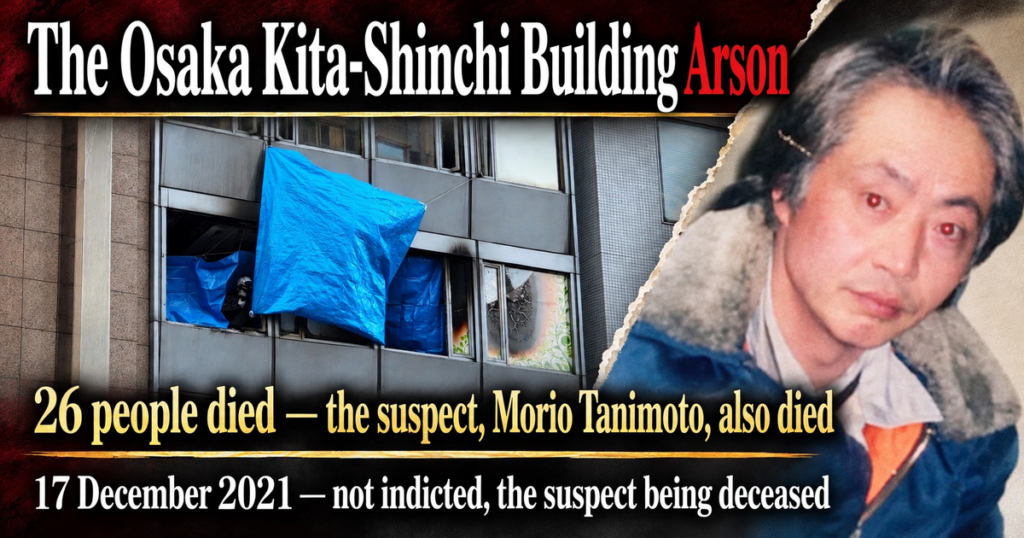
A fire broke out at a clinic in Kitashinchi
At about 10:15 a.m. on 17 December 2021, a fire broke out at the Nishi-Umeda Clinic of Mind and Body on the fourth floor of an eight-storey building in Sonezaki-Shinchi, Osaka's Kita Ward. The clinic served patients and employed medical staff. The fire spread rapidly through the premises, and 26 people—patients and employees—died. The scale of the loss made the incident one of Japan's most serious deliberate fires in recent decades. The location and the time of day also meant that people inside the clinic were present when the fire began.
The fire service identified the incident as deliberate ignition
The Fire and Disaster Management Agency's 2022 White Paper stated that the fire's cause was established from security-camera footage: a man who had visited the clinic spread gasoline and set it alight with a lighter. The suspected arsonist, Tanimoto Morio, was 61 at the time. He was transported to hospital in critical condition and died on 30 December 2021. The fire-service statistics therefore recorded 27 deaths, including Tanimoto, and one injured person. That figure must be distinguished from the 26 patients and staff who were killed as victims of the attack.
The fire began near the only direct escape stairway
The clinic occupied the fourth floor of a building with a single direct stairway leading to the ground. The fire was set near the entrance area, overlapping the route people would ordinarily have used to reach that stair. The Fire and Disaster Management Agency described the incident as an unusual or special type of fire: a large quantity of gasoline had been brought into a building, and the ignition method caused rapid fire growth while obstructing the route to the stairway. The result exposed how quickly a building's normal evacuation arrangements can become unusable when fire begins at the point through which occupants must escape.
Police referred the deceased suspect to prosecutors
Osaka Prefectural Police referred Tanimoto to the Osaka District Public Prosecutors Office on 16 March 2022 on suspicion of murder and arson of an inhabited building, among other offences. Because he had died, he could not be arrested, indicted and tried in the ordinary way. On 17 March, prosecutors decided not to indict him because of his death. This non-prosecution was not an acquittal, because no court heard the criminal case or determined guilt. It was also not a conviction. There was no criminal trial in which the suspect's motive, mental state or responsibility could be tested through adversarial proceedings.
Investigators reported signs of preparation, but there was no judicial finding
At the time the case was referred to prosecutors, Kansai Television reported investigative information suggesting that Tanimoto had been recording details about the clinic from around February 2021 and that entries in his smartphone schedule referred to checking a lighter. Police viewed the available material as indicating preparation over a period of months rather than a sudden act. These details came from the investigation and reporting, not from testimony tested at a criminal trial. Since Tanimoto died before prosecution, the public record contains no final judicial finding about his personal motive or criminal responsibility.
The national review treated the event as a special fire scenario
The Fire and Disaster Management Agency and the Ministry of Land, Infrastructure, Transport and Tourism convened a joint review after the disaster. Their report, compiled on 28 June 2022, treated the fire as a special scenario because a large amount of gasoline—an amount not normally present inside a building—had been ignited and the escape route to the only direct stairway had been blocked. The review did not conclude that every building with one stairway was unlawful. Instead, it considered how to reduce the risk in buildings whose structure leaves occupants dependent on a single route.
The proposed measures focused on a second route or a protected place to wait
The recommendations included adding another direct stairway or an effective evacuation balcony where possible, creating a refuge area when another stair could not readily be installed, and improving fire and smoke separation around stairways. The authorities also called for clearer evacuation guidance and more effective drills. The approach recognised that existing buildings cannot all be rebuilt immediately, but that owners and managers can improve the chances that occupants will have a protected place or another way out if the main route becomes unusable. The measures were designed as practical risk reduction, not as a promise that every form of deliberate arson could be prevented.
National inspections found problems in many comparable buildings
After the fire, the Ministry of Land, Infrastructure, Transport and Tourism carried out urgent inspections of buildings with features similar to the Kitashinchi property. The source article reports 784 legal violations and 1,201 cases of inadequate maintenance involving vertical fire compartments, as well as 351 legal violations and 1,518 cases of inadequate maintenance involving direct stairways. These were totals from inspections of relevant buildings nationwide, not findings about the single building where the fire occurred. The results showed that the incident had exposed broader weaknesses in compliance and maintenance across the building stock.
Fuel sales and emergency planning were also reviewed
The joint review addressed the handling of gasoline sales as well as building design. Rules already required identity checks when gasoline was sold into portable containers, and the authorities called for those procedures to be followed properly. The policy response therefore involved several layers: safe handling at the point of sale, fire and smoke separation, additional evacuation options, refuge areas, correction of legal violations and evacuation training. No single measure could guarantee that a deliberate attack would never occur, but the combined approach was intended to reduce the chance that one act could remove every escape route.
The absence of a trial leaves a different kind of public record
The confirmed outline is that a deliberate gasoline fire occurred at the clinic, 26 patients and staff were killed, Tanimoto later died, police referred the case to prosecutors and prosecutors declined to indict because he was deceased. The Fire and Disaster Management Agency's investigation and the post-fire building review provide an official account of the fire and its safety implications. They do not replace a criminal judgment. In December 2025, relatives of victims called for stronger public support for people bereaved by serious crimes, including the financial, physical and psychological burdens that begin immediately after an incident. The case left no criminal verdict, but it did lead to concrete changes in fire-safety policy.
Original Japanese record: 大阪北新地ビル放火事件|26人死亡、裁判なき不起訴と「直通階段1つ」の防火改修
Last updated:
Related articles
Case record
The Tsuyama Massacre: Thirty Residents Killed in a Rural Japanese Settlement
Case record
The Osaka Private Video Booth Fire: Sixteen Deaths, a Final Death Sentence and a Second Retrial Denial
Case record
The 1985 Paraquat Poisoning Cases: Poisoned Drinks, Vending Machines and 78 Reported Incidents
Case record