
The Nagoya Couple Murders: Two Young Victims, Six Offenders and the Appeal That Replaced a Death Sentence with Life Imprisonment
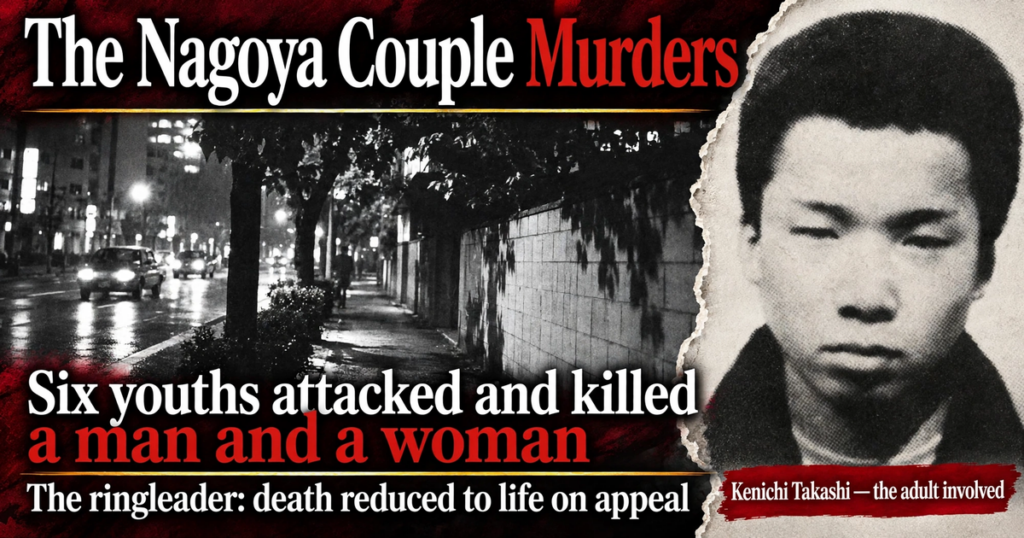
Between 23 and 25 February 1988, six young people aged 17 to 20 committed a series of robberies in and around Nagoya, culminating in the killings of two young people in Nagakute City, Aichi Prefecture, and Oyamada, Mie Prefecture. The Nagoya District Court imposed a death sentence on one defendant in 1989. In 1996, the Nagoya High Court replaced that sentence with life imprisonment and reduced another defendant's term from 17 to 13 years after separately examining the timing and scope of each participant's agreement to the killings.
A series of robberies preceded the two killings
The events began in the early hours of 23 February 1988, when six young people aged between 17 and 20 met near Nagoya's television tower. According to the later High Court judgment, they wanted money for leisure and decided to target couples sitting in cars late at night. They first approached another couple near the port area. That pair managed to drive away and seek help at a police box, so the robbery failed. About an hour later, the group attacked a different couple, taking approximately 86,000 yen from the man and injuring both occupants. The group nevertheless continued looking for targets.
Nomura and Suematsu were attacked at Odaka Ryokuchi
At about 4:30 a.m. on 23 February, the six found 19-year-old barber Nomura (野村昭善) and 20-year-old barber's apprentice Suematsu (末松須弥代) in a car at the Odaka Ryokuchi parking area. The attackers used weapons including a wooden sword and an iron pipe, assaulted the couple and took their property. Suematsu was also sexually assaulted. The group had taken steps to conceal the vehicle's number plate with tape. The victims had no established prior relationship with the offenders; they were targeted because they were a young couple sitting in a car at the park late at night.
The victims were kept under control instead of being released
After the robbery, the six did not release Nomura and Suematsu. They kept the couple in a vehicle and moved between locations. The prosecution and the courts treated the original robberies as planned, but the later killings arose during the continuing confinement rather than from a murder plan that had been fully settled before the group reached Odaka Ryokuchi. The offenders feared that the robbery and sexual assault would be reported. Discussions within the group and the influence its members exerted on one another led the original property crime to escalate into two murders. The period of confinement lasted about 45 hours.
Nomura was killed in Nagakute on 24 February
After 2:30 a.m. on 24 February, at a restaurant car park in Nagoya's Atsuta Ward, the central defendant proposed killing the two victims and burying their bodies. Four others successively agreed. The High Court found that a conspiracy among five defendants to kill both Nomura and Suematsu had been formed at that point. At about 4:30 a.m., Nomura was killed at a cemetery in what was then Nagakute Town, Aichi Prefecture. The court regarded the killing as an effort to avoid discovery of the earlier offences. It did not, however, find that every defendant had joined the conspiracy at the same time.
Suematsu was killed the following night in Mie Prefecture
Suematsu remained in the group's custody after Nomura had been killed. On the night of 24 February, another defendant joined the group in Nagoya and became involved in the conspiracy to kill Suematsu and dispose of both bodies. At about 3:00 a.m. on 25 February, Suematsu was killed in woodland in what was then Oyamada Village, Ayama District, Mie Prefecture. The two bodies were buried in a hole dug in the same general area. The distinction between the two killings later became legally significant: the High Court did not treat the scope and timing of every defendant's agreement as identical.
Six defendants were arrested and tried for different roles
The two victims had been missing for four days when Aichi Prefectural Police began arresting people connected with the group on 27 February. By 28 February, all six had been taken into custody. At the time of the offences, five were minors under the then applicable age threshold and one was 20. The charges covered attempted robbery, robbery causing injury, sexual assault, murder and abandonment of bodies. The case was not one in which all six had participated in every act from the first robbery through both killings. Their individual conduct and the points at which they joined particular conspiracies had to be assessed separately.
The district court imposed a range of sentences in 1989
On 28 June 1989, the Nagoya District Court sentenced the defendant who had led the group and carried out the killings to death. The other five received different penalties: one received life imprisonment, one 17 years, one 13 years, and two received indeterminate terms of between five and ten years. The range reflected the different levels of involvement and the defendants' ages. The death sentence was imposed on a defendant who had been 19 at the time of the crime. The fact that a defendant was a young person did not, under the law then in force, automatically exclude the death penalty for someone aged 18 or older.
The High Court reconsidered both the death sentence and the scope of a conspiracy
On 16 December 1996, the Nagoya High Court overturned the death sentence and imposed life imprisonment. It did not minimise the seriousness of the two murders or the defendants' responsibility. It considered, however, that the killings had not been the subject of a fully settled and carefully prepared plan from the outset. The young defendants had allowed a robbery to develop into prolonged confinement and then murder through group influence and immaturity. The court also considered the leading defendant's lack of prior violent convictions and the possibility of rehabilitation. It concluded that life imprisonment could provide for long-term punishment while leaving room for correction.
A separate finding reduced another defendant's sentence
The High Court also changed the sentence of the defendant who had received 17 years at first instance. It found that he had not joined the conspiracy to kill Nomura, although he later joined the agreement to kill Suematsu and abandon the bodies and was present at the latter killing. The court therefore excluded his responsibility for Nomura's murder and reduced his term from 17 to 13 years. This was not a general finding that he had played no part in the case; it was a specific reassessment of which killing he had agreed to and when.
The 1996 appeal judgment became final
The Nagoya High Court delivered its judgment on 16 December 1996. No further appeal was filed by the defendants whose sentences had been changed, and the appellate outcomes became final. The case is often reduced to the statement that a death sentence was changed because the offender was young. That description misses the court's more detailed reasoning: the way the killings emerged from the original robberies, the group dynamics, the offender's capacity for rehabilitation and the separate timing of each defendant's participation in the conspiracies. The appeal decision addressed those matters individually rather than treating the six defendants as a single undifferentiated group.
Original Japanese record: 名古屋アベック殺人事件|野村昭善さん・末松須弥代さん殺害、一審死刑を無期へ変えた控訴審
Last updated:
Related articles
Case record
The Murder of 18-Year-Old Manae Noguchi

Case record
The Toyokawa House Murder: A 17-Year-Old, Two Psychiatric Assessments and a Juvenile Court Disposition

Case record
The Nagoya Pregnant Woman Murder: A Surviving Newborn, Unanswered Clues and a 2003 Limitation Deadline

Case record