
The Kodaira Murders: Ten Murder Charges, Seven Convictions and a Postwar Pattern of Predation
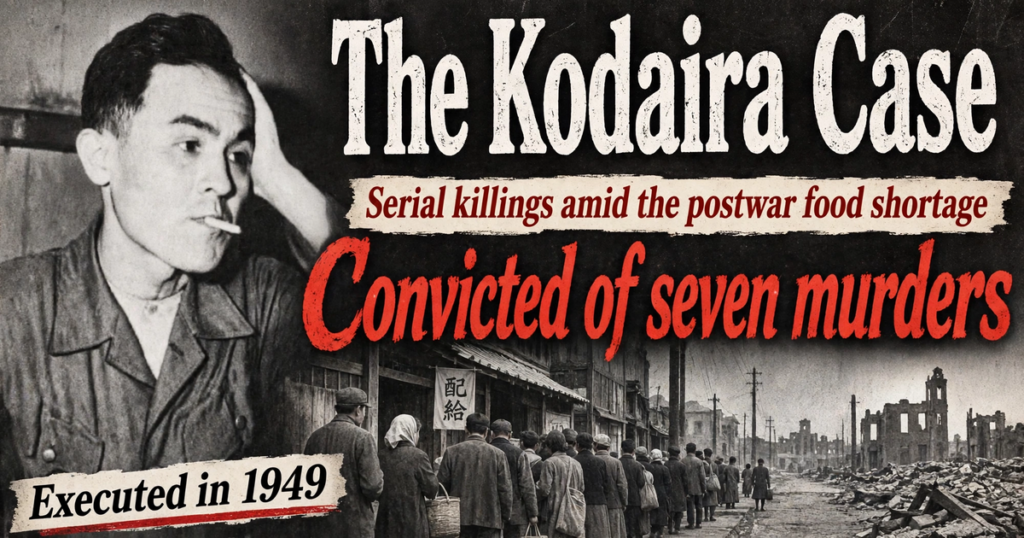
From May 1945 to August 1946, Yoshio Kodaira targeted women seeking food or work in the disruption of wartime and postwar Japan. He was indicted for ten murders, convicted of seven and acquitted of three; his death sentence was carried out in October 1949.
The case name refers to the offender, not Kodaira City
The Kodaira case took place from 25 May 1945 to 6 August 1946, during the final months of the Pacific War and the difficult period immediately after Japan's surrender. The name comes from the offender, Yoshio Kodaira; it does not mean that the crimes occurred in Kodaira City. The principal locations included parts of Tokyo and Tochigi Prefecture. Kodaira approached women who were looking for food or work, used offers of help to gain their trust and took them to isolated places. The case is sometimes described as a ten-victim serial murder, but that shorthand is legally inaccurate. Kodaira was indicted on ten murder counts, while the trial court convicted him of seven and acquitted him of three.
Postwar scarcity made the offers of food or employment plausible
In 1945 and the years immediately after the war, food and everyday goods were scarce. People in urban areas travelled to rural communities to obtain rice, potatoes and other supplies, sometimes through barter. Women could also be looking for employment or a way to support themselves. Kodaira exploited those circumstances. At railway stations and in busy urban areas, he approached women and claimed to know farmers who could provide food or employers who could offer work. The hardship of the period did not cause the crimes; it was the social condition he used to select and lure victims. The women were not responsible for the violence that followed their decision to seek basic necessities or employment.
Kodaira had a serious violent history before the murders
Kodaira was born in Tochigi Prefecture in 1905. He served in the Navy during his youth and had been sent to mainland China. After his marriage deteriorated, he attacked his wife's family when they refused to resume the relationship. Several people suffered serious injuries, and he received a 15-year prison sentence. His term was shortened through amnesty and related measures, and he was released on parole in 1940. He later worked in factories, remarried and had children. This earlier violent history is relevant background, but it should not be treated as proof of any particular later murder. The criminal findings in the serial-murder case must be based on the seven counts the court actually found proved.
The first murder was committed at a women's dormitory on 25 May 1945
The first murder later established at trial occurred on 25 May 1945. Kodaira entered a women's dormitory at a naval clothing and provisions facility in Tokyo, where he was working, and attacked a 21-year-old female service member. The murder was discovered relatively early, but investigators initially suspected another man. Kodaira left his workplace and was not identified as the perpetrator at that stage. The case remained unresolved while he approached other women in railway stations and city streets. The failure to connect him to the first murder meant that the investigation did not stop the later attacks. The first case eventually became one of the seven murder counts for which he was convicted.
He used offers of food and work to take women to isolated places
In later attacks, Kodaira approached women at stations including Shin-Tochigi, Shibuya, Ikebukuro, Tokyo and Asakusa. He offered to take women to farmers who could provide food or promised to introduce work to women looking for employment. Once the women trusted him, he led them to wooded or rural locations away from public view. The court found that he sexually assaulted and killed women and took money, watches, clothing, shoes and other belongings. During the period of severe shortages, these everyday items could themselves have exchange value. Some bodies were not discovered for months, and some had decomposed to the point that identification was difficult. The separate disappearances and discoveries initially complicated the investigation.
The last victim's family helped police identify Kodaira
The final murder count of which Kodaira was convicted involved a 17-year-old girl. In June 1946, he had approached her with an offer to introduce employment, and they exchanged addresses. In August he visited her home, where her mother saw his face. On 6 August 1946, the girl left with Kodaira and did not return. Her body was found on 17 August. The address record and the mother's identification helped police trace Kodaira. He was arrested on 20 August 1946, at the age of 41. The exchange of addresses and the fact that a family member had seen him created a direct link that had been absent in earlier incidents, when he had approached women more anonymously at stations.
Ten murders were charged, but three resulted in acquittals
After his arrest, Kodaira made statements about several women's deaths that had previously been treated as separate unsolved cases. Prosecutors ultimately indicted him on ten murder counts. At trial, however, he denied involvement in three of the cases. The court did not treat his statements to investigators as sufficient proof by themselves. It examined the condition of the bodies, physical items, witness testimony, the victims' movements and the links between Kodaira and each scene. The result was seven convictions and three acquittals because the evidence did not eliminate reasonable doubt in those three cases. The accurate description is therefore not that he was convicted of murdering ten women. Ten murder counts were brought; seven were proved beyond the required standard.
The death sentence became final in November 1948
On 18 June 1947, the Tokyo District Court sentenced Kodaira to death for the seven murders and the associated sexual and robbery offences it found proved. The court considered his repeated targeting of women in difficult circumstances, the false offers used to lure them away, the sexual violence, the killings and the repetition of the crimes over a relatively short period. Kodaira appealed, but the appellate court maintained the death sentence in 1948. On 16 November 1948, the Supreme Court rejected his final appeal, and the death sentence became final. The Supreme Court proceedings in Kodaira's case should not be confused with a separate Supreme Court grand-bench decision in March 1948 concerning the constitutionality of capital punishment. They were different cases.
Kodaira was executed at Miyagi Prison on 5 October 1949
On 5 October 1949, Kodaira's death sentence was carried out at Miyagi Prison. He was 44. His criminal proceedings ended with the execution. Later accounts have discussed additional offences that Kodaira may have committed, including sexual violence that did not result in death, but statements and theories not established by the final judgment cannot be added to the proven victim count. The article also distinguishes the so-called Second Kodaira case, a separate crime committed by another person using a similar method. It was not an additional offence by Yoshio Kodaira. The lasting significance of the case lies not in an unverified larger number, but in the seven murders proved at trial and the court's acquittal of three other counts where the evidence was insufficient.
Original Japanese record: 小平事件|食料と仕事を求める女性を狙い、10件起訴で7件有罪となった連続殺人
Last updated:
Related articles

Case record
The Ookayama–Senju Serial Murders: A Confession-Led Indictment, Then Two Other Men
Case record
The Mitaka Railway Incident: Six Deaths and a Fourth Retrial Petition in 2026

Case record
The Teigin Bank Poisoning: Twelve Deaths and a Conviction Challenged for Decades
Case record