
The Wanted Case of Tsuyoshi Yoshiya: The 1999 Ayase Group Attack
A group attacked two men in Tokyo's Adachi Ward on 4 June 1999, killing one 19-year-old victim. Police arrested 15 people in the wider case but continue to seek Tsuyoshi Yoshiya, whom they identify as a principal suspect.
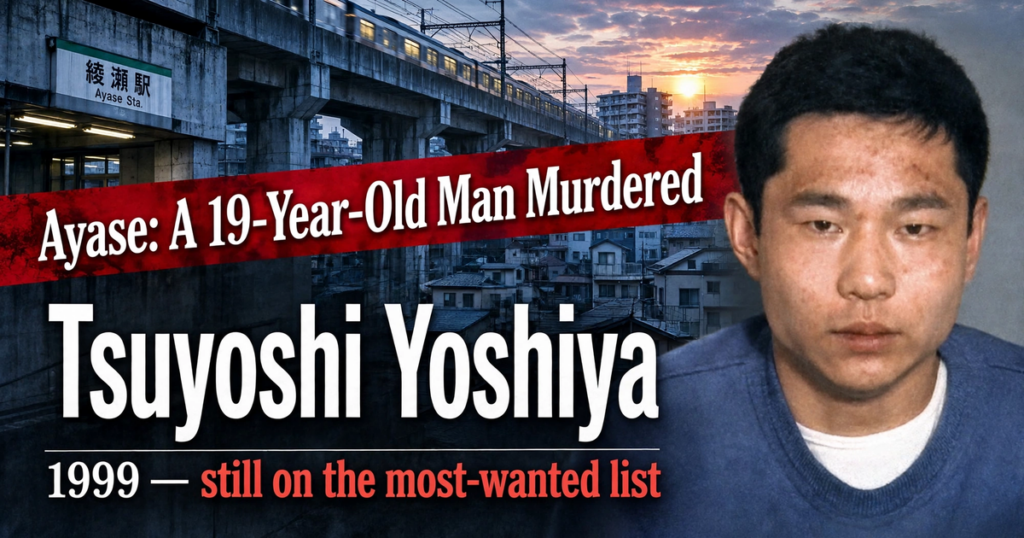
Two men were attacked in Adachi Ward on 4 June 1999
On 4 June 1999, a group of more than ten people attacked two men at and near the grounds of an apartment building in Ayase 5-chome, Adachi Ward, Tokyo. One of the victims, a 19-year-old man, was stabbed and died. The Tokyo Metropolitan Police Department described the background as a dispute between rival motorcycle gangs. The case is commonly referred to by the name of Tsuyoshi Yoshiya, whom police identify as a principal figure in the attack. Police records state that 15 people were arrested in connection with the wider series of events, but Yoshiya was not taken into custody. The number of people involved in the attack should not be confused with the number of people ultimately arrested or charged. Nor does the arrest of other participants establish Yoshiya's individual criminal responsibility. His position remains that of a wanted suspect, not a defendant convicted after trial.
Police describe Yoshiya as a principal suspect, not a convicted offender
The public account of the suspected offence says that Yoshiya acted in concert with more than ten others to attack the two men. Police have placed him in the principal role within the group and continue to list him as an important wanted suspect. His name is also recorded in Chinese characters as Mai Zhenqiang, with the Japanese reading Baku Shinkyō. The fact that 15 people were apprehended in the wider investigation is part of the official case history, but it does not mean that Yoshiya's own conduct has been tested in court. He has not been arrested, indicted or tried in connection with this homicide. There is therefore no judicial finding that he committed the stabbing or that he shared a particular intent with other participants. The police description is a statement of the suspicion underlying the warrant and public search. It must be presented as such, rather than converted into a statement of guilt.
The police have considered the possibility that he left Japan
The Tokyo Metropolitan Police Department has publicly stated that information from people connected with the case led investigators to believe that Yoshiya may have left Japan after the attack and travelled toward the Dalian area of China. The case has consequently appeared on the police list of wanted suspects believed to have fled overseas. That assessment is not confirmation of his present location. Police have also said that he may have re-entered Japan and be living somewhere in the country. The public record does not establish that he remains in Dalian, that he has crossed any particular border at a later date, or that he has died. A long period without an arrest does not turn an investigative theory into a confirmed account of a person's movements. The appropriate description is that police have considered overseas flight likely while continuing to investigate the possibility of domestic concealment.
The abolition of the limitation period matters to this older case
A further legal issue is the statute of limitations for serious homicide offences. On 27 April 2010, Japan amended its Code of Criminal Procedure and abolished the limitation period for certain offences resulting in death that were punishable by death, including murder and robbery-murder. The reform also applied to earlier cases in which the limitation period had not already expired when the law took effect. Because the Ayase attack occurred in 1999, the limitation period had not expired by April 2010. The passage of many years therefore does not, by itself, mean that prosecution is legally barred. This change is relevant to the continuing search, but it does not resolve the factual question of where Yoshiya is or whether he can be arrested. It also does not create a conviction. If he is apprehended, the prosecution would still have to prove the allegations in court.
The term principal suspect must not be confused with a court finding
The police use the description principal suspect because they consider Yoshiya to have occupied a central position in the group attack. That label is part of the public wanted notice and the investigative theory. It is not equivalent to a judicial determination that he planned the attack, ordered the stabbing or personally inflicted the fatal injury. Because he has not appeared in court, there has been no opportunity for him to enter a plea, challenge the evidence or present a defence. The other people arrested in the wider investigation were dealt with through their own proceedings, and their cases do not automatically establish the liability of a person who remains at large. This distinction is particularly important in group violence cases, where the prosecution must establish the conduct and intent of each defendant rather than rely only on the fact that a group was present.
The case remains an unresolved wanted investigation
More than two decades after the attack, the Tokyo Metropolitan Police Department continues to seek information about Yoshiya. Public information requests include not only direct sightings but also details about his possible whereabouts, aliases, contacts and movements. The police have published identifying information, including his Chinese name, and have stated that the possibility of a return to Japan cannot be excluded. The record does not establish a final outcome for the suspect or the criminal case against him. The known facts are that two men were attacked, one 19-year-old man died, 15 people were apprehended in the broader investigation, and Yoshiya remains wanted on suspicion of involvement as a principal figure. Any further description of his current location, guilt or fate would go beyond the publicly confirmed information. The case should therefore be understood as an unresolved homicide investigation with an outstanding wanted suspect.
Original Japanese record: 吉屋強指名手配事件|足立区綾瀬の19歳男性殺害、27年続く重要指名手配
Last updated:
Related articles
Case record
The Torigoe 2-Chome Murder and Arson: The Killing of an Indian Jewelry Worker and the Search for Diwakar Sethia
Case record
The Roppongi Nightclub Attack: Ryosuke Fujimoto's Death and the Search for Shinichi Mitate
Case record
The Higashi-Ueno 2-chome Condominium Murder
Case record