
The SM Club Robbery Murders
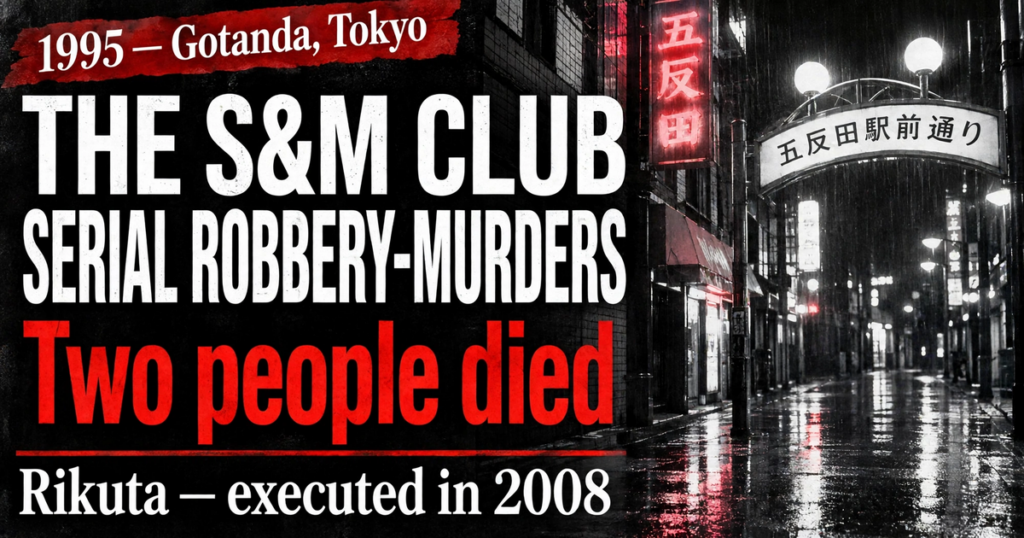
On 21 December 1995, employee Masashi Rikuta and others killed club manager Masahiro Hiraga and owner Seiji Hashiguchi in Tokyo's Shinagawa Ward. The plan was to take over the business and its income. Rikuta received a final death sentence and was executed at Tokyo Detention House on 17 June 2008.
A club manager and its owner were killed within hours
On 21 December 1995, two men were killed at an SM club in Higashi-Gotanda, Shinagawa Ward, Tokyo. The victims were manager Masahiro Hiraga, aged 33, and business owner Seiji Hashiguchi, aged 32. The principal defendant was Masashi Rikuta, an employee at the club. The Supreme Court found that Rikuta and others planned to remove the owner and manager, take control of the business and obtain its income. The killings were not treated as an isolated dispute between employees and managers; they formed part of a wider plan to take over a functioning business and profit from it.
The manager was killed first, followed by the owner
The Supreme Court found that Rikuta and other employees acted together. Hiraga was killed inside the club first. Several hours later, Hashiguchi was called to the same location and killed there. The two killings were carried out within one plan to eliminate the people who controlled the business. The court emphasized that the offenders had prepared items before the attacks, including weapons and materials for moving the bodies. The killings were not described as spontaneous incidents that happened to occur on the same day. The preparations and sequence supported the finding that the offences were planned.
The purpose was to take over the business and keep its profits
The court found that Rikuta and his accomplices wanted to remove Hashiguchi and Hiraga so that they could take control of the club and its earnings. After the two men disappeared, Rikuta's group did not simply abandon the premises. They continued operating the business for approximately eight months and received income from it. This conduct helped show that the killings and the subsequent financial activity were connected. The case was prosecuted as robbery-murder because the intention to obtain property and economic benefits was part of the plan, rather than an unrelated decision to take money after an impulsive killing.
Money was taken from Hashiguchi's wallet, safe and bank accounts
After Hashiguchi was killed, the group took his wallet, which contained approximately ¥200,000, and removed a safe from his home. The safe contained items including passbooks for time deposits in Hashiguchi's name. The offenders then used the documents to obtain money through fraudulent withdrawals or cancellation of deposits. The Supreme Court found that Rikuta obtained approximately ¥40 million through the fraud and related financial activity. The prosecution therefore concerned not only the two deaths but also the theft and deception used to obtain the victims' property and business income.
The bodies were hidden at sea for approximately seven months
After the killings, Rikuta and others arranged for an acquaintance to dispose of the bodies. The bodies were placed in wooden boxes, encased in concrete and submerged in the sea. They remained undiscovered for approximately seven months. The concealment was part of the effort to hide the murders while the club continued operating. The court treated corpse abandonment as a separate offence and considered the long concealment when assessing the seriousness of the case. The fact that the bodies were not immediately found also contributed to the length of time before the disappearances were understood as murders.
The initial investigation followed disappearances and financial transactions
When Hashiguchi and Hiraga disappeared, police initially investigated their whereabouts and the movement of money. People connected with transactions involving Hashiguchi's bank deposits were arrested on fraud-related suspicions. Statements obtained during that investigation led to information about the killings, the acquisition of property and the disposal of the bodies. The club's continued operation under Rikuta's group helped conceal the fact that the two men had been killed. The investigation eventually established that the disappearances were connected to robbery-murders, theft, fraud and corpse abandonment.
Rikuta disputed the intent to steal at the opening of the trial
At the first public hearing in March 1997, Rikuta broadly admitted the charged conduct but disputed that he had intended to take the victims' property. That issue mattered because robbery-murder requires a connection between the killing and the purpose of obtaining property. The court examined the plan to take over the club, the sequence of the killings, the wallet and safe, the use of bank documents and the continuation of the business. It concluded that the financial objective existed as part of the plan and was not merely an afterthought. The first-instance court sentenced Rikuta to death on 5 June 1998.
The Tokyo High Court and Supreme Court maintained the death sentence
Rikuta appealed, but the Tokyo High Court maintained the death sentence on 11 September 2001. The case then proceeded to the Supreme Court. On 17 October 2005, the Supreme Court's First Petty Bench dismissed his appeal. It considered the advance preparations, the killing of two people, the concealment of the bodies, the theft and fraud involving Hashiguchi's assets, the continued operation of the club and Rikuta's leading role. The court also considered mitigating matters, including his substantial admissions and the payment of more than ¥50 million to the victims' families. It nevertheless concluded that the death sentence was justified. The sentence became final through the Supreme Court's dismissal.
His twin brother received a different sentence
Rikuta's twin brother was also prosecuted in connection with the case and received life imprisonment at first instance. The different sentence illustrates that accomplices are not automatically assigned the same punishment. The courts examined who planned the offences, who directed the killings, who obtained the financial benefits and what each person did after the deaths. The Supreme Court described Masashi Rikuta as the principal who led the plan, its execution, the acquisition of property and the continued operation of the club. The distinction between the brothers' roles was relevant to the different sentences imposed.
The death sentence was carried out on 17 June 2008
Rikuta was executed at Tokyo Detention House on 17 June 2008. He was one of three death-row prisoners executed that day. His death sentence had become final on 17 October 2005 after the Supreme Court dismissed his appeal. The execution took place approximately two years and eight months later. The legal outcome should be stated as a final death sentence followed by execution, not as a pending sentence. The case remains notable for the connection between the killings and the plan to take over the business, the extended concealment of the bodies and the substantial financial benefit obtained after the victims were removed.
Original Japanese record: SMクラブ連続強盗殺人事件|橋口聖司さん・平賀聖浩さん殺害と陸田真志の死刑執行
Last updated:
Related articles

Case record
The Manila Insurance Murders
Case record
The Yoshinobu-chan Kidnapping and Murder: A Failed Ransom Exchange and a Death Sentence
Case record
The Cosmo Research Case: Two Abductions, One Hundred Million Yen and Litigation After the Executions
Case record