
The Suicide-Website Serial Murders
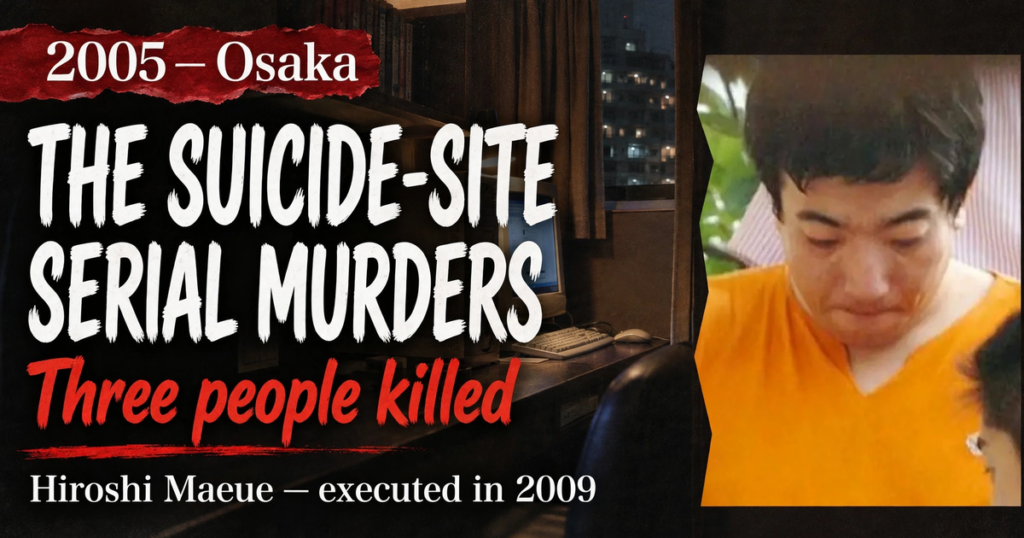
Hiroshi Maegami used online suicide forums to approach people who were considering death, inviting them to meet for a charcoal-burning suicide. Between February and June 2005, he killed a 25-year-old woman, a 14-year-old boy and a 21-year-old man. His death sentence became final after he withdrew his appeal and was carried out in 2009.
An online invitation concealed a different purpose
In 2005, people considering suicide used internet bulletin boards to discuss their feelings and look for others who might share their plans. Hiroshi Maegami contacted people through this environment and proposed that they meet for a charcoal-burning suicide. His stated invitation suggested that he would die alongside them. The Japanese source, however, describes a different purpose: Maegami wanted to watch another person suffer from suffocation. The victims' own suicidal thoughts did not amount to consent to be killed by him. The criminal proceedings treated the three deaths as murders, not as a consensual joint suicide or assistance in suicide.
Three people were killed between February and June 2005
Maegami killed three people over a period of approximately four months. The victims were a 25-year-old woman, a 14-year-old male junior-high-school student and a 21-year-old male university student. The first killing occurred in February in Toyonaka, Osaka Prefecture. In May, he contacted and killed the 14-year-old boy in Kobe. In June, he killed the 21-year-old university student in Higashiosaka, Osaka Prefecture. The offences were separate encounters with different victims, not a single attack against three people at one location. The shared method of approach was the use of internet suicide-related spaces to identify people who might accept an invitation to meet.
The first victim was a 25-year-old woman from Toyonaka
The first known victim was a 25-year-old woman whom Maegami approached in February 2005. He invited her to meet on the premise that they would die together by charcoal-burning suicide. After arranging the meeting, he suffocated her by obstructing her mouth and nose, including while they were in a vehicle. The victim's vulnerability and her stated wish to die were exploited to create a situation in which she would meet him. That background does not change the legal nature of the killing. The court treated her death as a homicide committed by Maegami, who had concealed his actual purpose when making contact.
A 14-year-old boy was approached in Kobe in May
In May 2005, Maegami contacted a 14-year-old male junior-high-school student in Kobe. He again used the language of a shared suicide to persuade the boy to meet him. Because the victim was a minor, the prosecution included the offence of kidnapping a minor as well as murder. The case therefore involved not only the killing itself but also the way Maegami induced a child to leave the protection of his ordinary environment. The source describes repeated contacts with people found through internet suicide-related forums, not one single recruitment or meeting.
The third victim was a 21-year-old university student
In June 2005, Maegami approached a 21-year-old male university student in Higashiosaka. The same general pattern was used: he found someone who was considering suicide online and arranged an in-person meeting by proposing that they die together. The student's death became the third killing in the series. The exact circumstances and the handling of each body differed from one incident to another, so the three offences should not be described as identical in every detail. What connected them was Maegami's repeated exploitation of people seeking a way to die and his use of suffocation to kill them.
The court rejected the idea that Maegami was helping the victims die
The central issue was not whether the victims had expressed suicidal thoughts; it was whether Maegami had acted to help them carry out their own wishes or had used those wishes as a means to kill them. The prosecution argued that he planned the offences to obtain sexual gratification from watching people suffocate and struggle. The Osaka District Court accepted the essential structure of that case. It found that Maegami had used the victims' suicidal intentions to bring them to him and then killed them to satisfy his own desires. Their willingness to meet for a purported joint suicide did not authorize him to take their lives.
The defence challenged his criminal responsibility
The defence argued that Maegami's unusual sexual interests and mental condition had seriously affected his ability to control his behaviour. It suggested that even if he understood the nature of his conduct, he might not have been able to restrain himself. The court considered his preparations before the killings, his efforts to avoid detection and his attempts to conceal evidence after each offence. Those actions indicated that he understood the nature of what he was doing and could organize his conduct around the goal of avoiding arrest. The court found that he retained full criminal responsibility. A psychiatric explanation or unusual preference did not automatically remove legal responsibility.
His disclosure of previously unknown offences was considered
The three murders did not all become known to investigators at the same time. After his arrest, Maegami spoke about offences that police had not previously identified, and those statements led to the discovery of additional victims. The defence argued that this cooperation, together with expressions of remorse, should weigh against a death sentence. The district court treated the disclosures as favourable considerations. It nevertheless found that they could not outweigh the seriousness of deliberately killing three people over a short period, including a child, after approaching them under false pretences.
The Osaka District Court imposed the death penalty in March 2007
On 28 March 2007, the Osaka District Court sentenced Maegami to death. The court considered the three murders, the use of online contact to lure the victims, the repeated suffocation and the self-serving motive. It also assessed the defence arguments concerning his mental condition and his disclosures to police. The sentence was imposed at first instance. It is important not to describe it as a Supreme Court sentence: the subsequent procedural history did not include an appellate merits judgment upholding the death penalty.
The sentence became final after Maegami withdrew his appeal
Maegami's defence counsel filed an appeal after the district court imposed the death sentence. Maegami himself, however, accepted the sentence and withdrew the appeal on 5 July 2007. The death sentence therefore became final because of the defendant's withdrawal. It was not affirmed by the Osaka High Court or the Supreme Court after a full appellate review. The first-instance judgment remained the operative sentence because the appeal was withdrawn, not because a higher court issued a merits decision.
The execution took place on 28 July 2009
Maegami was executed at Osaka Detention House on 28 July 2009, aged 40. The sequence was: three murders between February and June 2005; a death sentence from the Osaka District Court on 28 March 2007; finality after the defendant withdrew his appeal on 5 July 2007; and execution on 28 July 2009. He is not a person whose death sentence remains awaiting execution. The case remains significant because an online offer framed as a shared suicide concealed a series of intentional killings, and because the victims' own suicidal thoughts were exploited rather than respected.
Original Japanese record: 自殺サイト連続殺人事件|前上博が3人を誘い出した殺害と控訴取下げ・死刑執行
Last updated:
Related articles
Case record
The Zama Nine Murders: Why the Court Rejected Claims of Consent

Case record
The Ookayama–Senju Serial Murders: A Confession-Led Indictment, Then Two Other Men
Case record
The Osaka Sisters Murder: A Planned Robbery, Two Deaths and a Death Sentence Final by Appeal Withdrawal

Case record