
The Ogori Family Murders
A mother and her two young children were found dead at their home in Ogori, Fukuoka Prefecture, on 6 June 2017. Her husband, a serving police sergeant at the time, denied the killings throughout the proceedings but was convicted of all three murders on circumstantial evidence, and his death sentence became final in December 2023.
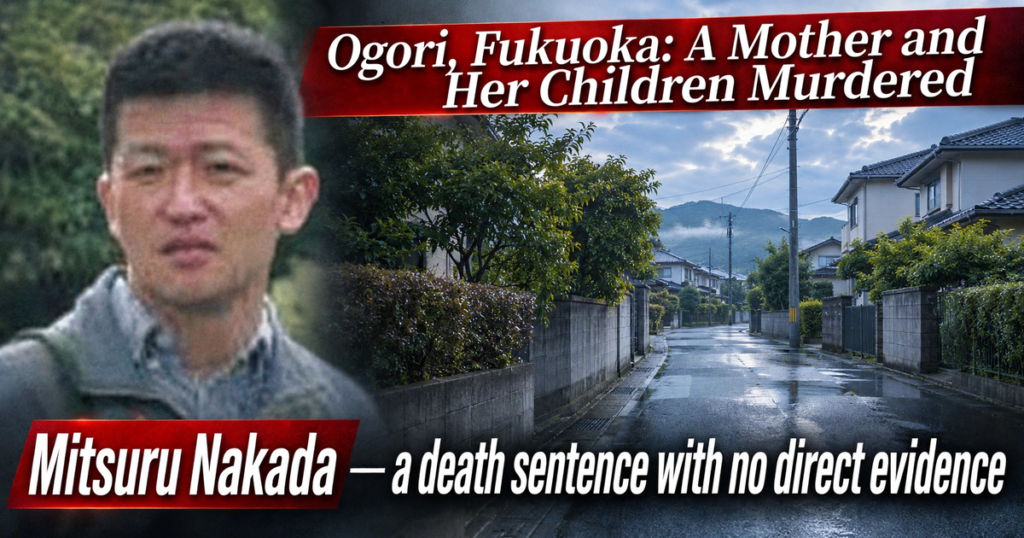
Three members of a family were found dead on 6 June 2017
On the morning of 6 June 2017, a mother and her two school-age children were found dead inside their home in Ogori City, Fukuoka Prefecture. The victims were Yukiko Nakata, aged 38, her son Ryosuke, aged 9, and her daughter Miyu, aged 6. Their husband and father, Mitsuru Nakata, was then a sergeant in the Fukuoka Prefectural Police. He was later prosecuted for all three killings and denied responsibility from his arrest through the trial and appeals.
The children failed to arrive at school
The case came to light after the children did not attend school. Yukiko was found on the first floor, while Ryosuke and Miyu were found in a bedroom on the second floor. Post-mortem examinations indicated that all three had died from asphyxia caused by pressure to the neck. Investigators initially considered whether the mother might have killed the children and then died herself, but the inquiry developed into a homicide investigation directed at the husband.
Nakata was arrested first in connection with his wife's death
On 8 June 2017, police arrested Mitsuru Nakata on suspicion of murdering Yukiko. The investigation later expanded to the deaths of the two children, and he was rearrested in February 2018 in connection with those killings before being additionally charged. He was dismissed from the police force in June 2017. The sequence matters because the first arrest and the later prosecution for the children were separate procedural steps, even though the final trial dealt with all three deaths.
There was no recording or eyewitness of the killings
The prosecution did not present a video showing the killings or a witness who had watched them happen. The case depended on the relationship among several pieces of circumstantial evidence: the estimated times of death, who could enter the house, the condition of doors and windows, forensic findings, injuries on Nakata's arm, smartphone records and his conduct after the deaths. The central question was whether the combined evidence left a reasonable possibility that an outsider or Yukiko had committed the killings.
Forensic findings included DNA and injuries on Nakata's arm
The Japanese article describes a mixed DNA profile consistent with Yukiko and Nakata in material recovered from beneath Yukiko's fingernails. It also records injuries on Nakata's left arm that were considered consistent with scratches or pressure from fingernails around the relevant period. These findings were evaluated with other evidence, not in isolation. A mixed DNA result does not independently prove the sequence of a struggle, and an injury does not identify its cause without considering timing and surrounding circumstances.
The courts examined whether an outsider could have entered the home
The defence suggested that an unknown third party might have entered and killed the family. The judgments discussed the absence of forced-entry marks on doors and windows, the lack of a clear route of entry through an upstairs window, and the fingerprints and palm prints identified inside the home. The court also considered that money and valuables remained and that the evidence did not indicate a sexual assault. These circumstances were used to assess the outsider theory; no single observation alone established the identity of the killer.
Nakata maintained his innocence and challenged the circumstantial case
Nakata consistently denied killing his wife and children. His position required the courts to decide whether the prosecution had proved guilt without a confession. The defence challenged the inferences drawn from the forensic evidence, the estimated times of death and the movements recorded by digital devices. The fact that the defendant had been a police officer was part of the context, but his former professional status was not a substitute for proof. The prosecution still had to establish each murder beyond reasonable doubt.
The Fukuoka District Court imposed death in December 2019
On 13 December 2019, the Fukuoka District Court found Nakata guilty of murdering all three family members and sentenced him to death. The court accepted that the evidence, considered as a whole, excluded a reasonable alternative explanation. The judgment was not based on a confession, because Nakata had denied the offences. It was a first-instance decision, and the defence appealed. The number of victims and the individual findings for each death remained central to the later appellate review. The district court did not find that the three killings had been planned in advance. It nevertheless considered that Nakata had repeatedly applied pressure to the necks of three victims, with opportunities to stop between the acts, and that the children had no circumstances that could mitigate the killings. His approximately fifteen years of police service and lack of prior criminal convictions were considered, but did not outweigh the seriousness of the offences.
The High Court and Supreme Court upheld the conviction
On 15 September 2021, the Fukuoka High Court dismissed the appeal and maintained the death sentence. On 8 December 2023, the Supreme Court dismissed Nakata's further appeal. The death sentence therefore became final in December 2023. These are separate procedural stages: the district court made the first conviction, the High Court reviewed the appeal, and the Supreme Court considered the further appeal. The article reported no announcement of an execution as of its stated 2026 update.
The case illustrates how circumstantial evidence is assessed
A circumstantial case is not automatically weaker or stronger than a case with an eyewitness. The court must consider whether the proven facts, taken together, establish guilt beyond reasonable doubt and whether a realistic alternative explanation remains. In this case, the courts assessed forensic findings, the condition of the home, access, timing and post-event conduct as a whole. The English account should neither imply that an eyewitness existed nor present the defence's alternative theory as a fact. The final legal outcome is a conviction for three murders and a final death sentence.
Original Japanese record: 福岡・小郡市母子殺害事件|直接証拠なしで中田充を有罪とした間接事実と死刑判決
Last updated:
Related articles
Case record
The Kitakyushu Confinement Murders: Seven Deaths Without Recovered Bodies and the Separate Sentences for Futoshi Matsunaga and Junko Ogata

Case record
The Fukuoka Family of Four Murders: Three Defendants Tried in Japan and China, and the Evidence Behind Wei Wei's Death Sentence
Case record
The Neyagawa Junior-High-School Double Murder: Two Victims and the Procedural Dispute That Made a Death Sentence Final

Case record