
The Kawasaki Serial Stabbing Attacks
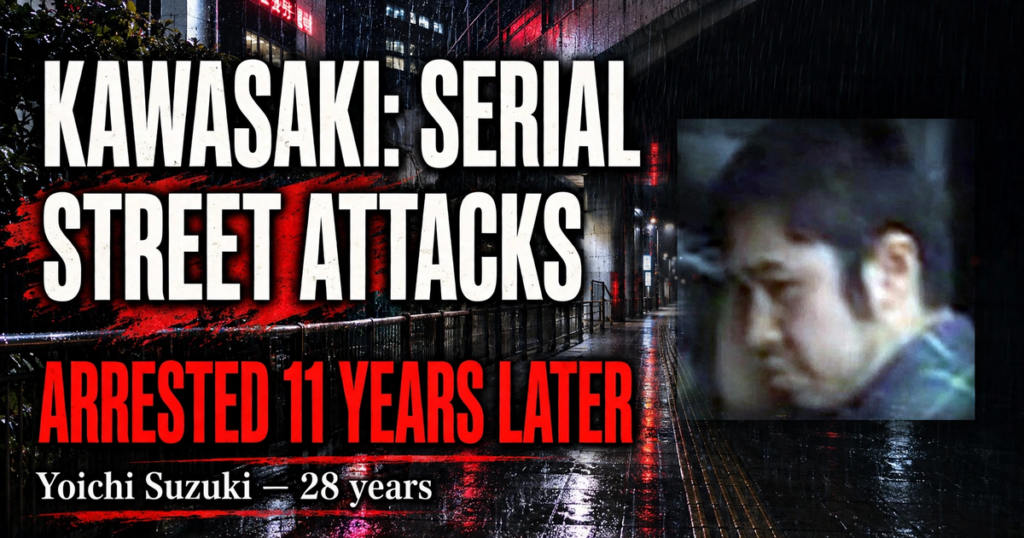
Yuri Kuronuma, aged 27, was killed in a tunnel in Kawasaki in September 2006. Six months later, another woman was seriously injured in a separate stabbing. The offender in the second attack initially presented himself as a witness. While serving a sentence for that attempted murder, Yoichi Suzuki contacted police about the earlier killing. The subsequent investigation relied on his account checked against preserved evidence from the original scene.
A woman was attacked while walking home through a tunnel
At about midnight on 23 September 2006, Yuri Kuronuma, aged 27, was stabbed in a tunnel in the Kajigaya area of Miyamae Ward, Kawasaki City. She was returning home after work. Contemporary accounts described her as studying confectionery while working part-time and hoping eventually to run a shop where she could serve cakes. She suffered stab wounds to the chest and abdomen and died after being taken to hospital. Investigators found no apparent sign of robbery and no known relationship between Kuronuma and the attacker. The incident was treated as a random street attack, and the investigation initially produced no identified suspect.
The investigation continued without an arrest
Police examined the surrounding area, interviewed people who might have been nearby and checked information about vehicles and suspicious movements. Ten years after the killing, in September 2016, the investigation headquarters remained in place. Kanagawa Prefectural Police had assigned approximately 22,000 investigators over the course of the inquiry, according to the Japanese article's account of contemporaneous reporting. Officers continued seeking information from the public. The long period without an arrest did not mean that the investigation had been formally abandoned. Photographs, records of the injuries and information about the scene remained available for later comparison if a new lead emerged.
A second woman was stabbed in the same ward six months later
At about 10:25 p.m. on 5 April 2007, a 40-year-old female office worker was attacked from behind on a street in Nogawa, also in Miyamae Ward. She was stabbed in the back and other parts of her body and seriously injured, but survived. After the attack, Yoichi Suzuki appeared at a police station with a cut on his left hand. He claimed that he had seen a man carrying a knife and had been injured while trying to help the woman. Police compared his explanation with the circumstances of the attack and arrested him on 20 April 2007 on suspicion of attempted murder.
The attempted-murder conviction was separate from Kuronuma's case
Suzuki denied that he had stabbed the 40-year-old woman. The Yokohama District Court's Kawasaki Branch nevertheless found him guilty on 14 July 2008 and sentenced him to ten years' imprisonment, relying on the woman's account and the circumstances at the scene. Both the prosecution and the defence appealed: the prosecution argued that the sentence was too lenient, while Suzuki sought acquittal. The Tokyo High Court dismissed both appeals on 13 April 2009. The Supreme Court's First Petty Bench dismissed the defence appeal on 12 August 2009, and the ten-year sentence became final. This attempted-murder case did not at that point resolve Kuronuma's separate killing.
A letter from prison reopened the earlier investigation
In January 2016, while serving the sentence for the attempted murder, Suzuki sent a postcard to Miyamae Police Station indicating that he wanted to speak about Kuronuma's death. Investigators travelled to the prison and began questioning him. Suzuki then made statements that he had killed Kuronuma. A confession made many years after an offence cannot simply be accepted without examination. Investigators compared the details he provided with information recorded at the time of the original investigation, including the location and nature of the wounds and facts that had not been publicly disclosed. His account changed in some respects, making its reliability an important issue for the later trial.
Preserved records helped test the confession
The weapon had not been recovered, and Kuronuma could no longer give evidence. The prosecution therefore needed more than a late statement by a person already convicted of another violent offence. Investigators examined whether Suzuki's account was consistent with the photographs, injury records and scene information preserved from 2006. The Japanese article emphasizes that the confession was the starting point for renewed investigation, not the only basis for prosecution. The case illustrates why old investigative materials can matter years later: records created before a suspect was identified may allow investigators to test a new account against facts that were documented independently at the time.
Suzuki was re-arrested and tried for the 2006 murder
Suzuki was re-arrested on 10 October 2017 in connection with Kuronuma's murder. The murder prosecution was separate from the already final attempted-murder conviction for the 2007 attack. At the lay-judge trial that began in November 2019, Suzuki largely admitted the charged facts relating to Kuronuma's killing. The prosecution argued that he had sought a woman whose suffering he wanted to observe and had attacked Kuronuma with a strong intent to kill. The defence did not simply deny the stabbing; it also argued that planning, the influence of his sexual interests and his own disclosure to police should be considered when deciding the appropriate sentence.
The court imposed 28 years, taking account of the disclosure
On 13 December 2019, the Yokohama District Court sentenced Suzuki to 28 years' imprisonment. The prosecution had sought life imprisonment. The court strongly condemned the attack on a woman who was unknown to the defendant and the use of a knife against parts of the body where an injury could be fatal. At the same time, it considered that Suzuki had himself brought information about a serious unresolved murder to police, helping to move the investigation forward. The court treated that disclosure as a factor relevant to rehabilitation and sentencing, but not as a legal acquittal or as proof that the killing was less serious.
The Tokyo High Court dismissed the appeal in 2020
The Tokyo High Court dismissed Suzuki's appeal on 16 October 2020 and maintained the 28-year sentence. The appellate proceedings considered the arguments about sentence and whether Suzuki's conduct amounted to voluntary surrender under Japanese criminal law. The court did not accept that the statutory requirements for voluntary surrender were met, although the first-instance court had already considered his disclosure as part of the sentencing circumstances. The Japanese article reviewed for this translation records the district-court judgment and the high-court appeal dismissal. It does not provide a verified later Supreme Court disposition, so this record does not label the 28-year sentence as finally affirmed by the Supreme Court.
Original Japanese record: 川崎連続通り魔事件|黒沼由理さん殺害、11年後の逮捕と懲役28年
Last updated:
Related articles

Case record
The Sendai Arcade Truck Attack: Three Dead, Four Injured and a 28-Year Sentence Replaced by Life
Case record
The Kashiwa Serial Street Attacks
Case record
The Ikebukuro Street Attack: Two Women Killed, Six Injured and the Death Sentence for Hiroshi Zoda
Case record