
The Yoyogi 1-chome Bookstore Office Robbery-Murder
A bookstore employee was found unconscious after a violent attack in a Yoyogi office on 10 December 2007 and died thirteen days later. A hand-held safe containing sales money was missing. Police continue to seek a man seen wearing a pale-green balaclava-like covering and a grey jacket. The offender has not been identified.
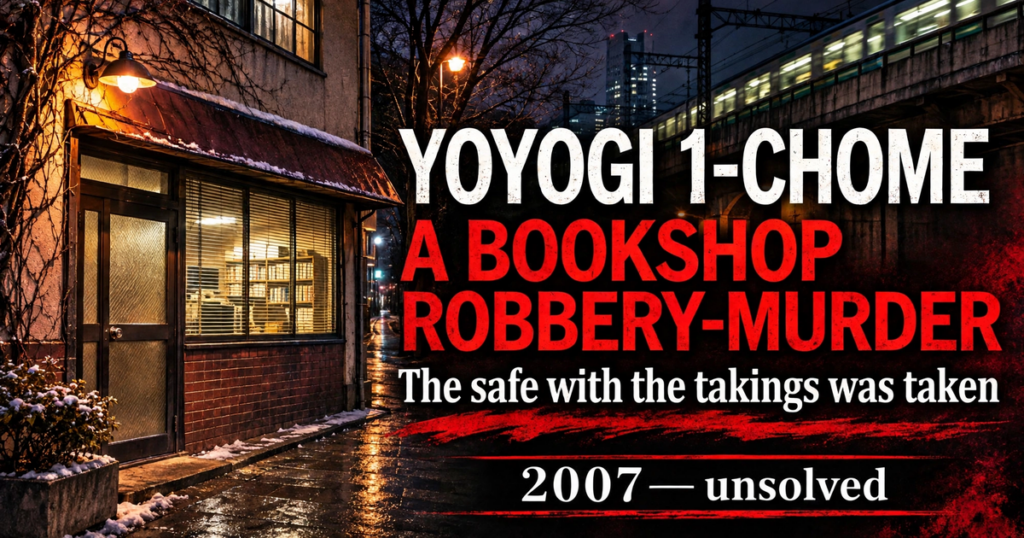
A bookstore employee was found gravely injured in the office
At about 9 p.m. on 10 December 2007, a male employee was found collapsed inside a bookstore office at 1-37-5 Yoyogi, Shibuya Ward, Tokyo. He had been struck on the head with an object described as resembling a blunt weapon and was unconscious in critical condition. A hand-held safe containing the store's sales money was missing. The Metropolitan Police Department investigated the incident as a robbery. The employee did not die at the scene; he remained in a serious condition and died thirteen days later, on 23 December. The investigation was then treated as a robbery-murder.
The victim's name and age come from contemporary press reports
The current Metropolitan Police Department page identifies the victim simply as a man. Contemporary newspaper reports identified him as a bookstore employee named Isoshima (磯島護), aged 51 at the time. The translation retains that attribution to the press rather than presenting the name as information published on the current police page. The distinction matters because the official appeal has continued to use a limited description of the victim while asking the public to provide information about the offender. The public police page does not supply a full personal biography or family details.
The missing safe contained sales money from the bookstore
Reports at the time described the business as Kinkodo Bookstore. After closing, the employee was responsible for carrying a hand-held safe containing the day's sales from the shop to the office. The safe disappeared during the attack. Newspapers reported that it contained approximately 98,000 yen. The exact amount is based on press coverage, not a figure published in the current police notice. Investigators examined whether the offender knew when the sales money would be moved, but the public record does not establish how the person learned the store's routine or whether the amount was known in advance.
The victim survived for thirteen days before dying in hospital
The difference between the time of the attack and the date of death is important to the chronology. The employee was found gravely injured on 10 December and was taken for medical treatment. Reports said he never regained consciousness and died on 23 December. The case therefore began as a serious assault during a robbery and became a homicide investigation after the victim died. The thirteen-day interval should not be collapsed into a statement that he died at the scene. The current public appeal treats the case as a robbery-murder and seeks information about what happened at the office that evening.
A witness described a man in a pale-green head covering and grey jacket
The clearest public description of a possible offender concerns clothing. The Metropolitan Police Department says a man was seen wearing something resembling a pale-green balaclava or face covering and a grey jacket. The current official page does not publish the man's name, face or exact age. Some earlier reporting included additional physical details, but the current police appeal focuses on the head covering and jacket. The description is based on witness information and does not amount to an identification of a known person. Police ask anyone who remembers such a man near the office to come forward.
A loud noise reportedly led the bookstore's owner to discover the attack
Newspaper reports said the bookstore's owner heard a loud noise inside the building and went toward the office, where he found the employee collapsed. The office did not appear to have been extensively ransacked. Investigators considered the possibility that the offender had waited inside the office before attacking the employee. The exact time at which the offender entered, how long he remained there and whether he knew the employee's schedule have not been established publicly. The missing safe and the timing of the sales transfer were important investigative features, but they do not prove that the offender was an employee or business insider.
The same office had reportedly been targeted in a burglary about a month earlier
Contemporary reports said that the office had suffered a separate break-in about one month before the fatal attack. On that earlier occasion, a fixed safe was reportedly targeted after a window was broken, but the safe was not opened. The earlier incident and the December robbery-murder have not been conclusively linked. No public statement establishes a match between fingerprints, DNA or other evidence from the two incidents, and no defendant has admitted involvement in both. The earlier burglary is relevant background, but it must not be described as a proven part of the same offender's plan.
The earlier fixed safe and the later hand-held safe were different
The reported earlier break-in involved a fixed safe, whereas the safe missing on 10 December was a hand-held safe that the employee was carrying after closing. The difference has led to questions about whether the offender had observed the bookstore's routine or knew when the sales money was moved. Police have not confirmed that the offender had inside information. A person watching the premises from outside could potentially learn the pattern, but that is only one possible explanation. The public record does not establish a relationship between the victim and the offender or the precise reason the employee was attacked.
The investigation remains open and the limitation period was abolished
The Metropolitan Police Department continues to list the Yoyogi bookstore office robbery-murder among its public investigations. The Harajuku Police Station's special investigation headquarters accepts information about suspicious people or vehicles, noises or arguments, and anyone seen with blood on their clothing. No arrest or indictment has been publicly announced. The 2007 crime was still well within the former limitation period when Japan abolished the limitation period for death-eligible offences in 2010. The passage of time therefore does not, by itself, prevent prosecution if evidence identifies the offender. The police continue to seek information that can be checked against their investigation records.
Original Japanese record: 代々木一丁目書店事務所内強盗殺人事件|売上金入り金庫を奪った男を追う未解決捜査
Last updated:
Related articles
Case record
The Murder of Diet Member Koki Ishii: A Political Career, a Fatal Attack and an Unresolved Motive
Case record
The Attacks on Former Health Ministry Officials' Residences

Case record
The Setagaya Family Murders: Why a Wealth of Evidence Has Yet to Identify the Killer
Case record