
The Ebetsu University Student Group Assault Death
University student Tomoya Hase, 20, died after a group assault and robbery in Ebetsu, Hokkaido, on 25–26 October 2024. Six people were indicted. Three sentences became final, two defendants appealed and have appeal hearings scheduled for January and March 2027, while the trial of Ama Yagihara has not begun.
A relationship dispute brought six people to a park
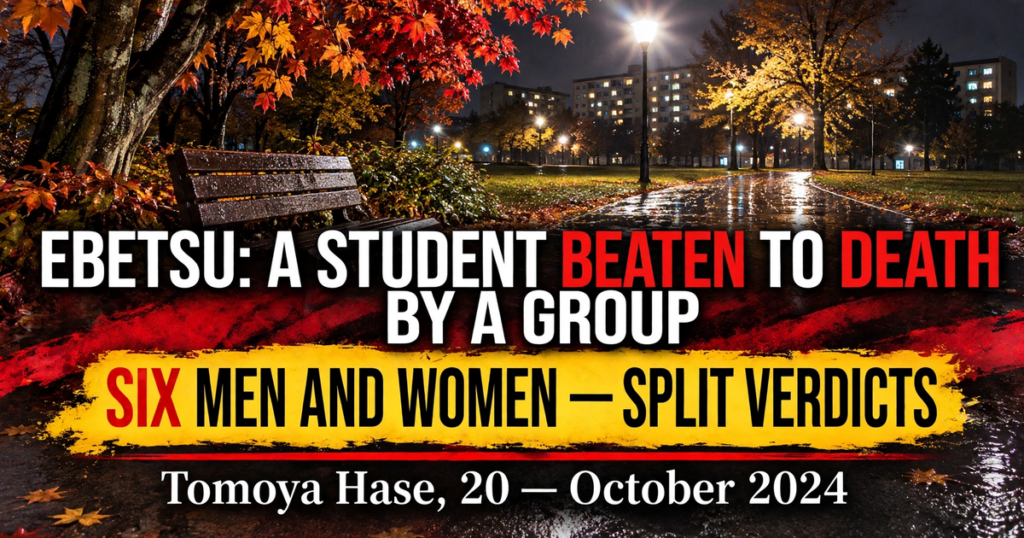
On the night of 25 October 2024 and into the early hours of the next day, university student Tomoya Hase, aged 20, was assaulted in a park in Bunkyodai Minamimachi, Ebetsu, Hokkaido. Hase was dating Ama Yagihara. Messages and a disagreement about their relationship, including a possible separation, preceded the gathering. Yagihara contacted Hanon Kawamura, who went to the park with Kaiyu Takizawa and others. Yuto Kawaguchi and two boys who were then 16 and 17 also became involved. The six surrounded Hase, and their roles were later examined separately in court.
The group demanded money and financial cards
At the park, Hase was ordered to hand over cash, bank cards and other valuables. A recording from his smartphone was played in court, including voices demanding that he surrender everything. The case was prosecuted as robbery resulting in death. That offence does not require proof that the group initially planned to kill the victim. It concerns a death caused by violence or threats committed in the course of a robbery. The defendants were also charged with offences connected to the subsequent use of Hase's cards. The precise acts and degree of participation were assessed individually.
The assault continued for about two hours
The prosecution described an assault lasting approximately two hours, involving repeated punches and kicks by multiple people. Hase was reportedly stripped, and a cigarette was pressed against his body. The autopsy attributed his death to traumatic shock following extensive injuries and blood loss. The court treated the duration, the number of assailants and the one-sided nature of the violence as serious aggravating circumstances. The case was not treated as a single blow or a short confrontation. The evidence showed a prolonged attack in which the victim was surrounded and repeatedly assaulted.
Audio and video recordings helped establish individual conduct
At the 2026 trials, prosecutors played audio recorded on Hase's smartphone and video footage made by people involved in the attack. The recordings captured voices during the assault and the conduct of some defendants, including laughter. Digital evidence helped establish the sequence of events, the length of the violence and the actions and words of individuals at the scene. It was relevant not only to proving that the defendants had been present, but also to assessing how each person participated. The existence of recordings did not make every defendant's role identical.
The stolen cards were used after Hase had died
The six defendants were accused of taking cash and cards from Hase and then using the cards to purchase cigarettes and other goods. Those transactions formed part of the fraud-related charges. Payment records and shop security footage provided objective material for tracing who possessed and used the cards. The use of the stolen cards connected the violence at the park with the defendants' conduct afterwards. It also showed that the robbery allegations were not limited to a demand made during the assault; the prosecution relied on later transactions to establish what happened to the property taken from Hase.
The victim was found dead on the morning of 26 October
Hase was found collapsed in the park on the morning of 26 October, and his death was confirmed. He had numerous injuries and personal property was missing. Hokkaido Prefectural Police examined communications, messages, surveillance footage, vehicle movements and card-use records. Those lines of inquiry led investigators to the six people who had been with him shortly before his death. The two boys who were 16 and 17 at the time of the offence were prosecuted under the juvenile-law framework applicable to their ages. The proceedings later became divided into separate trials.
Kawamura, Takizawa and a 16-year-old received sentences in June
The trial of Kawamura, Takizawa and the boy who had been 16 began at Sapporo District Court on 25 May 2026. All three admitted the charges, leaving sentence as the main issue. Prosecutors argued that Kawamura had conveyed the relationship dispute and helped create the momentum for the assault and demands for money. The defence argued that the defendants had different roles and that Kawaguchi had exercised greater influence. On 25 June, the court sentenced Kawamura to thirty years, Takizawa to twenty years and the 16-year-old to an indeterminate term of nine to thirteen years.
Takizawa and the 16-year-old's sentences became final
Neither the prosecution nor the defence appealed the sentences imposed on Takizawa and the 16-year-old. Their terms became final by 10 July 2026. Kawamura's thirty-year sentence was different: prosecutors had sought life imprisonment, while the defence argued that a thirteen-year term was appropriate. Both sides appealed, so her sentence remained under review by the Sapporo High Court. The distinction is important because a first-instance sentence is not automatically final when an appeal has been filed. The three defendants in the first trial therefore left the district court with different procedural outcomes.
Kawaguchi received life imprisonment and the 17-year-old received thirty years
The trial of Kawaguchi and the boy who had been 17 began on 13 July 2026. Both admitted the charges. On 7 August, Sapporo District Court sentenced Kawaguchi to life imprisonment, finding that he had taken a central role and directed other participants through the assault and demands for money. The same day, the court sentenced the 17-year-old to thirty years. He did not appeal, and his sentence became final on 24 August. Kawaguchi filed an appeal on 10 August. His life sentence was therefore not final at the time of the latest update.
Two appeals are scheduled and Yagihara's trial remains outstanding
As of 21 November 2026, three of the six defendants had final sentences: Takizawa, the 16-year-old and the 17-year-old. Kawamura and Kawaguchi remained on appeal. A report on 19 November stated that Kawamura's appeal hearing was scheduled for 26 January 2027 and Kawaguchi's for 16 March 2027. Yagihara, Hase's girlfriend and one of the six indicted defendants, had not yet begun trial, and no first-hearing date had been announced. The six were prosecuted in separate groups, so the criminal proceedings arising from one death remained at several different stages.
Original Japanese record: 江別大学生集団暴行死事件|長谷知哉さん死亡、6人の役割と分かれた判決
Last updated:
Related articles
Case record
The Kaminokawa Robbery-Murder

Case record
The Kofu Murder and Arson Case: The First Death Sentence Under Japan's Specified-Juvenile Framework
Case record
The Asahikawa High School Student Murder
Case record