The Asahikawa Junior High School Bullying Case: A Death, Two Investigations and a 2026 Settlement
A 14-year-old student died in Asahikawa in 2021 after a prolonged pattern of bullying. A 2024 re-investigation identified seven bullying incidents and found a strong causal connection. In March 2026, the family and Asahikawa City settled a civil lawsuit for 70 million yen.
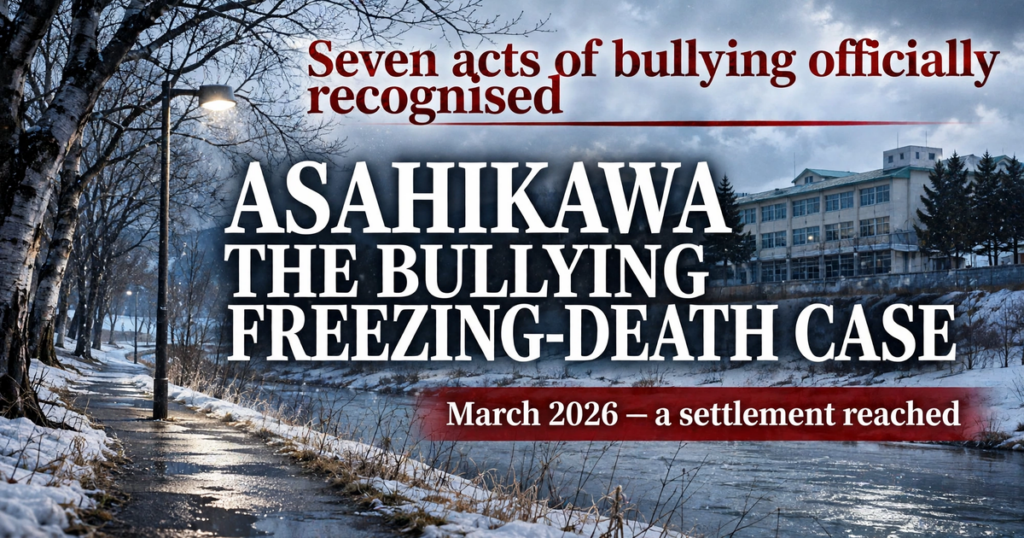
A 14-year-old student died after a period of bullying and isolation
The student at the centre of the Asahikawa case was 14. She entered junior high school in April 2019. Investigations later described a pattern of treatment that began with teasing and imitation in the classroom and developed into isolation and harmful interactions outside school. The student was also exposed to sexualized bullying by older students, including demands for sexual images and videos. These events must be described with restraint. The case is not simply a story about a single incident between children; the later investigation considered how school and off-campus experiences accumulated and affected the student's mental health over time.
She went missing in February 2021 and was found dead the following month
On 13 February 2021, the student left home and did not return. A search continued for more than a month. On 23 March, her body was found in a park in Asahikawa. The recorded cause of death was hypothermia. Her disappearance and death led to questions about what the school and the city education board had known about the bullying, what action had been taken and whether the matter should have been treated as a serious incident under Japan's Act for the Promotion of Measures to Prevent Bullying. The student's name is given in Japanese public records, but this English account does not assign an unverified romanization.
The first third-party investigation recognized six bullying incidents
The first third-party committee was commissioned in June 2021 and delivered its report in September 2022. It identified six acts as bullying, including conduct with sexual elements. It also examined the school's and education board's response. However, the first report did not reach a clear conclusion about the causal relationship between the bullying and the student's death. The family considered the findings and the investigation process insufficient and called for a further examination. The distinction between the first report and the later re-investigation is important: the initial committee's six recognized incidents were not the final number in the subsequent report.
A re-investigation identified seven incidents and examined the cumulative harm
Asahikawa City established a re-investigation committee in December 2022. The five-member panel reviewed the earlier materials, conducted additional interviews and examined medical and psychological information. It delivered its report on 1 September 2024. The re-investigation identified seven bullying incidents, adding conduct inside the classroom that had not been adequately recognized in the first investigation. The panel also considered the student's post-traumatic stress symptoms and the continuing psychological effects of the treatment she had experienced. Rather than treating each act as a separate episode that had ended, it examined the sequence and cumulative impact.
The re-investigation found a strong causal connection with the death
The 2024 report concluded that there was a high probability that the bullying was the primary cause of the student's suicide. The committee considered the connection between the bullying, the student's psychological condition and the deterioration in her daily life. It also criticized the way school staff and the education board had approached the situation. The school had focused too much on the student's own behaviour and had not sufficiently recognized her as a child experiencing serious harm. The education board did not provide the necessary expert guidance and coordinated support. These were findings of an administrative re-investigation, not criminal convictions of individual students.
The family sued Asahikawa City in February 2025
In February 2025, the family filed a civil damages lawsuit against Asahikawa City, alleging that the school and education board had failed to respond appropriately. The city accepted that the off-campus bullying should have been recognized as a serious incident, but disputed parts of the family's case, including what the school had known about classroom conduct and whether the death could have been foreseen after a period of time. The lawsuit was therefore not a simple admission of every allegation. The court considered the investigation reports, school records and the positions of both sides before proposing a settlement.
The parties settled for 70 million yen on 26 March 2026
The Asahikawa mayor announced on 26 March 2026 that the family and the city had reached a settlement. The agreed compensation total was 70 million yen. A 30-million-yen death benefit already paid by the Japan Sport Council was credited toward that amount, leaving the city to pay 40 million yen. The city stated that it would pay 20 million yen from a school-accident insurance arrangement and 20 million yen from general funds. The settlement followed a court recommendation and approval by the city assembly. It resolved the civil lawsuit without a final judgment deciding every disputed issue of negligence and causation. The terms should not be presented as a criminal verdict or as a court judgment against particular students.
The case remains a warning about institutional response to bullying
The first investigation offered 20 recommendations, and the re-investigation added 29, for a total of 49 proposed measures. The city described work to improve early detection, information-sharing, access to psychological and welfare professionals, and support for students who stop attending school. The central issue is not only whether a particular act can be classified as bullying. It is whether adults recognize a pattern of harm, treat a potentially serious situation as a serious incident, and coordinate support before the consequences become irreversible. The family's settlement in 2026 brought the civil claim to an end, but it did not erase the student's suffering or turn every disputed question into a judicial finding.
Original Japanese record: 旭川女子中学生いじめ凍死事案|廣瀬爽彩さん死亡、再調査が認定した7件のいじめと2026年和解
Last updated: