
The Shinjuku Tower-Mansion Stabbing
On 8 May 2024, 25-year-old Toshino Hirasawa was fatally stabbed outside a tower-mansion complex in Nishi-Shinjuku. The defendant, Manabu Wakui, had previously been arrested over stalking conduct and made subject to a no-contact order. His 15-year sentence was upheld on appeal in December 2025; further appeal and finality remain unconfirmed.
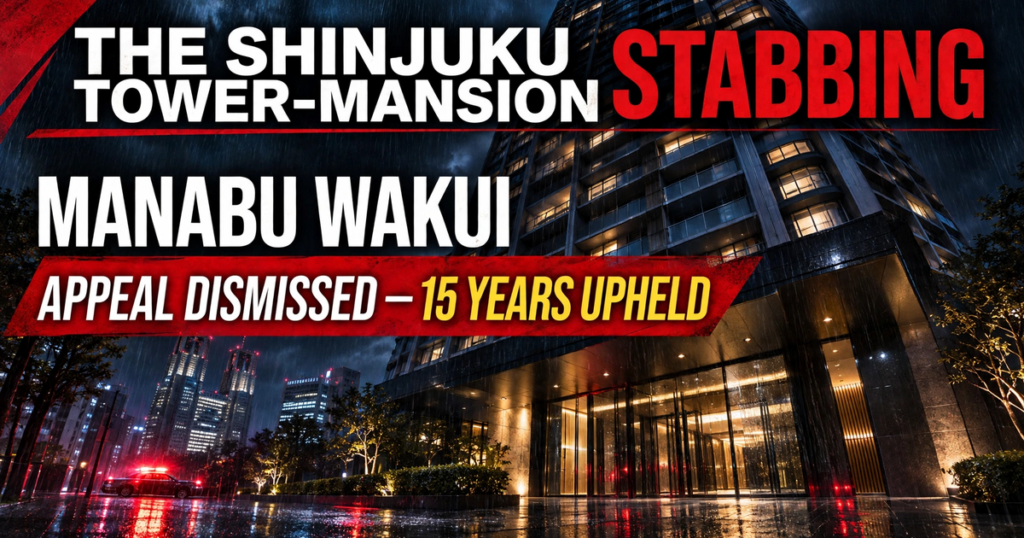
A woman was stabbed outside a tower-mansion complex
Shortly after 3 a.m. on 8 May 2024, Toshino Hirasawa, aged 25, was repeatedly stabbed in the grounds of a tower-mansion complex in Nishi-Shinjuku, Tokyo. She suffered wounds to her chest and abdomen. She was taken to hospital, where she died from blood loss. Manabu Wakui, aged 51 at the time, was secured at the scene and arrested on suspicion of attempted murder in the act. He was later indicted for murder and a violation of the Firearms and Swords Control Act. Two fruit knives were identified as the weapons he had carried.
Wakui had been a customer at the club where Hirasawa worked
Wakui and Hirasawa had come into contact through the nightlife business. Hirasawa worked at a cabaret club, and Wakui was a customer. Their relationship deteriorated amid a serious disagreement about money and Wakui's expectations of a personal relationship. Wakui said that he had given Hirasawa a large amount of money and wanted it returned. The prosecution accepted that substantial sums had been transferred but disputed the amount. Wakui claimed that the total was approximately ¥16 million. The court record, as summarised in the Japanese article, did not establish every detail of the payments as an uncontested fact.
A stalking-related arrest and a no-contact order preceded the killing
The history between the two was not limited to a financial dispute. In 2022, Wakui was arrested over stalking conduct directed at Hirasawa, and police issued an order prohibiting him from approaching her. The Japanese article states that he continued trying to contact her despite the order. This earlier police action is important to the chronology because it shows that concerns about unwanted pursuit had arisen well before the fatal attack. It should not, however, be confused with the later murder indictment: the stalking-related arrest and the 2024 killing were separate stages in the history.
Wakui waited with two fruit knives
On the night before the attack, Wakui waited near the residential complex for Hirasawa to appear. He had two fruit knives with him. The Japanese account says that Hirasawa had declined to meet him, while Wakui believed that a meeting had been arranged. When she came out of the building, he attacked her. He stabbed her at least fifteen times, including in the chest and abdomen. The trial record described him continuing the attack with the second knife after the first could no longer be used. Hirasawa was taken to hospital but died from the injuries.
A livestream became part of the dispute over motive
Before the killing, Hirasawa had mentioned Wakui by name during a livestream and spoken about his stalking conduct. The prosecution argued that Wakui watched the broadcast, became angry and decided to attack her. The defence disputed that the broadcast had a direct causal connection to the killing. This point should remain attributed to the parties' arguments rather than presented as a fact independently established by the court. The broader case concerned a sustained pattern of attachment, the prior stalking-related proceedings, the preparations with two knives and the attack at the residential complex.
The Tokyo District Court imposed fifteen years' imprisonment
The first-instance trial concluded on 14 July 2025 at the Tokyo District Court. Prosecutors sought seventeen years' imprisonment. The defence argued that a prison term of 11 years was appropriate, relying in part on the money Wakui said he had provided and the circumstances surrounding the relationship. The court found that Wakui had repeatedly stabbed Hirasawa with the fruit knives and killed her. It described the offence as planned and pointed to his strong fixation on the victim. The court imposed a fifteen-year prison sentence, two years below the prosecution's request.
Wakui appealed, arguing that the sentence was excessive
Wakui filed an appeal on 28 July 2025. The appellate proceedings focused on his challenge to the sentence rather than a claim that someone else had carried out the stabbing. The Tokyo High Court held a hearing on 26 November 2025, where the defence argued that the first-instance sentence was too severe. The prosecution asked the High Court to dismiss the appeal. No new evidentiary examination was requested, and the hearing concluded on the same day. The appeal therefore concerned whether the fifteen-year term should be changed, not a retrial of the basic identity of the attacker.
The Tokyo High Court upheld the fifteen-year term on 17 December 2025
On 17 December 2025, the Tokyo High Court dismissed Wakui's appeal and maintained the fifteen-year sentence. The court found no basis to overturn the first-instance assessment. The outcome did not itself establish whether Wakui had taken a further appeal to the Supreme Court. The Japanese article's latest update states that the existence of a further appeal and the finality of the sentence had not been confirmed as of November 2026. It would therefore be inaccurate to describe the fifteen-year sentence as definitively final without additional confirmation.
The financial dispute does not lessen the distinction between claim and finding
The amount of money was a prominent feature of the relationship, but the defendant's claim of approximately ¥16 million should not be repeated as an uncontested finding. Wakui said that he wanted repayment; the prosecution accepted that substantial transfers had been made but disputed the amount. The court's central responsibility was to assess the killing, the planning and the defendant's conduct. A customer's payments to a club employee do not create a right to control, pursue or harm that person. The final known appellate outcome is that the Tokyo High Court left the fifteen-year sentence unchanged, with any further appeal still unconfirmed.
Original Japanese record: 新宿タワマン刺殺事件|平澤俊乃さん殺害、和久井学被告の控訴棄却・懲役15年維持
Last updated:
Related articles
Case record
The Koganei Stalking Attack: A Victim's 110 Call, Police Dispatch Failures and the Limits of the Law
Case record
The Mitaka Stalking Murder: A Twenty-Two-Year Sentence, a Retrial on Remand and Digital Abuse
Case record
The Komae Robbery Resulting in Death: Kinuyo Oshio's Killing and the Separate Trials of Local Operatives and Overseas Organisers
Case record