
The Tatsuno Mother-and-Daughter Murders
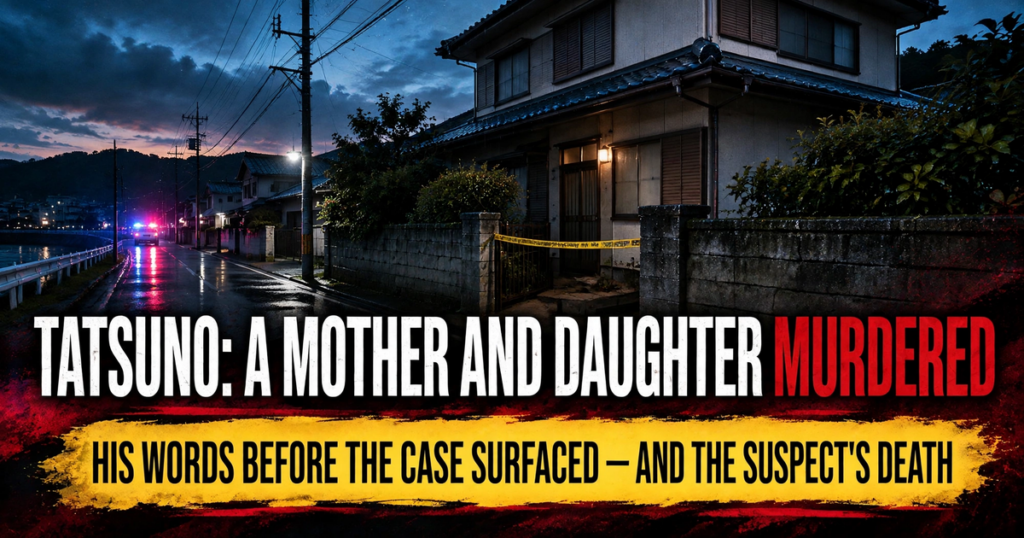
Two women, aged 74 and 52, were found stabbed to death in their home in Tatsuno, Hyogo Prefecture, on 19 May 2026. A former neighbour was referred to prosecutors after being found dead; prosecutors later declined to indict him because he had died, leaving the case without a trial or judicial determination of guilt.
A remark to police three days before the bodies were discovered
The investigation later focused on a statement made before the deaths became public. Late on 16 May 2026, police officers approached Kenji Oyama, then 42, who was sleeping on a pavement in Takasago, Hyogo Prefecture. He reportedly told them, “I killed someone.” The statement was vague: he did not identify a victim, a location or a date, and the two women had not yet been found. Officers checked his identity and took him to an area near his family home in Tatsuno in the early hours of 17 May. Three days later, the deaths of a mother and daughter in Tatsuno were discovered.
Two women were found dead in their home on 19 May
On the morning of 19 May, police entered a house in Danno-no-ue, Shingu-cho, Tatsuno City, after a person concerned about the women’s welfare reported that they could not be contacted. The victims were Sumie Tanaka, aged 74, and her younger daughter Chihiro, aged 52. Both had suffered multiple knife wounds, including injuries to the neck; defensive wounds were also reported. Sumie was found near the entrance and Chihiro in a nearby hallway. The deaths were believed to have occurred around 13 May. The autopsy findings described fatal blood loss in the mother and haemorrhagic shock in the daughter. Wallets, bankbooks and smartphones remained in the house, while the suspected weapon was not found. Police established an investigative headquarters on 21 May and treated the deaths as a double homicide.
The former neighbour became the focus of the investigation
Oyama had previously lived next door to the victims. Police examined surveillance-camera footage, physical traces and the movements of people who might have approached the house. On 23 May, an arrest warrant was obtained in connection with Chihiro’s murder, and on 24 May Oyama’s photograph and information were made public in a nationwide wanted notice. The warrant at that stage concerned Chihiro’s death; police continued investigating possible involvement in Sumie’s death as well. At that stage he was a suspect, not a person convicted of murder. Police were also investigating his possible involvement in Sumie’s death. The distinction between an arrest warrant and a court judgment matters because the suspect died before any criminal trial could test the evidence.
Physical traces linked the suspect to the victims’ home
Investigators reported that the murder weapon had not been found. Evidence from the victims’ home and from a former residence used by Oyama became important. Reports cited in the Japanese article described a plastic bottle bearing Sumie’s blood and a hoodie with bloodstains recovered from the empty house where Oyama had once lived. Police also examined a handwritten note found there, but its author, date and meaning were not established. An item or unexplained note does not by itself prove what happened; the evidence had to be considered together with the scene, surveillance records and the suspect’s movements.
Oyama was found dead in a river on 3 June
On 3 June, a man’s body was found in a river in Tatsuno, approximately thirteen kilometres from the house where the women had been killed. The body was identified as Oyama’s. The estimated time of death was around 20 May, close to the period after the murders and before the discovery of the victims. A resident had filmed a person believed to be Oyama beneath a bridge over the Ibo River at about 4 p.m. on 20 May, roughly two kilometres south of the scene. The clothing differed from what appeared in earlier surveillance footage. Clothing, a bag and cigarette butts were also found around the river area. The autopsy did not establish a definite cause of death. Although police considered suicide, the medical conclusion was undetermined; the location where a body was found and the absence of a major fatal injury do not, on their own, establish the precise cause. His death meant investigators could no longer question him or obtain his account in court.
The 25 September referral covered the murders of both women
On 25 September 2026, Hyogo Prefectural Police referred Oyama to prosecutors on suspicion of murdering both Sumie and Chihiro, with the suspect deceased. The alleged time and place of the offence were specified in the referral, and police stated that the two women had been stabbed repeatedly with a knife-like object. The referral was a formal step from the police investigation to the public prosecutors; it was not an indictment and did not establish guilt. Reports also said investigators had not identified a prior dispute or financial trouble between Oyama and the victims, and the motive remained unknown. The police theory was based on the combined physical traces, surveillance images and reconstructed movements, not on a confession made after the suspect was identified.
Prosecutors declined to indict because the suspect had died
On 23 October 2026, the Himeji branch of the Kobe District Public Prosecutors Office decided not to prosecute Oyama because he had died. This decision followed the September referral and is the latest procedural outcome confirmed for the case. A non-prosecution decision in these circumstances is not an acquittal: there was no defendant before a court, no trial and no judicial assessment of the evidence. Police had identified a suspect and referred him on suspicion of murdering both women, but the legal process ended without a verdict because he was no longer alive.
The statement before discovery was not a detailed confession
Oyama’s reported statement to officers on 16 May has attracted attention because it preceded the discovery of the two bodies. But it was not a detailed confession. It did not identify the victims or describe how or when anyone had been killed. The investigation later connected him to the case through other evidence, including physical traces and his movements. A careful account should not treat the brief remark as if police had been given a full explanation three days before the discovery. Its significance lies in the timing and in the fact that officers did not then have enough information to connect it to a specific homicide.
The absence of a trial leaves motive and responsibility untested in court
The victims’ deaths, the police investigation, the arrest warrant, the suspect’s death, the September referral and the October non-prosecution are separate events. Police statements and the prosecution file may set out the authorities’ theory, but they are not a substitute for a contested trial. Oyama did not enter a plea, give evidence or face cross-examination. No court determined whether he was guilty, and the motive was not established. The case ended with a police referral followed by non-prosecution due to death, rather than a conviction. The inability to hear the suspect’s account also left questions about the relationship between the former neighbour and the victims unanswered.
Original Japanese record: たつの市母娘殺害事件|事件発覚前の「人を殺した」発言と元隣人死亡で失われた裁判
Last updated:
Related articles
Case record
The Tokushima–Awaji Father-and-Son Murders: Eleven Years of Flight, No Trial

Case record
The Ikebukuro Pokémon Center Stabbing
Case record
The Takatsuki Murder of Naoko Takai
Case record