
SNS-Based Romance Scams in Japan
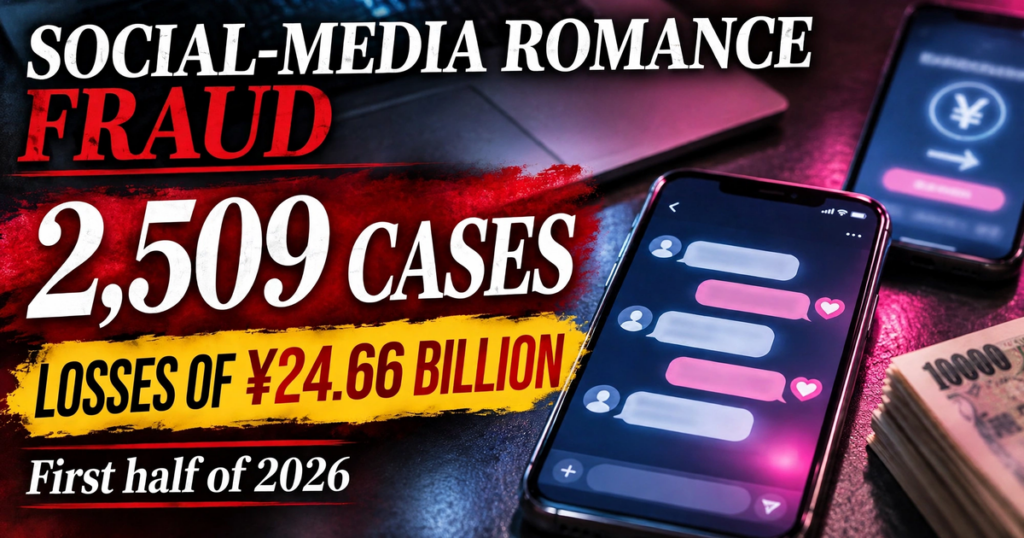
Police recorded 5,645 SNS-based romance scams and ¥54.64 billion in losses in 2025. Provisional figures for the first half of 2026 showed 2,509 cases and ¥24.66 billion in losses, while the police statistical classification changed in April 2026.
Romance scams move from online contact to repeated requests for money
SNS-based romance scams exploit romantic feelings, affection or a sense of personal closeness to obtain money. Initial contact may occur through a dating application or a social-media direct message. The request is not necessarily a simple appeal for travel expenses to meet in person. A conversation may shift toward investments, cryptocurrency, an online shop, work-related advances or another supposed opportunity. Once the other person has invested time and emotion in the relationship, the request can be framed as support for a shared future or help for a trusted partner through a temporary difficulty. The crime is not limited to one payment or one type of platform.
The scale remained substantial in 2025 and the first half of 2026
According to National Police Agency figures cited in the Japanese article, police recorded 5,645 SNS-based romance scam cases in 2025, with losses of ¥54.64 billion. Compared with 2024, the number rose by 1,821 cases, or 47.6 percent, while losses increased by ¥14.55 billion, or 36.3 percent. In the first half of 2026, provisional figures were 2,509 cases and ¥24.66 billion in losses. The average loss per completed case in that period was ¥9.841 million. The first-half figures are provisional, not a final annual total.
Cryptocurrency became a major way to transfer the money
In 2025, direct cryptocurrency transfers accounted for 2,177 cases and ¥24.77 billion in losses. When cases in which money was first transferred through a bank and then converted into cryptocurrency were also included, cryptocurrency was the main form of delivery in 40.4 percent of cases and 48.6 percent of the total loss amount. These figures show that the scam is not limited to bank transfers or cash. Victims may be instructed to buy cryptocurrency and send it to a wallet controlled by someone else, making it difficult to recover once the transfer has been completed.
Direct messages are a common first point of contact
The article reports that direct messages accounted for approximately 90 percent of initial contacts in the first half of 2026. Dating applications were the leading initial-contact tool by both the number of recognised cases and the amount of loss. Facebook followed for losses, while Instagram followed for case numbers. Around 80 percent of victims were in their forties through sixties, and the article notes an increase among people in their seventies. These figures challenge the assumption that online relationship scams affect only young users. The first contact can appear ordinary: a profile, a message, a compliment or a conversation about daily life.
Moving the conversation to another messaging service can isolate the target
A common pattern is to move the conversation from a dating application or social platform to LINE or another private messaging service soon after contact. Once the conversation leaves the original platform, its reporting and moderation systems may no longer be available to the same extent. Daily messages and discussion of marriage or a future together can make later requests harder to evaluate as separate financial decisions. The scammer may gradually introduce a new reason for payment, such as travel, a business expense, an investment or an online shop. The relationship becomes the context through which each new payment is explained.
Investment websites can make fictitious profits look real
In investment-related versions, the target may be directed to a specific application or website controlled by the scammers. The screen can show an account balance or apparent profits increasing over time. A displayed balance is not evidence that a real asset exists or can be withdrawn. When the victim tries to take the money out, the operator may demand additional payments described as tax, a guarantee deposit, verification costs or an account-unlocking fee. Someone who has already transferred a substantial amount may send more money in an attempt to recover the earlier payments. The apparent gains and the actual ability to withdraw funds are separate matters.
Police examples show how large individual losses can become
The National Police Agency examples cited in the article include a woman in her forties who lost about ¥5 million after being asked to advance work expenses, a man in his forties who lost about ¥7 million in a cryptocurrency-related scheme, and a man in his fifties who lost approximately ¥33 million through supposed online-shop inventory and guarantee costs. Another example involved a person who sent about ¥150 million after meeting someone on a dating application who claimed to be a foreign-exchange analyst and recommended FX investment. These are separate reported examples, not one case or a typical amount. They show how repeated transfers can turn a small request into a large loss.
Romance scams and investment scams can overlap
Police statistics distinguish SNS-based romance scams from SNS-based investment scams, but actual conduct can contain elements of both. A person posing as a romantic partner may say that an investment is being made for the couple’s future. The emotional relationship is part of the deception, while the stated reason for the transfer is an investment. It is therefore misleading to classify a case solely by the wording used to request money. The relevant questions include how the relationship was created, what false information was provided, where the money went and whether the victim could withdraw it.
The police statistical classification changed in April 2026
From April 2026, SNS-based investment and romance scams were incorporated into the statistical classification of special fraud as methods within that broader category. The Japanese article warns that figures for 2025 and earlier should not be compared mechanically with statistics compiled after the change without considering the revised classification. The change did not mean that the conduct first appeared in 2026; it was a change in how police grouped and reported offences. In the first half of 2026, losses across special fraud totalled ¥181.62 billion. SNS investment scams accounted for ¥79.79 billion, impersonation of police officers for ¥50.79 billion, and SNS romance scams for ¥24.66 billion.
A victim may also be used to move money for another crime
The National Police Agency has warned about cases in which a victim is told that they are helping with an investment and is asked to receive money into their own bank account before transferring it elsewhere. The person may believe they are assisting a partner, but the account can be used to move criminal proceeds. That creates risks beyond the loss of the victim’s own money. Requests to receive funds for someone else, forward them to a different account or purchase cryptocurrency on another person’s instructions should be treated as serious warning signs.
Original Japanese record: SNS型ロマンス詐欺|2026年上半期2509件・246.6億円、DMから送金へ至る手口
Last updated:
Related articles
Case record
The JP Dragon Special-Fraud Network: An Estimated ¥900 Million in Losses and Separate Proceedings After Repatriations

Case record
The Sasaguri Five-Year-Old Child Death Case: Coercive Control, Neglect, and Two Final Prison Sentences

Case record
The Nagoya Marriage-Fraud Scheme Using a Dating App

Case record