
The JP Dragon Special-Fraud Network: An Estimated ¥900 Million in Losses and Separate Proceedings After Repatriations
Japanese police have investigated the Philippines-based group known as JP Dragon in connection with special-fraud cases dating from 2019. Fukuoka Prefectural Police estimated that about 250 people in 20 prefectures had been victimised, with losses of approximately ¥900 million. That figure is a police estimate for the wider investigation, not a total adjudicated in one trial. Separate defendants have been repatriated and prosecuted in Japan. Five members received seven-year prison terms on 28 October 2026, while a man believed to be the group's second-in-command was arrested by Philippine authorities on 31 October.
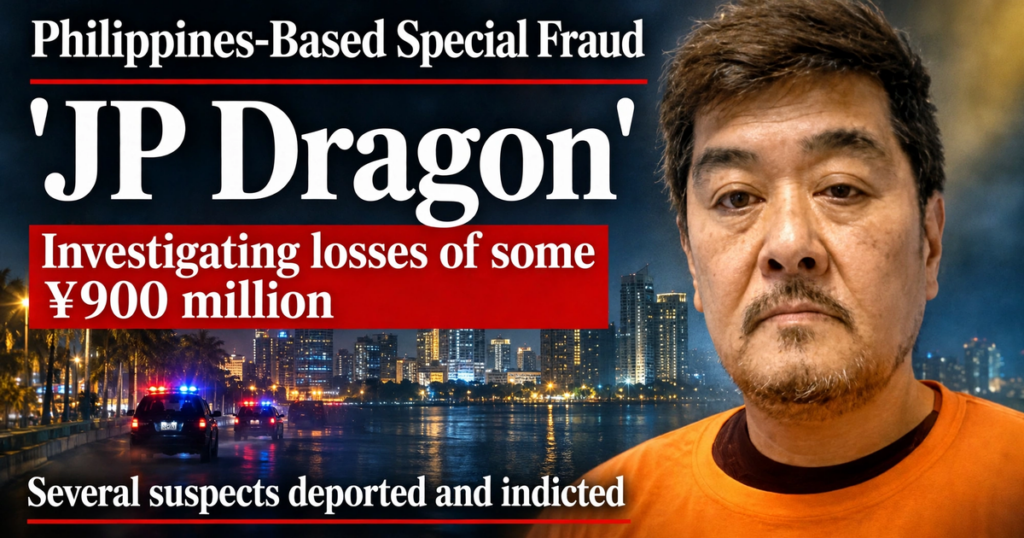
A Philippines-based network investigated for fraud in Japan
JP Dragon is the name used in Japanese reporting for a group of Japanese nationals believed to have operated from the Philippines and participated in special-fraud schemes targeting people in Japan. The public record does not describe one single criminal trial covering every person associated with the group. Instead, investigations and prosecutions have proceeded in separate cases as individuals were located, detained, repatriated and charged. This distinction is essential. A person described by police or the media as a member of JP Dragon is not automatically guilty of every fraud attributed to the network, and each defendant's criminal responsibility must be determined from the charges and evidence in that person's case.
The fraud method linked overseas callers with domestic runners
In cases described in the indictments, callers based in the Philippines allegedly posed as police officers or other officials. They told older people that their bank accounts had been used in crime or that counterfeit notes were circulating, creating pressure to hand over cash or bank cards. A domestic runner then visited the victim's home to collect the money or cards. In some cases, victims were asked to place a card in an envelope while the runner substituted another card. The PIN was obtained separately, allowing cash to be withdrawn at ATMs. The roles could include caller, recruiter, collector, cash-withdrawer and person who moved the proceeds.
The ¥900 million figure is an investigative estimate
Fukuoka Prefectural Police have described the wider investigation as involving approximately 250 victims across 20 prefectures since 2019, with losses estimated at about ¥900 million. Those figures describe the scale of the police investigation. They are not a court finding that one defendant stole ¥900 million, nor do they represent a single indictment or one final judgment. In criminal proceedings, prosecutors identify particular victims, dates, telephone calls, card thefts and withdrawals. A defendant may be charged with only a portion of the conduct attributed to the wider group. The English article therefore identifies the ¥900 million figure as a police estimate, not a judicially established loss total.
Repatriation from the Philippines took place in separate stages
Several people associated with the investigation were detained by Philippine authorities and later transferred to Japan. A group returned in September 2025, and additional individuals were sent back in April 2026. The procedures were not one mass extradition. Local immigration or law-enforcement action in the Philippines, Japanese arrest warrants and the specific allegations against each person affected when and how a transfer took place. Once in Japan, suspects could be arrested, questioned, re-arrested on separate allegations and then indicted. The timing of a repatriation does not by itself establish guilt; it only explains how Japanese authorities obtained custody for domestic proceedings.
Separate trials have addressed different defendants and offences
The Fukuoka District Court has heard multiple proceedings involving people described as JP Dragon associates. In one trial that began on 26 January 2026, five defendants were charged with offences involving a senior woman whose bank card was allegedly stolen after callers posed as police officers. Four of the five admitted the indictment's allegations at the opening hearing, while the fifth did not. Another defendant, Amano Tsubasa, was sentenced to four years' imprisonment on 27 April 2026 for fraud and theft involving the recruitment of domestic runners. These are separate judicial decisions concerning specific defendants, not a single judgment against the entire organisation.
Five defendants received seven-year sentences on 28 October 2026
On 28 October 2026, the Fukuoka District Court sentenced five defendants described in reporting as JP Dragon members to seven years' imprisonment each for theft and fraud. The judgment concerned a series of offences between October 2022 and May 2025 in which older people in eight prefectures were targeted; the court found that more than ¥50 million had been taken from 20 victims. The prosecution had sought eight years for each defendant. The court described the offences as organised, habitual and professional. It rejected the argument by two defendants that their teams operated independently, finding that the teams complemented one another. This judgment concerns the five defendants and the offences before that court; it does not resolve the entire ¥900 million police estimate.
The court's findings about the network must be kept within the case
RKB published a four-page detailed report on 21 November 2026 about the prosecution's account of JP Dragon's formation and methods in the five-defendant trial. The report is useful for understanding what prosecutors said about the network, but a prosecutor's closing account is not automatically a judicial finding. The English draft therefore uses the report to identify the scope of the case and the prosecution narrative, while relying on the court's 28 October judgment for the facts the court actually found. It does not treat every allegation about the wider organisation as proved against every person associated with the name JP Dragon.
A man believed to be the group's second-in-command was arrested in the Philippines
On 1 November 2026, Kyodo reported that Philippine authorities had arrested a 57-year-old Japanese man identified in reports by the family name Yamamoto, who was believed to be second in command to leader Yoshioka. The man was wanted in Japan on suspicion of fraud and theft under a warrant issued by a Fukuoka summary court. The reported arrest took place in the Philippines on 31 October. This is an arrest by Philippine authorities, not a Japanese conviction or an adjudication of the alleged offences. As of 22 November 2026, the sources reviewed for this draft did not confirm that he had been returned to Japan or indicted in a Japanese court.
The legal status remained mixed as of 22 November 2026
By 22 November 2026, the network's legal position remained fragmented. Five defendants had received seven-year first-instance sentences on 28 October; the materials reviewed did not establish whether those sentences had become final after appeal periods or further proceedings. Other defendants had received separate sentences, while still others remained at the initial-hearing or evidence-taking stage. The reported arrest in the Philippines of a man believed to be a senior figure was a further investigative development, not a judgment. The correct summary is therefore that a number of individual prosecutions had advanced, while the broader investigation and several proceedings continued.
Why the group-wide figure must not be confused with a court total
The phrase “JP Dragon case” is useful as a label for a complex investigation, but it can hide important differences between people and proceedings. The estimated ¥900 million concerns the wider series of suspected frauds. The five-defendant judgment concerned more than ¥50 million in a defined group of offences. The four-year sentence imposed on Amano concerned a different set of acts and a different defendant. The man arrested in the Philippines on 31 October had not, on the information reviewed, been tried in Japan. Keeping those categories separate protects the victims' record and avoids presenting an investigative estimate or an arrest as a final judicial finding.
Original Japanese record: フィリピン特殊詐欺「JPドラゴン」|約9億円の被害把握、送還後も複数公判が進行
Last updated:
Related articles

Case record
The Sekisui House Land-Title Fraud Involving Kaikikan

Case record
SNS-Based Romance Scams in Japan

Case record
The Aconite Insurance Murder: Two Toxins in Preserved Blood and a Case Built on Circumstantial Evidence

Case record