The Ikebukuro Pokémon Center Stabbing
Twenty-one-year-old employee Moe Harukawa was fatally stabbed at Pokémon Center Mega Tokyo on 26 March 2026. Her former partner also died at the scene; police later sent the case to prosecutors with the suspect deceased.
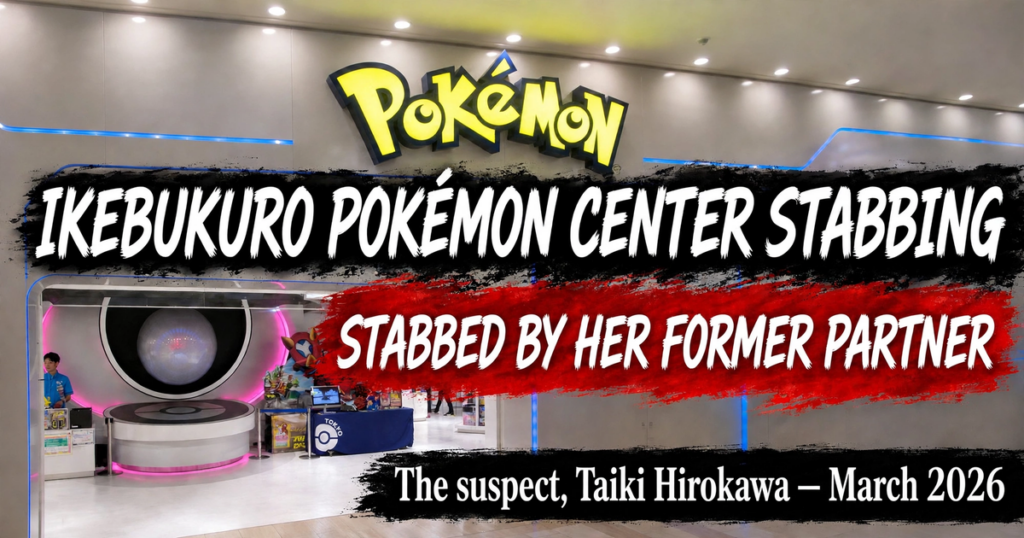
A worker was attacked at her workplace in Sunshine City
At approximately 7:15 p.m. on 26 March 2026, Moe Harukawa, a 21-year-old part-time employee at Pokémon Center Mega Tokyo in Sunshine City, Higashi-Ikebukuro, Toshima Ward, Tokyo, was attacked with a knife. She was taken to hospital and died. Her former partner, identified in the case record as Taiki Hirokawa, aged 26, also died after inflicting a fatal knife wound on himself. The location was a public retail workplace inside a large commercial complex. The incident was therefore both a fatal attack on a young worker and a case raising questions about the safety of people who report stalking and continue to work in public-facing jobs.
The victim had previously sought police assistance over stalking
Harukawa had consulted the Metropolitan Police Department about persistent unwanted attention from her former partner beginning in December 2025. The police response included an arrest for an alleged violation of the Anti-Stalking Act, a further referral concerning the Swords and Firearms Control Law, and a later arrest in relation to alleged unlawful filming under the Act on Punishment of Acts of Taking Sexual Images. A restriction prohibiting him from approaching her was also issued. These are separate legal steps and should not be collapsed into one conviction. The public case account describes the prior consultations and police actions as part of the chronology leading to the fatal attack.
The suspect’s earlier arrests and the restrictions imposed on him
The former partner was arrested on 25 December 2025 on suspicion of stalking-related conduct. A knife found in a vehicle was separately investigated under the Swords and Firearms Control Law. In January 2026, he was rearrested on suspicion of taking sexual images of Harukawa. The case record says he was released after summary prosecution at the end of January and was not thereafter held in continuous custody. A prohibition on approaching Harukawa had been issued. The precise legal outcome of each earlier allegation must be distinguished from the later homicide investigation; the existence of an arrest or referral does not mean every allegation resulted in a full criminal trial.
Investigators reconstructed the final approach through objective evidence
Because the suspect died, investigators could not obtain his account through questioning. They therefore examined security-camera footage, digital devices, purchase records and documents recovered from his residence. The case record says that he entered Sunshine City approximately 30 minutes before the attack and looked into the store around 15 minutes before it, then left the immediate area. He was also recorded entering the complex earlier on the same day, around six hours and four hours before the attack. A knife believed to have been used was reportedly purchased three days earlier at a shop near his home. These findings were used by police to examine whether the attack had been planned.
The 30 March search recovered documents and a computer
On 30 March 2026, police searched the suspect’s residence in Kawasaki City on suspicion of murder. They seized a computer and documents relating to the approach prohibition. The documents were relevant to confirming that he had received the restriction. The digital and video material helped investigators reconstruct when he entered the commercial complex, when he approached the shop and how he prepared for the attack. These are investigative findings based on records and physical material. Since the suspect was dead, they were not tested through cross-examination at a criminal trial.
The police sent the case to prosecutors with the suspect deceased
On 29 July 2026, the Sugamo Police Station sent the suspect’s case to the Tokyo District Public Prosecutors Office on suspicion of murder, violations of the Swords and Firearms Control Law and the Anti-Stalking Act. The murder allegation concerned the attack on Harukawa at her workplace despite the approach prohibition. The legal status is often described in Japan as a referral or sending of papers with the suspect deceased. This is not an indictment after a trial, and it is not a conviction. Because the suspect had died immediately after the incident, he could not stand trial as a defendant.
The case raises questions about the practical protection of stalking victims
Harukawa had reportedly followed police advice to stay at a relative’s home for a period and received follow-up contact from officers after returning to her residence. Police also advised security measures and a possible change of workplace. The case record notes that the job at Pokémon Center was one she had chosen and wanted to keep. The sequence illustrates a difficult policy issue: protective measures can impose substantial practical burdens on the person being stalked, including changes to home and work, while the risk of renewed contact remains. The fact that a restriction was issued does not itself guarantee that a perpetrator will comply.
The death of the suspect prevents a criminal trial
The suspect’s death means there was no prosecution at trial and no judicial judgment determining guilt. The police referral records the conclusion of their investigation and the allegations they sent to prosecutors, but it should not be described as a court conviction. The victim’s death and the suspect’s death are established facts; the detailed allegations about the suspect’s conduct are the police case as submitted. The legal endpoint is therefore a deceased-suspect referral and no trial, rather than a sentence or a finding of guilt after adversarial proceedings.
The sequence of prior warnings remains central to the public record
The incident is significant not only because it occurred at a prominent commercial site, but because the victim had previously sought assistance and the authorities had taken several steps under different statutes. The chronology includes consultations, arrests, a restriction on approaching her, the suspect’s release from custody and the later fatal attack. Those events should be assessed carefully without assuming that every later outcome was foreseeable or that a single measure would certainly have prevented the killing. The record documents the steps taken and the tragic result; broader conclusions about institutional responsibility require evidence beyond the chronology itself.
The earlier police response included several distinct legal measures
The source article dates Harukawa’s first consultation to 25 December 2025 at Hachioji Police Station. Hirokawa was arrested that day on suspicion of violating the Anti-Stalking Act after appearing near her home. A knife was found in the vehicle he had used. On 8 January 2026, police referred him on suspicion of violating the Swords and Firearms Control Law; on 15 January he was rearrested over alleged filming of Harukawa. The sequence matters because the eventual homicide followed several separate investigative steps. The arrests and referrals must not be described as a murder conviction or as findings made after a full trial.
The store reopened after approximately five months
Pokémon Center Mega Tokyo closed temporarily after the attack. The Pokémon Company said that it would strengthen measures to protect employees and create a safer environment for customers. The store and Pikachu Sweets by Pokémon Café reopened on 24 August 2026. The reopening is part of the aftermath and does not change the criminal status: Hirokawa had died, the police sent the case to prosecutors with him deceased on 29 July, and no trial took place.
Original Japanese record: 池袋ポケモンセンター刺殺事件|春川萌衣さん殺害、元交際相手を死亡のまま書類送検
Last updated: