
The Meat Hope Meat-Falsification Case
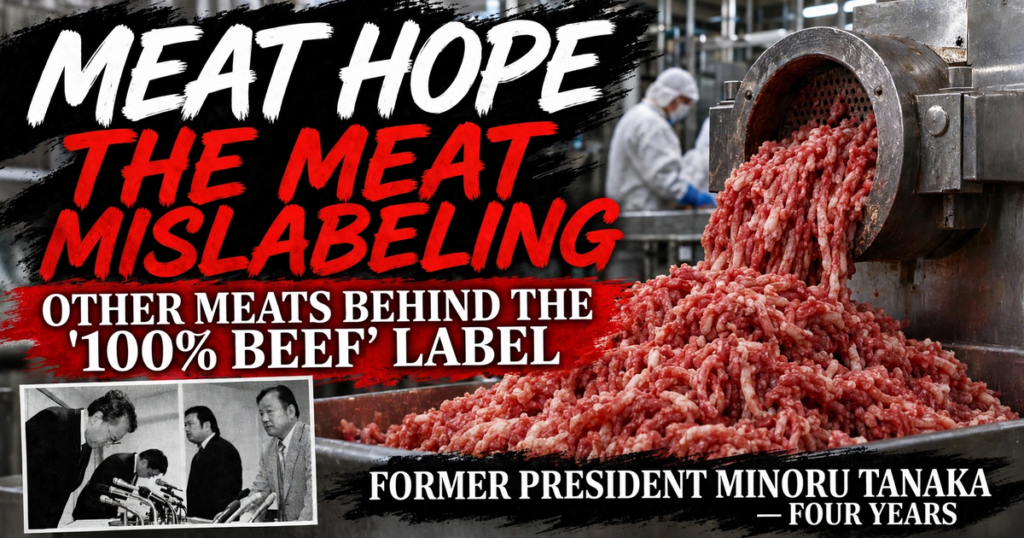
Meat Hope, a meat-processing wholesaler in Tomakomai, falsified meat products sold as beef. The 2008 court findings covered approximately 138,044 kilograms of mislabelled meat and a series of fraud offences.
A meat-processing company sold products that were not what their labels claimed
Meat Hope Co., a meat-processing and wholesale business based in Tomakomai, Hokkaido, became the centre of a major food-falsification case in 2007. The company mixed meats including pork, chicken, lamb and duck into products represented as beef. The central problem was not simply a quality-control failure: the products were sold with labels that misrepresented their ingredients. The Sapporo District Court’s 2008 findings covered approximately 138,044 kilograms of falsified meat. The prosecution period from May 2006 through June 2007 included 327 false representations and 331 deliveries or transfers. These figures refer to the court-covered conduct, not necessarily every product ever handled by the company.
Information had reached government agencies before the scandal became public
The case did not emerge without warning. Information concerning Meat Hope’s ground-beef products reportedly reached the Ministry of Agriculture, Forestry and Fisheries in February and March 2006. Meat believed to be evidence of the falsification was also brought to the Hokkaido Regional Agricultural Administration Office around April or May. The ministry’s later review identified delays in responding to early information, problems in how information was passed between the national government and Hokkaido, and shortcomings in handling the submitted meat. These findings concern administrative response. They should not be confused with the separate criminal findings against company personnel.
The falsification became public on 20 June 2007
On 20 June 2007, the mixing of different kinds of meat into products sold as beef became public. Further inquiries revealed other irregularities, including cases in which imported beef was represented as domestic and problems involving expiry-date labelling. Business partners began recalling products and suspending sales. The company’s production lines stopped, and its commercial relationships deteriorated rapidly. The disclosure was not limited to one package or one mistaken label; the court later examined repeated false representations over a defined period. The scandal undermined confidence in the company and in the supply chain that had accepted its products.
The company dismissed its employees and entered bankruptcy
After the scandal became public, returns and cancelled orders accumulated. On 29 June 2007, the company dismissed all employees. On 17 July, it filed for bankruptcy at the Tomakomai branch of the Sapporo District Court, with reported liabilities of approximately 670 million yen. The business had operated since 1976, but it could not continue after the loss of commercial trust. Bankruptcy is a corporate insolvency procedure; it is separate from the criminal responsibility of the individuals prosecuted for the falsification and fraud.
The first arrests concerned false labelling under the Unfair Competition Prevention Act
On 24 October 2007, Hokkaido police arrested four people, including company president Minoru Tanaka, on suspicion of violating the Unfair Competition Prevention Act through false labelling. The initial allegation concerned products containing pork or chicken that were presented as 100-percent beef. The investigation also examined whether buyers had been deceived into paying for products on the basis of those false representations. That conduct was pursued as fraud. It is important to distinguish the two legal theories: false labelling and obtaining payment through deception were related but separately charged forms of wrongdoing.
The court identified repeated false representations and fraud
The court findings included 327 false representations and 331 deliveries or handovers during the charged period. The fraud component was described as 14 transactions totalling 39,269,453 yen. These are specific figures associated with the criminal proceedings. They should not be enlarged into an unsupported claim that every transaction by the company was part of the indictment. The legal case concerned the acts charged and proven in court, while the broader public scandal also involved administrative oversight, product recalls and the collapse of the business.
The former president received a four-year prison sentence
On 19 March 2008, the Sapporo District Court sentenced Tanaka to four years’ imprisonment. The sentence was an immediate custodial term, not a suspended sentence. The court’s judgment established criminal responsibility for the offences before it. The company’s bankruptcy, the dismissals and the government’s administrative review were separate consequences and processes. The available case summary identifies the district-court sentence; any description of later appeal proceedings should be based on a verified court record rather than inferred from the fact that the sentence was reported as final in later summaries.
The case exposed weaknesses beyond the conduct of one company
The Meat Hope case raised questions about how food businesses verify the contents and origins of products, how suppliers and purchasers monitor labels, and how government agencies respond to early warnings. The administrative review was critical of delays and coordination problems before the public disclosure. The criminal proceedings, by contrast, focused on the acts of false representation and fraud that could be proved against the accused. Keeping these strands separate allows the case to be understood as both a criminal matter and a failure of oversight without attributing every administrative shortcoming to the defendants or every company transaction to the indictment.
The legal outcome and the wider food-safety lessons should remain distinct
The central criminal outcome was the four-year prison sentence imposed on former president Tanaka in March 2008. The company had already entered bankruptcy in July 2007. The case’s wider significance lies in the scale and duration of the falsification, the damage to commercial trust, and the delayed response to information held by public agencies. It is not necessary to exaggerate the figures or treat the company’s collapse as a separate criminal penalty. The documented quantities, dates, charges and sentence provide a sufficient basis for understanding the case and its consequences.
The court figures cover the charged period and the sentence became final
The judgment’s specific findings covered false representations from approximately 29 May 2006 to 18 June 2007: 327 false labels, 331 deliveries or handovers and about 138,044 kilograms of meat. The fraud findings covered 14 transactions from June 2006 to May 2007 involving three business partners and a total of 39,269,453 yen. The 138,044-kilogram figure is the amount covered by the criminal findings, not a verified total for every year of the company’s operations. Tanaka did not appeal the Sapporo District Court judgment of 19 March 2008, and the four-year sentence became final on 3 April 2008.
Original Japanese record: ミートホープ食肉偽装事件|約13.8万kgを「牛肉」と偽装、元社長に懲役4年
Last updated:
Related articles
Case record
The “Itadaki Joshi Riri-chan” Fraud Case: Romance-Based Deception, a Paid Manual, and a Final Sentence of Eight Years and Six Months
Case record
The Akashi Mummified Remains Case: A Son Hid His Father's Death and Fraudulently Collected Pension Payments
Case record
The Sasaguri Five-Year-Old Child Death Case: Coercive Control, Neglect, and Two Final Prison Sentences
Case record