
The Suspicious Death of Physician Shoko Yajima
Physician Shoko Yajima, 34, was found dead in the Kizu River in November 2009. Her death was ruled drowning, but the circumstances remain unresolved; in 2026 Osaka police disclosed that three items submitted by her family had been lost.
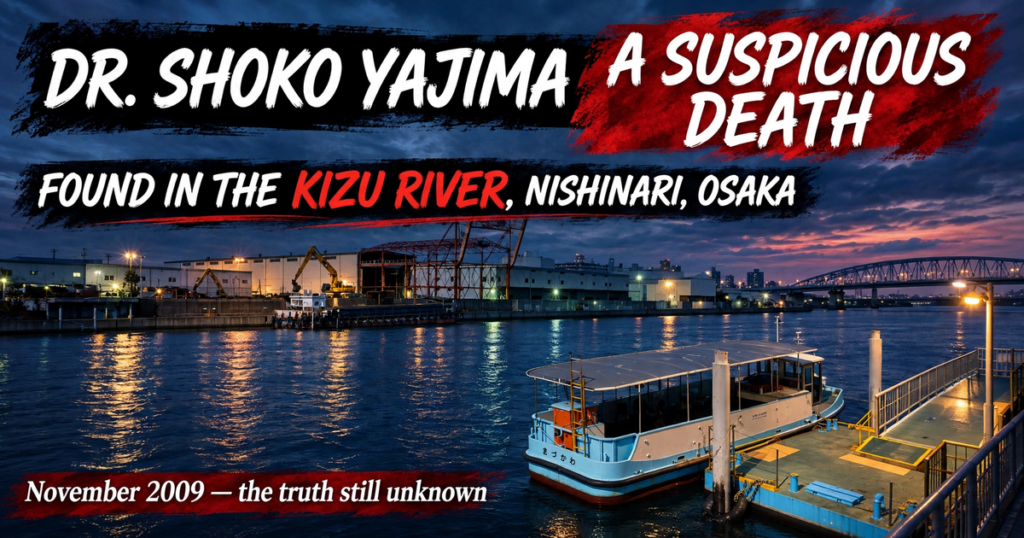
A community physician was found dead in the Kizu River
Shoko Yajima, a 34-year-old physician who worked in community medicine in Osaka’s Nishinari Ward, was found dead in the Kizu River in November 2009. Her cause of death was reported as drowning, but the circumstances that brought her into the river have not been publicly established. Later reporting places her disappearance around 14 November and the discovery of her body on 16 November, although the public record does not permit a complete reconstruction of her movements during that interval. The central question has not simply been the medical cause of death, but whether the drowning resulted from an accident, suicide or the involvement of another person.
Her work in Nishinari shaped the response of people who knew her
Yajima worked with people facing poverty and unstable housing, including people living outdoors. Television reporting and articles published after her death described patients and people in the neighbourhood calling her “Sacchan-sensei.” These accounts help explain why her death deeply affected patients, colleagues and supporters. They do not, however, establish the cause of death. A person’s professional dedication or the affection of those around them cannot by itself prove that suicide was impossible, just as the fact of drowning cannot establish that the death was self-inflicted. The investigation must be understood through the available physical evidence, official statements and the family’s requests for further examination.
The family questioned a suicide interpretation and sought further investigation
Yajima’s family did not accept the view that she had taken her own life and continued to ask police to clarify the circumstances. The family and supporters submitted materials to the authorities, later described by Osaka Prefectural Police as approximately 100 items. The family’s concern led to a formal complaint alleging murder and abandonment of a body. Their position is an important part of the history, but it must be distinguished from a judicial finding. No court has ruled that Yajima was murdered, and the public record does not identify a person who was arrested or prosecuted for causing her death.
The National Police Agency told the Diet that both crime and accident were being examined
On 25 February 2011, the death was discussed in the Third Subcommittee of the House of Representatives Budget Committee. The National Police Agency’s Criminal Affairs Bureau explained that police had carried out an examination, autopsy-related procedures and interviews with people concerned. Officials said that the circumstances did not clearly establish a criminal death, while also stating that investigators were pursuing both criminal and accidental possibilities. This answer should not be simplified into a final declaration of suicide. Nor did it amount to an official finding of homicide. It was a public explanation that the investigation had not reached a definitive conclusion and was being considered from both perspectives.
A complaint alleging murder and abandonment of a body was accepted in 2012
In August 2012, the family’s complaint alleging murder and abandonment of a body was accepted by Osaka Prefectural Police. Acceptance of a criminal complaint means that the authorities formally received the allegation; it does not prove the offences occurred. The complaint did not publicly identify a convicted perpetrator, and the available record does not show a criminal trial that determined the death to be homicide. The distinction is especially important because the family’s allegations, police investigative position and judicial findings are different categories of information. The public account says the limitation period for abandonment of a body was completed in November 2012; murder is not subject to a limitation period under current Japanese law.
Three pieces of evidence were reported missing in March 2026
On 12 March 2026, Osaka Prefectural Police disclosed that three items submitted by the family had been lost: one business card, one note and one plastic bag. The police said that the family had submitted approximately 100 items in total. The bag had contained postage stamps, but the stamps themselves remained. The police also stated that photographs or other records existed and expressed the view that the loss would not affect the investigation. The physical loss is nevertheless distinct from the existence of photographs: an original object cannot be examined again if it is no longer available.
The missing items had been noticed years before the family was informed
The reported chronology is significant. The police station had noticed that the business card and note could not be found in July 2012, while the plastic bag was recognised as missing in January 2016. The matter was not reported to the relevant headquarters sections until later: the investigation division was reportedly informed in April 2023 and the criminal affairs administration division in April 2025. Police explained the loss to the family and apologised on 10 March 2026. The interval between the initial awareness and the explanation to the family was therefore more than a decade for the first two items. The disclosure raised questions about evidence management and communication with bereaved families.
The loss does not itself prove homicide or a cover-up
The disappearance of evidence is a serious administrative issue, but it does not establish that the missing items proved murder or that officers intentionally concealed evidence. Osaka police denied an intention to conceal the loss. The public materials do not demonstrate that the business card, note or bag contained information that would identify a killer. The family’s concerns and the police’s explanation should both be reported, while avoiding an unsupported conclusion about motive or misconduct beyond what has been established. A responsible account separates the question of how evidence was managed from the unresolved question of how Yajima died.
The death circumstances remain unresolved
As of the source article’s August 2026 update, the public record did not establish whether Yajima’s death was accidental, self-inflicted or caused by another person. Police had publicly described examining both criminal and accidental possibilities; the family continued to seek clarification; and no person had been convicted of causing her death. The 2026 disclosure about three missing items added a new issue concerning investigative records, but did not resolve the cause of death. The case must therefore be described as a suspicious death with unresolved circumstances, rather than as a proven murder or a confirmed suicide.
Original Japanese record: 矢島祥子医師不審死|木津川での遺体発見と2026年に判明した証拠品紛失
Last updated:
Related articles
Case record
The Disappearance of Yuri Yoshikawa: The Unresolved Route Home from School
Case record
The Higashiosaka University Student Murders: Retaliation, Two Burials and a Final Death Sentence
Case record
The Ochi Kiyoshi Wanted Case: The Killing of Eiko Ochi and the Disappearance on Kuchinoerabu Island
Case record