
The Murder of Kyoto Seika University Student Daisaku Chiba
Twenty-year-old Kyoto Seika University student Daisaku Chiba was fatally stabbed in Kyoto on 15 January 2007. Police have released a description of a young man seen near him, but no suspect has been publicly identified.
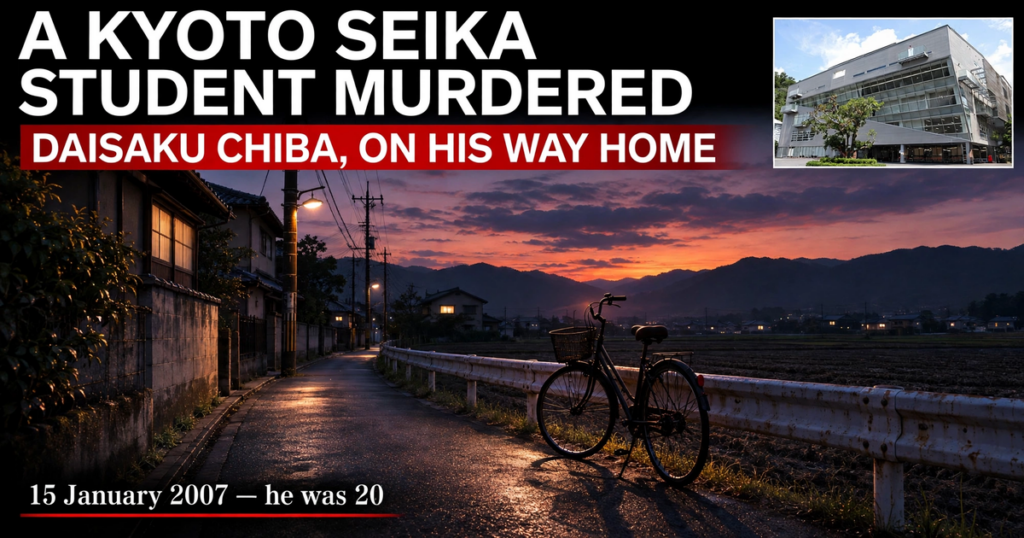
A university student was attacked on an ordinary journey home
On the evening of 15 January 2007, Daisaku Chiba, a 20-year-old first-year student in the Manga Faculty at Kyoto Seika University, was riding his bicycle through Iwakura Hataedacho in Sakyo Ward, Kyoto. At approximately 7:45 p.m., he was attacked with a knife on a pedestrian path and died after sustaining multiple stab wounds. Police-association material describes him as having been on his way from the university bicycle parking area toward a friend’s home. The attack occurred during an ordinary local journey, rather than inside the university or at a place identified as his residence. The distinction matters because the public record does not establish that the university itself, his studies, or a known personal dispute was the motive.
The published account identifies the victim and the location, but not a confirmed motive
Chiba was from Sendai and had moved to Kyoto to attend university. The available public account identifies his age, course of study, route and the approximate time of the attack. It does not establish that he had been receiving threats, that he was involved in a serious dispute, or that he had been deliberately followed before the encounter. The fact that a young man was seen in contact with Chiba shortly before the attack is central to the investigation, but the public materials do not establish whether the two already knew one another. They may have met for the first time that evening; they may also have had an earlier connection that has not been made public. Neither possibility should be presented as a fact.
Police have released a detailed description of a man seen near the scene
Kyoto Prefectural Police have sought information about a man reportedly seen in contact with Chiba. The published description places the man at approximately 20 to 30 years old at the time, around 170 to 180 centimetres tall, with a centre-parted, somewhat untidy hairstyle and dark clothing on both the upper and lower body. He was associated with a dark, ordinary city bicycle resembling a mamachari. Later reporting has also referred to light hiking-style shoes, while the official public description focuses on the man’s apparent age, height, hair, clothing, bicycle and behaviour. These are witness-based investigative details, not a confirmed identification. The man has not been named, arrested or charged in connection with the murder.
Witnesses described an argument and distinctive behaviour
Public police information includes an account that the man appeared agitated, moved his face or upper body from side to side, and repeatedly used the words “aho” and “boke” at the ends of his remarks. These expressions are Japanese insults, roughly comparable to calling someone an idiot or fool. The reported behaviour may be memorable to someone who encountered the man before or after the incident. It is not a medical diagnosis, and the available records do not establish any mental or physical condition. Reports have also described an argument or confrontation shortly before the stabbing. Even if an argument occurred, it does not by itself establish why the attack escalated or whether the parties had met previously.
The number of wounds indicates a sustained attack, but the sequence remains unclear
Police-association materials and later reporting state that Chiba was stabbed more than ten times. Recent reporting has described wounds to the chest and abdomen. The details are sufficient to establish that the fatal attack involved repeated knife strikes, but a detailed reconstruction of every injury is neither necessary nor supported by the public information. The type of knife, where it came from, whether it was carried before the encounter, and what happened to it after the attack have not been publicly resolved. The precise sequence of the confrontation and the movements of the assailant after the stabbing also remain unclear. The case should therefore be described as a fatal stabbing by an unidentified person, not as a fully reconstructed dispute with a known motive.
The investigation has continued through public appeals and renewed attention
Kyoto Prefectural Police have continued to seek information through the Shimogamo Police Station investigation headquarters. The release of a suspect description is intended to connect the original witness account with people who may now recognise the individual, remember a bicycle or clothing item, or know of someone whose appearance and movements changed around the time of the murder. In 2025, reporting referred to more than 68,000 investigative personnel deployments over the course of the inquiry and 1,502 pieces of information received by that point. Those figures show the scale of the investigation; they do not mean that all the information was independently corroborated or that a viable suspect had emerged.
A former classmate who became a manga artist continued to publicise the case
A former classmate of Chiba later became a manga artist and continued to draw and speak about Chiba and the unresolved case, using manga to keep the investigation in public view and encourage information submissions. A TBS interview in January 2026 revisited the classmate's efforts and the family's long wait for an arrest.
A memorial and renewed information appeal took place on 15 January 2026
On 15 January 2026, the nineteenth anniversary of the killing, a memorial service was held at the scene. Chiba's mother Junko, relatives, university staff and local residents attended. Afterward, the family and Kyoto Prefectural Police distributed manga booklets and pocket tissues at Shijo-Kawaramachi and appealed for information. The Shimogamo Police Station chief also asked the public to cooperate with the investigation.
A special reward does not mean the case has been solved
The case has been designated for the National Police Agency’s special reward system. The published 2026 period runs from 14 December 2025 through 13 December 2026, with a maximum reward of three million yen for information that contributes to identifying the perpetrator or resolving the case. The maximum is not an automatic payment for any tip. The amount, if any, depends on the contribution of the information, and may be divided among multiple contributors. The reward programme is an investigative tool and a sign that police continue to solicit information; it is not evidence that the suspect has been identified or that a prosecution is imminent.
The case remains unsolved and the suspect’s identity is unknown
As of the source article’s latest update in November 2026, no arrest or prosecution has been publicly announced. The man described by witnesses remains unidentified. The public record does not establish a motive, a prior relationship between Chiba and the man, or the man’s whereabouts after the incident. The passage of time changes the age of the person described: someone estimated to have been 20 to 30 in January 2007 would now be substantially older. That calculation may help people reconsider memories, but it cannot itself identify anyone. The continuing task is to test new information against the original witness accounts and physical evidence without converting an unverified resemblance or rumour into an accusation.
Original Japanese record: 京都精華大生・千葉大作さん殺害事件|19年続く未解決捜査と目撃された男の特徴
Last updated:
Related articles
Case record
The Kyotanabe Police Officer Murder: A 16-Year-Old Daughter and the Family Court's Decision Not to Transfer
Case record
The Maizuru High School Girl Murder: An Acquittal Based on Reasonable Doubt
Case record
The Uji Cram-School Murder: Eighteen Years Reduced to Fifteen After a Diminished-Responsibility Finding
Case record