
The Urawa Game-Center Murder: The Unsolved Killing of a 73-Year-Old Employee Near Kita-Urawa Station
At approximately 1:30 a.m. on 31 March 1997, a 73-year-old female employee was found stabbed to death inside a game center near the west exit of Kita-Urawa Station in what was then Urawa City. The location is now Tokiwa 9-chome, Urawa Ward, Saitama City. The offender’s identity and route of escape have not been publicly established. Saitama Prefectural Police continue to list the case as an unsolved serious crime and seek information.
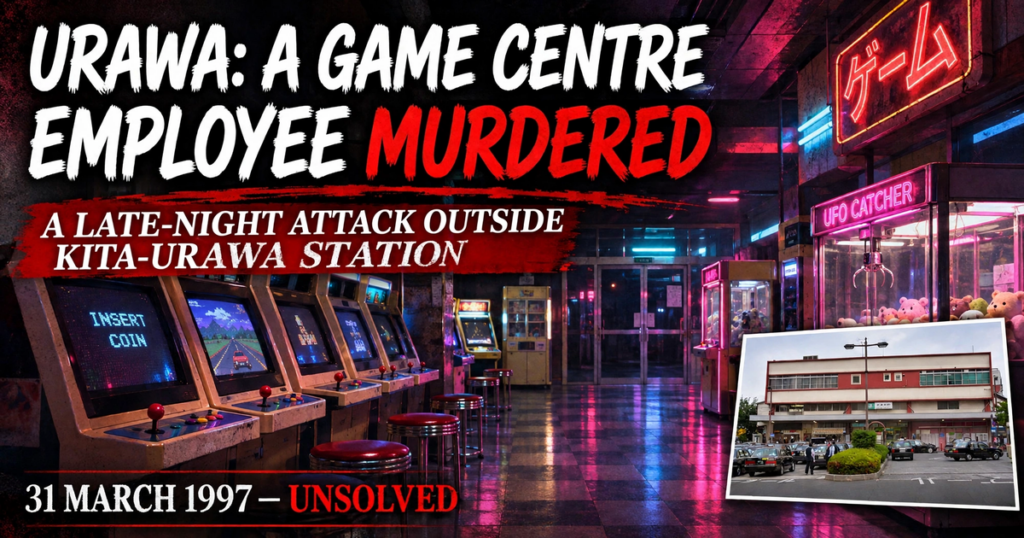
A 73-year-old employee was found dead inside a game center
At approximately 1:30 a.m. on 31 March 1997, a 73-year-old woman who worked at a game center near JR Kita-Urawa Station was found dead. She had been stabbed in the chest and other parts of her body. The business was located approximately 70 metres south of the station’s west exit, in an area containing mixed-use buildings, shops, and apartment blocks. The victim was working at the premises, and the incident was investigated as a homicide.
The location was in the former city of Urawa
At the time of the incident, the address was Tokiwa 9-chome, Urawa City, Saitama Prefecture. Urawa City later merged with Omiya City and Yono City in 2001 to form Saitama City. In 2003, Saitama City became a designated city and the area became Tokiwa 9-chome, Urawa Ward. The police case name retains the municipality name used at the time of the offence. For present-day location searches, the relevant area is near the west side of Kita-Urawa Station in Urawa Ward.
The offender’s identity and escape route have not been publicly established
The public police information does not identify a suspect by name or provide a confirmed route by which the offender left the scene. Investigators have sought information about suspicious people and vehicles seen near the game center and the surrounding streets. It would be speculative to state that a particular person entered or left the building, or that a specific vehicle was used, unless that detail is supported by an official announcement. The case remains unsolved because the available public record does not establish who killed the employee.
The public appeal asks for information about people and vehicles near the scene
Saitama Prefectural Police continue to include the case in their list of unsolved serious crimes. The Urawa Police Station asks anyone who remembers suspicious persons, vehicles, or unusual activity around the game center to contact investigators. Police guidance states that information providers’ confidentiality will be protected. The appeal is not limited to people who witnessed the attack itself. Information about the area, movements, or events around the relevant time may help investigators reassess the case.
The case remains listed among the police’s Heisei-era unsolved murders
The Saitama police list places the incident under the ninth year of the Heisei era, corresponding to 1997. The list includes multiple unsolved murder and robbery-murder cases from different years and links to individual information pages. The continued listing shows that the case is not simply retained as a historical record. Police still maintain a public information channel and continue to ask for leads, even though more than 29 years have passed since the killing.
The 2010 amendment abolished the limitation period for applicable murders
The legal position on prosecution changed after the incident. In 2010, Japan amended the Code of Criminal Procedure and abolished the statute of limitations for offences punishable by death that resulted in a person’s death. The transitional rules applied the change to qualifying cases in which the limitation period had not already expired when the amendment took effect. The 1997 Urawa case had not reached the end of its former limitation period by then. It therefore remained legally open to prosecution rather than becoming time-barred solely because of the passage of years.
The absence of a known suspect is not the same as a legal finding of innocence
No suspect has been publicly identified as the offender, and no criminal trial has taken place. This does not mean that a court acquitted someone or that investigators concluded that no crime occurred. The police continue to treat the case as an unsolved homicide. The distinction is important in long-term cases: the absence of an arrest or indictment describes the state of the investigation, not a judicial decision about the guilt or innocence of a particular person.
The passage of time makes witness information especially important
The incident occurred in a busy urban area near a railway station, where people may have been travelling, working late, or passing through the surrounding streets. More than two decades later, memories may be incomplete, but a person may still recall an unusual vehicle, an encounter, or an event that seemed unimportant at the time. The police appeal is directed at people who may have information from the night of 30 to 31 March 1997 or the period immediately around it. No unverified description should be treated as an established offender profile.
The case remains unresolved as of November 2026
As of 21 November 2026, the victim’s death remains an unsolved homicide. The police have not publicly confirmed the offender’s identity, a route of escape, or a motive. The legal abolition of the limitation period means that the passage of time alone does not prevent prosecution under the applicable law, but it does not guarantee that the case will be solved. The responsible description remains that a 73-year-old game-center employee was killed near Kita-Urawa Station on 31 March 1997 and that Saitama Prefectural Police continue to seek information.
Original Japanese record: 浦和市ゲームセンター女性従業員殺人事件|北浦和駅前で73歳女性が刺殺、現在も続く捜査
Last updated:
Related articles
Case record
The Okegawa Stalking Murder: A Woman's Repeated Appeals for Help, Police Failures and a Final Life Sentence

Case record
The Kawaguchi Namiki Real-Estate Office Murder
Case record
The North Kanto Child Disappearances and Murders: Five Cases, a Wrongful Conviction and a Possible Connection
Case record