
The Ochi Kiyoshi Wanted Case: The Killing of Eiko Ochi and the Disappearance on Kuchinoerabu Island
Osaka Prefectural Police seek Kiyoshi Ochi in connection with the suspected killing of his 65-year-old wife, Eiko, at their home in Neyagawa between the afternoon of 28 February and around 1 March 2006. Ochi was later seen on Kuchinoerabu Island in Kagoshima Prefecture, with the last reported sighting on 24 March. He remains designated an important wanted suspect. No arrest, death confirmation, or criminal judgment has been publicly reported.
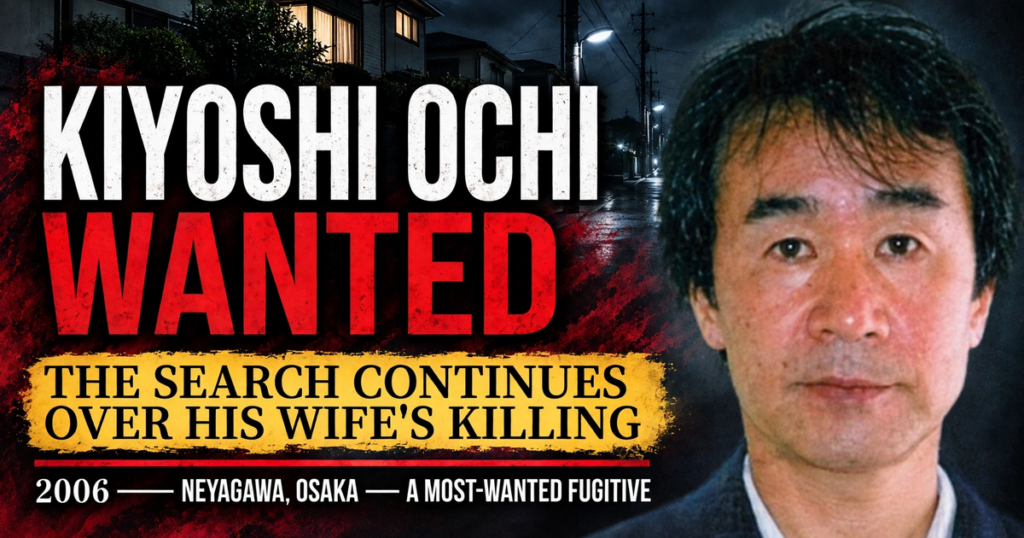
Police suspect Ochi in the killing of his wife in Neyagawa
Osaka Prefectural Police seek Kiyoshi Ochi in connection with the suspected murder of his wife, Eiko Ochi, who was 65. The suspected incident took place at the couple’s home in Shimokanda-cho, Neyagawa City, between the afternoon of 28 February and around 1 March 2006. The exact time is expressed as a range in the police wanted notice. The public record describes the case as a murder investigation, but no criminal trial has taken place and the allegation must not be written as a judicially established fact.
The wanted suspect’s identifying information remains public
The Osaka Prefectural Police notice identifies the suspect as Kiyoshi Ochi, born on 6 April 1952. He is described as approximately 175 centimetres tall. The notice names Neyagawa Police Station as the station responsible for the investigation and asks anyone with information to contact police. These identifying details are intended to help locate a wanted suspect. They do not establish that he was convicted or that his current appearance is unchanged after two decades.
Ochi was traced to Kuchinoerabu Island in March 2006
After disappearing from Neyagawa, Ochi was reported to have travelled to Kuchinoerabu Island in Kagoshima Prefecture. Residents saw him there during March 2006. The last reported sighting was on 24 March, when he was said to have been walking in the direction of the island’s mountainous interior. Reports also stated that he had contact with residents and gave away some personal belongings, including a wristwatch. The public record does not establish where he went after that sighting.
The island sightings gave investigators a limited timeline
The accounts of residents helped police establish that Ochi had been on the island and to narrow the period in which he was last seen. The sightings did not, however, reveal whether he left by boat, remained in the interior, or died on the island. There is no publicly confirmed record of his subsequent travel. The distinction between a last sighting and a confirmed final location is important: a witness may have seen him on 24 March, but that does not prove what happened afterward.
Police searched the island, including mountainous areas
In the summer of 2006, Osaka investigators travelled to Kuchinoerabu Island and conducted searches that included wooded and mountainous terrain. Reports described more than ten investigators taking part in the local search. Police examined the places associated with the reported sightings and the terrain in which Ochi had last been seen. The searches did not locate Ochi or remains that could confirm his death. Intensive local activity was reduced in August 2006, but the absence of a discovery did not resolve the question of his whereabouts.
A possible death on the island was considered but never confirmed
Contemporaneous reporting said investigators considered the possibility that Ochi had died on the island. That possibility was one line of inquiry, not a confirmed conclusion. No body or other conclusive evidence establishing his death was publicly announced. The wanted notice was not withdrawn, and the police have continued to treat him as a person sought in connection with the suspected murder. It would be inaccurate to describe him as deceased, to say that the case was solved, or to state that he escaped overseas.
The National Police Agency designated him an important wanted suspect
Ochi’s case was included among the National Police Agency’s important wanted suspects. That designation allows information about a person sought in a serious case to be circulated nationally. The Osaka Prefectural Police page remained active in the latest reviewed material, and the suspect was still listed as wanted in 2026. The designation is an investigative classification, not a judicial determination of guilt. The underlying allegation remains that he killed his wife; the police have not announced an arrest or trial.
The long gap complicates identification and public information
The publicly available photograph of Ochi dates from the period around the disappearance. Police have also circulated an artist’s impression to account for the passage of time. A person’s appearance can change significantly over 20 years, so older photographs and physical measurements may not be sufficient on their own to identify a person. The public appeal is therefore directed at people who may recognize the name, history, or other personal details, as well as those who may have encountered him after March 2006.
The legal position remains a wanted investigation, not a prosecution
As of 21 November 2026, Ochi had not been publicly reported arrested or indicted. No court has ruled on the suspected killing of Eiko Ochi. The case should be described as an unresolved suspected domestic homicide with a wanted suspect whose whereabouts are unknown. The 24 March 2006 island sighting is the last reported lead, not proof that he died there. Any conclusion about his survival, death, or later movements would go beyond the publicly confirmed evidence.
Original Japanese record: 越智清事件|妻・越智栄子さん殺害容疑、口永良部島で途絶えた足取りと重要指名手配
Last updated:
Related articles

Case record
The Disappearance of Mai Ishii: A Seven-Year-Old Missing from Her Home in 1991
Case record
The Disappearance of Yuri Yoshikawa: The Unresolved Route Home from School
Case record
The Wanted Case of Katsuyuki Obara and the Death of 17-Year-Old Kozue Sato

Case record