The King of Comedy Kenichi Takahashi School-Uniform Theft Case: 182 Items, 25 Victims, and a Suspended Sentence
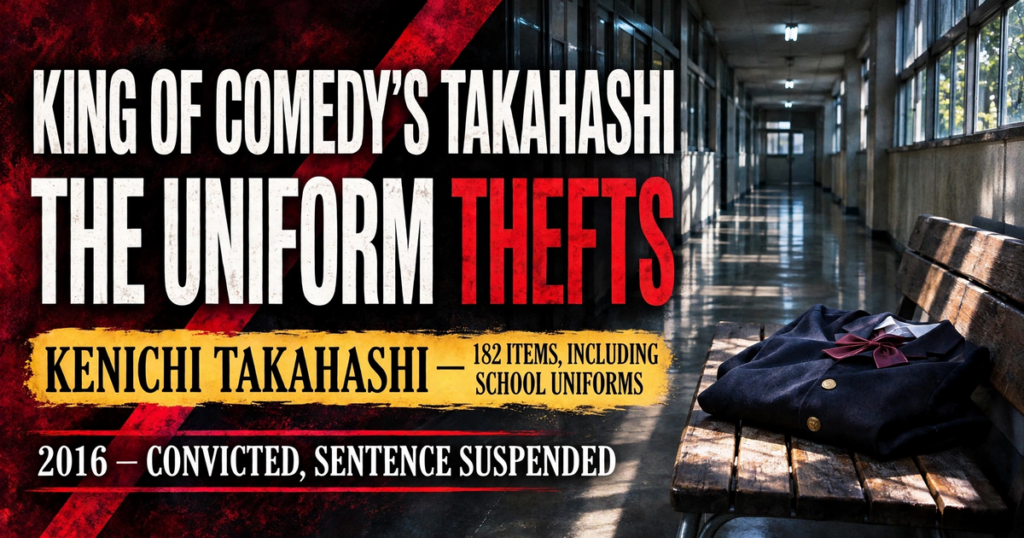
Comedian Kenichi Takahashi was arrested in December 2015 after repeated break-ins and thefts at high schools in Tokyo and Kanagawa. The offences established in court involved 25 victims and 182 items of clothing worth approximately 770,000 yen; he received a sentence of two years and six months, suspended for four years.
A comedian was arrested after a series of school break-ins
In December 2015, Kenichi Takahashi, a member of the comedy duo King of Comedy, was arrested on suspicion of entering a high school in Tokyo and stealing girls' school uniforms. Police later reported that a large number of uniforms and related items had been found at his home. The investigation expanded beyond the first school and examined incidents at multiple high schools in Tokyo and Kanagawa Prefecture. The case was not limited to a single theft. It involved repeated entry into school buildings and theft of clothing from areas used by students.
Security-camera footage helped bring Takahashi into the investigation
The investigation began with a theft at a Tokyo high school. Security-camera footage showed a person carrying a backpack entering or leaving the school area. Police traced the movements and came to suspect Takahashi. At the time of his arrest he was active as a television comedian, but the investigation increasingly focused on alleged repeated school intrusions rather than his public career. Reports said that approximately 600 pieces of clothing and related items were found at his home. That reported seizure total must be distinguished from the smaller number of items ultimately connected to offences established in court.
The first prosecution concerned a school in Setagaya
On 26 December 2015, the Metropolitan Police Department arrested Takahashi. In January 2016, prosecutors first indicted him over an incident at a high school in Setagaya Ward. The alleged offence took place on 25 April 2015, when he entered a school and stole blazers, skirts, and other clothing belonging to three students from the girls' changing area in the gymnasium. At the first hearing in March 2016, Takahashi admitted the charge. The investigation continued as police compared seized items, school reports, and security-camera footage from other locations.
Further indictments covered schools in several districts and in Yokohama
Additional prosecutions described incidents at other schools. One involved a high school in Shinagawa Ward, where Takahashi was said to have entered through a student entrance and stolen 31 items, including seven sets of sailor-style uniforms. Other charges concerned a high school in Toshima Ward, where 43 items and cash were allegedly taken, and schools in Nerima Ward and Yokohama. The source article records incidents on 29 March and 4 April 2015 among the later charges. The repeated use of school facilities and changing rooms was a common feature, while the specific items and schools differed.
The court established 25 victims and 182 stolen items
The final offences covered by the criminal judgment involved 25 victims and 182 items of clothing, with an estimated value of approximately 770,000 yen. This is the number of victims and items connected to the prosecuted conduct and accepted in the criminal case. It is not the same as the approximately 600 items reportedly seized from Takahashi's home. An item found during a search cannot automatically be treated as stolen property in a particular charged offence; investigators needed to connect it to a school, a victim, and an incident. The distinction between seized property and proven offences is important when describing the scale of the case.
Takahashi admitted the charges as the cases were prosecuted
The proceedings developed through a series of indictments and hearings rather than one single charge covering every suspected incident from the outset. Takahashi admitted the main charges as they were brought. During questioning in court, he said that he had engaged in similar uniform theft for approximately twenty years; that was his account of his history, not a finding that every such act was included in the judgment. The prosecution sought a prison term of three years. The defence relied on matters including the absence of a prior conviction and the steps taken to resolve claims with victims. Sixteen of the 25 victims had reached settlements, and 14 reportedly expressed a wish for leniency.
The comedy duo dissolved, but the criminal judgment concerned the theft offences
After Takahashi's arrest, his management agency, Production Jinrikisha, terminated his contract, and King of Comedy dissolved. Those were consequences for his professional activities, not criminal sentences. The court was required to determine the criminal responsibility for the school break-ins and thefts. The fact that Takahashi was a television comedian did not change the legal elements of the offences. The victims were students, many of them minors, and their identities were not made public in the source article. The English record therefore focuses on the established offences and avoids adding identifying details about the students.
The Tokyo District Court imposed a suspended sentence on 9 September 2016
On 9 September 2016, the Tokyo District Court sentenced Takahashi to two years and six months' imprisonment, suspended for four years. The court recognized the repeated nature of the conduct and expressed concern about recurrence. It also considered that he had no prior criminal record and that settlements had been reached with 16 of the 25 victims, with 14 reportedly asking for leniency. The suspended sentence meant that he would not immediately serve the prison term, provided the conditions of suspension were maintained during the four-year period. The result was a conviction and a custodial sentence whose execution was suspended, not an acquittal or a dismissal.
The 182 proven items should not be confused with every item seized
The case is often summarized through the report that approximately 600 pieces of clothing were found at Takahashi's home. The criminal judgment, however, concerned 182 items connected to 25 victims and worth approximately 770,000 yen. The larger seizure figure was part of the investigation, while the smaller figure describes the offences that were prosecuted and established. This distinction is not a technicality: it prevents the record from attributing every recovered item to a proven theft. The final legal outcome remains the 9 September 2016 sentence of two years and six months, suspended for four years.
Original Japanese record: キングオブコメディ高橋制服窃盗事件|複数高校で制服など182点、懲役2年6月・執行猶予4年
Last updated: