
The 300 Million Yen Robbery: The Unsolved Theft of Japan's Showa Era
On December 10, 1968, a man disguised as a police motorcycle officer took a cash transport vehicle carrying ¥294,307,500 in employee bonuses in Fuchu, Tokyo. The vehicle and numerous pieces of evidence were later recovered, but no one was arrested or prosecuted. The prosecution limitation period expired on December 10, 1975.
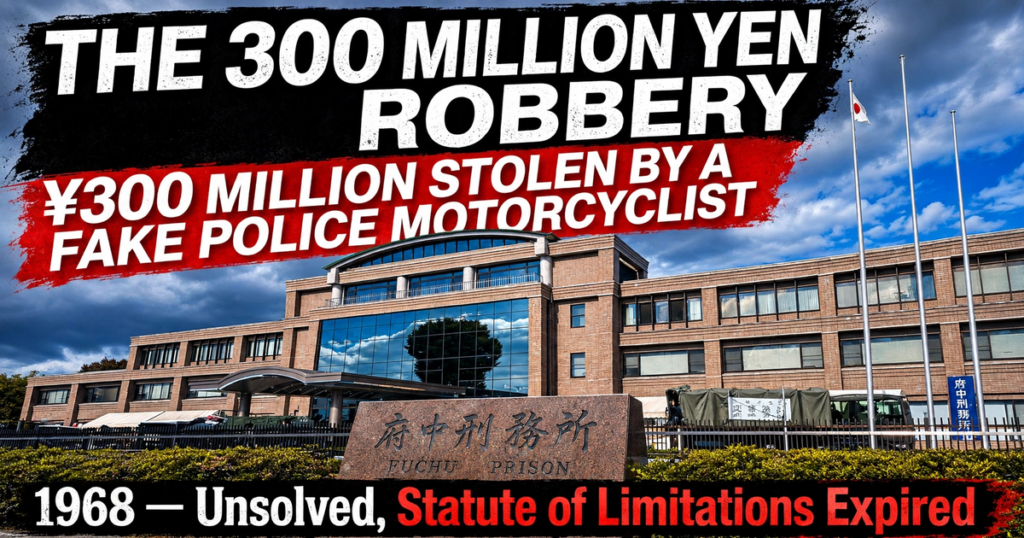
A cash delivery disappeared on a road in Fuchu
At about 9:20 a.m. on December 10, 1968, a cash transport vehicle was travelling from the Kokubunji branch of the Nippon Trust Bank to the Toshiba Fuchu Works in Tokyo. It carried ¥294,307,500 in winter bonuses intended for approximately 4,500 factory employees. Four bank employees were in the vehicle, and the money had been divided among three aluminium cases. The amount was close to ¥300 million, which gave the crime its familiar name, but the exact sum was ¥294,307,500. The vehicle was stopped on a road north of Fuchu Prison by a man riding a white motorcycle and dressed to look like a police officer. The man took the transport vehicle and disappeared with the cases. No one was killed or injured.
A threat had arrived at the bank four days earlier
The disguise worked in part because the bank employees had recently received a separate threat. On December 6, a letter demanding ¥3 million had been sent to the bank, warning that the branch manager’s home would be bombed if the money was not provided. When the motorcycle rider approached the transport vehicle four days later, he claimed that an explosion had occurred at the manager’s home and that a bomb had also been placed under the vehicle. The employees already knew about the earlier threat and therefore had reason to take the warning seriously. The man did not need to overpower them with a weapon. He used the appearance and authority of a police officer, together with information about the earlier threat, to make them leave the vehicle.
A flare was presented as evidence of a bomb
The disguised man pretended to inspect the underside of the cash transport vehicle. He then ignited a flare, creating smoke and flame that could be mistaken for an explosive device. He warned the bank employees that the vehicle might explode and directed them away from it. Once they had moved to safety, he entered the driver’s seat and drove away with the cash. The operation took approximately three minutes. Its central feature was deception rather than direct violence: the employees were induced to leave the vehicle because they believed the man was protecting them from a bomb. The case is often described in popular language as a robbery or a cash heist, but the legal classification requires a separate explanation.
The transport vehicle and the empty cases were found later
The police began searching immediately. The transport vehicle was found about an hour later in a wooded area in Kokubunji, approximately one kilometre from the original scene. The three aluminium cases were gone. On April 9, 1969, roughly four months after the crime, another vehicle believed to have been used in the escape was found in a housing-complex parking area. The three cases were inside, but the money had been removed. The discovery established that the cash had been transferred out of the original transport vehicle and that the cases had been moved again. It did not establish who had driven the vehicles or where the money had gone. Investigators continued tracing vehicles and objects, but the recovery of the cases did not produce an arrest.
A large quantity of physical evidence did not identify an offender
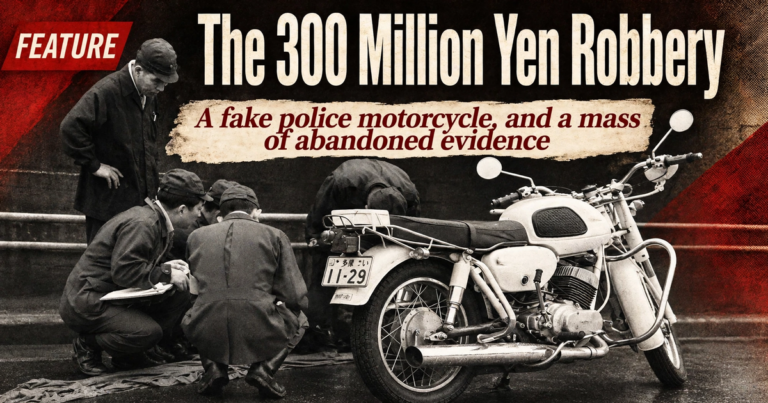
Investigators examined 153 items connected with the crime, including the false police motorcycle, helmet, flare, vehicles, clothing and other equipment. A small piece of newspaper was later found in paint on a transistor megaphone attached to the fake motorcycle. The police traced the circulation and possible purchase routes of individual objects. A montage image of the suspected offender was released on December 21, eleven days after the theft. The investigation was exceptionally large: figures compiled from contemporary records cite a total of 171,805 police personnel deployed, 117,950 people questioned or interviewed, and investigation costs of approximately ¥900 million. The scale of the operation did not guarantee that any one person could be connected to the offence with evidence sufficient for prosecution.
The offence was legally treated as theft, not robbery
Although newspapers and books sometimes call it the Three Hundred Million Yen Robbery, the Japanese case article explains that the offence was classified as theft under the criminal law. The offender did not use violence against the bank employees or directly threaten them with a weapon in order to force them to hand over the money. Instead, he impersonated a police officer, deceived them into believing that an explosion was imminent, and took the vehicle while they were away from it. The popular word robbery therefore should not be mistaken for the legal classification. This distinction is important because the name of a crime in public discussion does not automatically determine the statutory offence or the applicable legal process.
The prosecution limitation period expired in 1975
No person was arrested and charged with the theft. Under the law applicable at the time, the prosecution limitation period expired on December 10, 1975, seven years after the incident. A civil limitation period was reported to have expired on December 10, 1988. The expiration of the prosecution period did not amount to an acquittal: no defendant had been tried, and no court had found anyone innocent or guilty. It meant that the criminal prosecution could no longer proceed for the offence. The later abolition of limitation periods for certain serious crimes did not revive a case whose limitation period had already expired. The crime remains unsolved in the historical sense, but the legal position is different from a murder investigation that remains open to prosecution.
Famous theories have never become judicial findings
Many theories about the offender have appeared in books, television programmes and newspaper reporting. Some focus on a young person, others on a group or on people with particular access to police equipment or information. None of these theories resulted in a criminal conviction, and no court identified a perpetrator. A person being investigated, mentioned in a report or proposed by a later writer is not the same as a person whose guilt has been legally established. The most reliable account therefore separates confirmed facts—the date, the amount, the method, the recovered vehicles and the expiry of the prosecution period—from speculation about the identity of the offender. The money was never recovered, and the person who took it remains unidentified.
Original Japanese record: 三億円事件|偽白バイと発炎筒で2億9430万7500円を奪い、1975年に公訴時効
Last updated:
Related articles
Same case · Feature
The 300 Million Yen Robbery: The 'Perfect Crime' with Evidence Everywhere — A Fake Police Motorcycle and 294,307,500 Yen That Vanished

Case record
The King of Comedy Kenichi Takahashi School-Uniform Theft Case: 182 Items, 25 Victims, and a Suspended Sentence

Case record
The Luffy Wide-Area Robbery Cases: Four Separate Leadership Trials and Their Different Legal Stages

Case record