
The Higashiosaka Child Murder: Two Attacks on Two-Year-Old Makiko Tsuchiyama
Two-year-old Makiko Tsuchiyama was found unconscious with marks around her neck in an alley near her home in Higashiosaka on 19 October 1984. She survived and spent several days in hospital. About a month later, on 21 November, she was found in almost the same place with similar marks and died after being taken to hospital. Police reportedly investigated the incidents as related, but no offender was identified. The former limitation period expired before the 2010 abolition of the limitation period for murder.
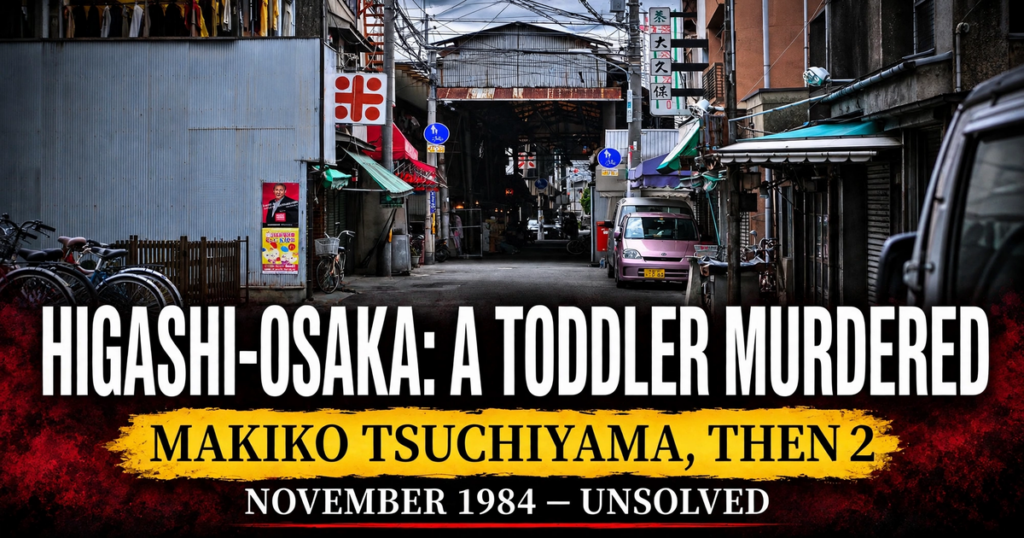
A two-year-old girl was found unconscious in an alley
On the afternoon of 19 October 1984, two-year-old Makiko Tsuchiyama was found lying face down in an alley near the home where she lived in Inaba, Higashiosaka City, Osaka Prefecture. She was unconscious and had marks around her neck consistent with pressure from a cord-like object. She was taken to hospital, regained consciousness and reportedly remained there for five days. The incident was initially described in later accounts as having been treated as an accident, although the original police records and newspaper originals from that day have not been directly verified in the materials reviewed.
The first incident was later reconsidered after a second attack
Some later summaries based on contemporary reporting say that police initially considered the possibility that a plastic cord attached to a nearby household door had accidentally caught around the child's neck. After the second incident in November, the earlier event was reportedly reconsidered as a possible criminal attack. The detail about the door and cord comes from later accounts, not a directly examined original police report. It should therefore be presented as a reported early explanation, not as an established finding about exactly how the first injury occurred.
The second incident occurred in almost the same place
At about 2:10 p.m. on 21 November 1984, Makiko was found again in an alley near her home, close to the location of the October incident. Later accounts say a neighbour heard a noise, checked the alley and found her near a drainage channel. Marks similar to those seen after the first incident were present around her neck. She was taken to hospital but died approximately nine hours later. Reports based on the contemporary coverage state that an autopsy identified asphyxiation as the cause of death.
The two incidents were investigated as possibly connected
The fact that the same two-year-old child had been found with similar neck injuries in nearly the same place about one month apart led investigators to examine whether the events were connected. Later newspaper-based accounts say police considered the possibility that the same person was responsible. That investigative theory is not the same as a judicial finding. No publicly available forensic report or trial record establishes that the two incidents were committed by one offender. The responsible person was never identified in the public record reviewed.
The child's age limited what could be learned from a direct account
Makiko was only two years old. After the October incident she survived, but she was too young to be expected to provide a detailed account of who had approached her or what had happened. After the November incident she died, so the opportunity to obtain further information from her was lost. This does not establish why the attacks occurred or whether the offender knew the family. It does explain why a case involving repeated injuries in a familiar area could remain difficult to investigate when there was no reliable description of a suspect and no public identification of the person responsible.
Later stories about telephone calls are not treated as proof
Later retellings have described telephone calls to the victim's grandfather's home, including a call from a woman who was said to have been crying. Accounts disagree about when the call occurred, and the materials reviewed do not include the original newspaper record, a telephone log or an official police document that identifies the caller. The identity of the caller and any connection to the attacks have not been established. For that reason, the telephone story is not used here to infer that the offender was a woman, a relative or someone known to the family.
No offender was publicly identified or brought to trial
The public record reviewed does not identify a person arrested or indicted for either incident. There is no criminal judgment that establishes the offender's identity, motive or relationship to Makiko. The two events were treated in later reporting as related, but the evidence available to the public does not allow the offender to be named or a particular theory to be presented as proven. The absence of a conviction must not be filled by assigning suspicion to a neighbour, relative or other person without a verified basis.
The former limitation period had expired before the 2010 reform
When the murder occurred in 1984, the limitation period for murder under Japanese law was 15 years. The period was later extended for certain serious offences in 2004 and abolished for murder in 2010. The 2010 reform did not revive cases for which the former limitation period had already expired. Later reporting and the archive article describe the limitation period in this case as having been completed under the former system. This means that the 2010 abolition did not reopen the possibility of prosecuting the unknown offender in this case.
The case remains an unresolved death, not an identified offender's crime
The facts that can be stated with care are that Makiko survived an incident on 19 October 1984, was found with similar injuries in almost the same place on 21 November and died after being taken to hospital. Police reportedly considered a connection between the events, but the same-offender theory was never confirmed in court. No suspect was publicly identified, and the former limitation period expired before the 2010 law change. The record should preserve both the seriousness of the child's death and the limits of what can now be established.
Original Japanese record: 東大阪女児殺人事件|2歳の土山真樹子ちゃんが同じ路地で二度襲われた未解決事件
Last updated:
Related articles
Case record
The Glico–Morinaga Case: Kidnapping, Corporate Extortion and an Unsolved National Investigation

Case record
The Cosmo Research Case: Two Abductions, One Hundred Million Yen and Litigation After the Executions

Case record
The 1985 Paraquat Poisoning Cases: Poisoned Drinks, Vending Machines and 78 Reported Incidents
Case record