
The Mizunami Kindergarten Teacher Murder: A Debt Dispute, Two Stolen Bank Cards and a Final Life Sentence
Kindergarten teacher Yoko Matsui, 40, disappeared after leaving work in Mizunami, Gifu Prefecture, on 7 May 2012. Her body was found in woodland five days later. The court found that Katsumi Ando, a longtime acquaintance who had borrowed about 10 million yen from her, killed her after she refused another loan, took two bank cards and withdrew 850,000 yen. The Gifu District Court imposed life imprisonment on 4 February 2013. Ando did not appeal, so the judgment became final.
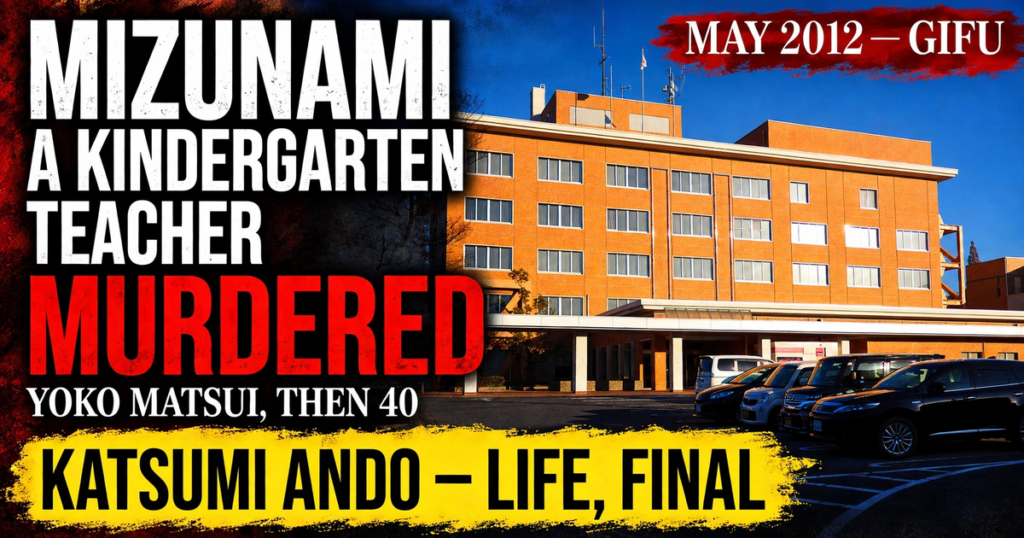
A kindergarten teacher disappeared after leaving work
On the evening of 7 May 2012, Yoko Matsui, a 40-year-old kindergarten teacher in Mizunami City, Gifu Prefecture, left her workplace at about 6:30 p.m. She did not return home or make the expected contact with her family. The following day was a day off, but her whereabouts remained unknown, and her family reported her missing. The case quickly became more serious when her car was found near Mizunami City Hall and money was withdrawn from two of her bank accounts shortly after she disappeared.
The ATM withdrawals pointed investigators toward a financial motive
At about 7:30 p.m. on 7 May, a person wearing a knitted cap and a mask withdrew a total of 850,000 yen from Matsui's two accounts at an ATM near City Hall. The money was taken in two transactions, reported as 350,000 yen and 500,000 yen. Security-camera footage showed a person whose face was concealed. The withdrawals were important because they occurred shortly after Matsui's disappearance and involved her own bank cards. The transaction records provided an objective amount and time for investigators to compare with the movements of people who knew her.
Matsui and Ando had known each other for more than a decade
The investigation focused on Katsumi Ando, an operator of an architectural-design office who had known Matsui for more than ten years. He had repeatedly borrowed money from her, and the total was reported to have reached approximately 10 million yen. Ando was experiencing financial difficulties after losing business and facing family medical expenses. On the day of the crime, he met Matsui near Mizunami City Hall and entered her car. He asked her for another loan. She refused. The court later treated the request and refusal as part of the motive for the robbery-murder.
The killing took place in Matsui's car, not in the woodland where her body was found
Matsui's body was discovered on 12 May in woodland in Mizunami, five days after she disappeared. She had a deep knife wound to the left side of her chest. The investigation established that the killing occurred inside her car in the City Hall parking area, not at the place where the body was later found. Ando used the car to transport her body to the woodland and left it concealed under leaves. Her car was later returned to the area around City Hall. The distinction between the murder site and the disposal site is important to the chronology.
The court examined whether Ando intended to kill her
Ando admitted bringing a knife but argued that he had intended to use it only to threaten Matsui if she refused to lend him more money. He claimed that the fatal wound occurred accidentally during a struggle and that the appropriate offence was not robbery-murder. The prosecution argued that he had planned to take her money and had prepared items including a knitted cap, a mask and boots. The court considered these preparations together with the later card withdrawals, the movement of the body and the disposal of clothing and cards.
The depth and location of the wound supported the finding of intent
The Gifu District Court placed weight on the fact that the knife had entered Matsui's left chest to a depth of approximately 9.5 centimetres. The wound was in a vital area. The court rejected the explanation that the knife had entered by accident during a scuffle. It found that Ando stabbed her to obtain her bank cards and the money in her accounts. The ruling treated the request for another loan, the refusal, the stabbing, the card taking and the immediate withdrawals as connected actions rather than unrelated events.
Two cards were used to withdraw 850,000 yen
After killing Matsui, Ando used two of her cash cards at the City Hall ATM to withdraw 850,000 yen. The transactions required PINs. Reports said that he used some of the money to pay his own debts. The court also considered the disposal of the cards, clothing and the car key. The sequence helped establish the robbery element of the offence. It was not simply a case in which a person happened to find a card after a death; the court found that the killing and the acquisition of money were linked by the purpose of obtaining property.
The knife was eventually found in the Kori River
During questioning, Ando initially said that he had discarded the knife in the nearby Toki River. Police searched there but did not find it. His account later changed, and a search based on the revised information found a knife in the Kori River near his home. Investigators also examined the disposal of the clothing used at the ATM and other items connected with Matsui. These details formed part of the evidence about what happened after the killing and how Ando attempted to conceal the offence.
Arrests and indictment covered more than the homicide
Ando was first arrested on 1 June 2012 on suspicion of abandoning a corpse and was rearrested on 11 June on suspicion of robbery-murder. He was also prosecuted for corpse abandonment, violations of the Firearms and Swords Control Law, theft and fraud. The fraud charges concerned separate incidents in 2010 and 2011 in which he allegedly presented fictitious construction plans to obtain money from construction-business representatives. Those fraud allegations were separate offences and should not be confused with the facts of Matsui's killing.
The life sentence became final because Ando did not appeal
On 4 February 2013, the Gifu District Court sentenced Ando to life imprisonment. The court accepted the robbery-murder charge and rejected the defence argument that the stabbing had been accidental. Ando did not appeal the judgment. It therefore became final without an appellate court or the Supreme Court reviewing the case. The final legal status is a life sentence imposed at first instance and made final by the defendant's decision not to appeal. The case is not an example of a sentence that became final after a Supreme Court ruling.
Original Japanese record: 瑞浪市幼稚園教諭殺人事件|松井洋子さん殺害と85万円引き出し、無期懲役確定まで
Last updated:
Related articles

Case record
The Manila Insurance Murders

Case record
The Ginza Wealthy Couple Robbery-Murders
Case record
The Sakahogi Family Triple Murder: A First-Instance Death Sentence Finalized by Withdrawal of Appeal
Case record