
The Jōshinsho Murder Case: An Insurance Killing Exposed by a Death-Row Inmate's Written Statement
In 2005, Ryōji Gotō, who was appealing a death sentence in a separate multiple-murder case, submitted a written statement to Ibaraki police describing several earlier deaths in which he said he had been involved. The central case later tried was the 2000 insurance killing of 67-year-old interior-decoration company owner Yutaka Kuriyama. Mikami Shizuo received a life sentence that became final in 2010; Gotō received a 20-year sentence in the Kuriyama case. The other allegations in the statement must not be treated as if they all resulted in convictions.
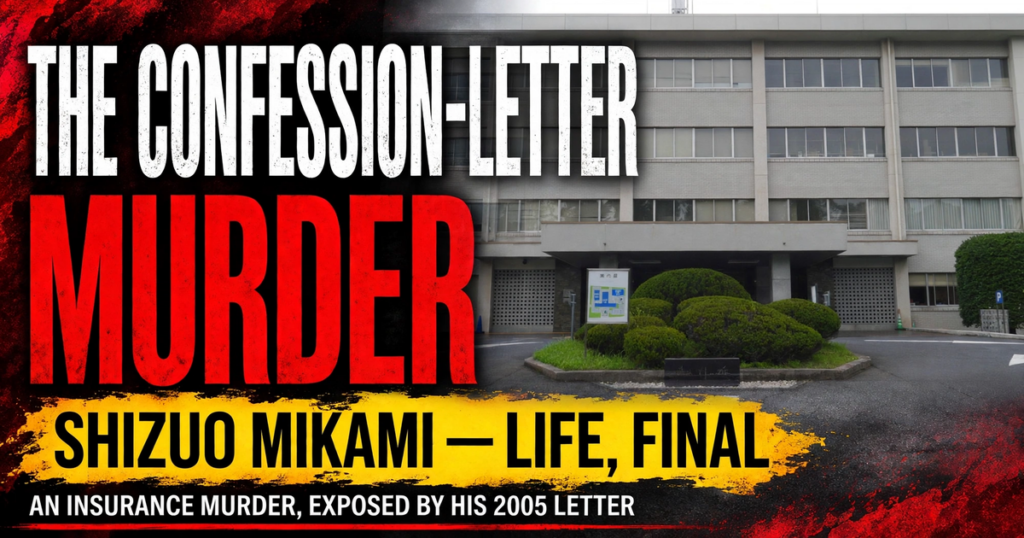
A written statement reopened several unresolved deaths
In 2005, Ryōji Gotō submitted a written statement, known in Japanese as a jōshinsho, to Ibaraki Prefectural Police. At the time, he was appealing a death sentence imposed in a separate multiple-murder case. The document described several earlier deaths and named people whom Gotō said had been involved. The statement became the starting point for renewed investigations. It did not, by itself, prove that every named person had committed a crime. Police still had to check the account against witness testimony, financial records, physical evidence and other independent information.
The term 'Jōshinsho Murder Case' covers more than one allegation
The label 'Jōshinsho Murder Case' is used for a group of allegations described in Gotō's statement, rather than for a single incident with one set of defendants. The best-documented case to reach a full criminal trial was the death of Yutaka Kuriyama, a 67-year-old owner of an interior-decoration company in Ami Town, Ibaraki Prefecture. Other incidents described in the statement were investigated, but they did not all lead to the same kind of prosecution or final judgment. A written accusation and a fact established by a court are different things.
Kuriyama had serious health conditions and was insured for a large amount
Kuriyama had conditions including liver cirrhosis and diabetes. He ran an interior-decoration business in Ami Town and had a life-insurance policy with a total benefit reported at approximately 100 million yen. The prosecution's case was that family members and outside participants planned to obtain the insurance proceeds by causing his death to appear connected to his existing illness and drinking. The court proceedings examined the relationships among the family, Mikami Shizuo, Gotō and other participants, as well as the insurance arrangements and the actions taken before Kuriyama died.
The court found that alcohol was used over an extended period
According to the prosecution case and the findings reported from the trial, Kuriyama was repeatedly made to drink alcohol over about a month, through 13 August 2000. The plan exploited his existing liver disease and other health problems. At the final stage, he was made to drink very high-proof vodka, reported as 96 percent alcohol. The method was intended to worsen his condition and cause death in circumstances that might initially be mistaken for illness or alcohol-related complications. The court accepted that the death was the result of a planned killing for insurance money, rather than a natural death.
The statement led to arrests in January 2007
After the 2005 statement, investigators reopened the relevant lines of inquiry. In January 2007, Mikami, Gotō and members of Kuriyama's family were arrested on suspicion of murder. The case had not been prosecuted as a murder for about six and a half years after Kuriyama's death. The investigation then examined the role of each participant and the insurance proceeds. Kuriyama's wife, daughter and son-in-law were also prosecuted. Their involvement was not treated as an allegation against the family as a whole; the courts considered the specific acts and responsibility attributed to each defendant.
Mikami denied involvement but was convicted as a central participant
Mikami denied involvement during the investigation and at trial. He argued that Gotō's statement was false and that Gotō was attempting to shift responsibility onto him. The prosecution relied not only on the statement but also on testimony from other participants and evidence about the plan and insurance payments. On 26 February 2009, the Mito District Court sentenced Mikami to life imprisonment, finding that he had played a central role. The judgment also noted that the killing had remained undiscovered until Gotō made his statement.
The appeal and final appeal left Mikami's life sentence intact
Mikami appealed, continuing to challenge the credibility of Gotō and the other participants. On 24 August 2009, the Tokyo High Court dismissed the appeal and upheld the first-instance judgment. The High Court considered the accounts of Gotō and other participants to be mutually consistent on important points. Mikami then filed a final appeal. On 3 March 2010, the Supreme Court rejected it, and the life sentence became final. This is the final criminal-procedure status for Mikami in the Kuriyama insurance-murder case.
Gotō received a separate 20-year sentence in the Kuriyama case
Gotō was also prosecuted for his role in Kuriyama's death. On 30 June 2009, the Mito District Court sentenced him to 20 years' imprisonment, rather than the prosecution's request for life imprisonment. The court recognised that he had disclosed an offence that had not yet been detected by submitting the written statement, and treated the disclosure as voluntary surrender under Japanese criminal law. The 20-year sentence in the Kuriyama case was separate from the death sentence that had already become final in another case involving five victims.
Three members of Kuriyama's family also received prison sentences
Kuriyama's wife, daughter and daughter's husband were convicted of offences including murder and fraud in connection with the insurance proceeds. Their prison terms ranged from 13 to 15 years and became final. The judgments therefore established criminal responsibility for the family participants as well as for Mikami and Gotō. The case was not simply an accusation made by a death-row inmate: the Kuriyama killing proceeded through arrest, indictment, trial and final judgments against multiple defendants. The courts examined the testimony and the insurance arrangements rather than accepting the written statement as conclusive proof.
Other allegations in the statement must remain separate
Gotō's written statement described other deaths and suspected crimes, including incidents that prompted searches and further questioning. Some details were investigated, but they did not all lead to a final murder conviction comparable to the Kuriyama case. In particular, it is inaccurate to write that every allegation in the document was proven in court or that all named people were convicted. The central legal record is the insurance killing of Kuriyama and the judgments entered against the defendants in that case. The broader label should be used with care because it can otherwise blur the difference between a lead, an allegation and an adjudicated offence.
Original Japanese record: 上申書殺人事件|死刑囚の告白で発覚した栗山裕さん保険金殺人と三上静男の無期懲役
Last updated:
Related articles

Case record
The Goka High School Girl Murder: The Disappearance of Mai Sato After a Summer Festival
Case record
The Utsunomiya Confinement Murders: Two Deaths, Three Survivors and a Final Death Sentence
Case record
The Ibaraki University Student Murder: DNA Evidence, Two Life Sentences and a Third Suspect Still Sought
Case record