
The One-Hundred-Million-Yen Find in Ginza: Hisao Ohnuki and the Six-Month Wait for an Unknown Owner
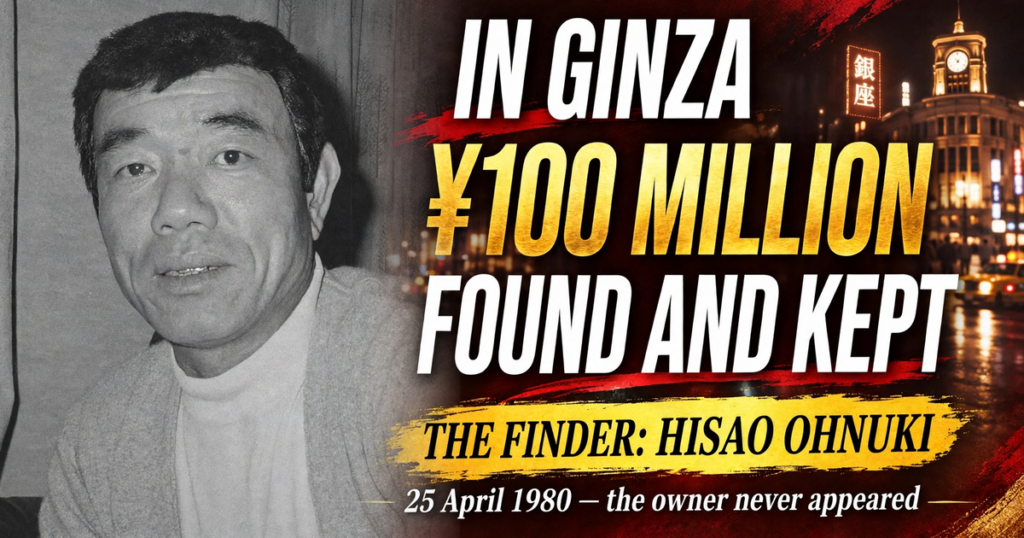
On 25 April 1980, truck driver Hisao Ohnuki found a cloth-wrapped bundle on Showa-dori in Tokyo's Ginza district. It contained ten bundles of banknotes worth a total of 100 million yen. He reported the money to police. When no owner was legally identified during the six-month period then prescribed by Japan's lost-property system, ownership passed to Ohnuki at midnight on 9 November 1980. The source of the money was never officially established.
A cloth-wrapped bundle appeared on Showa-dori
At about 6 p.m. on 25 April 1980, truck driver Hisao Ohnuki, then 42, noticed a light-brown cloth bundle near a guardrail along Showa-dori in Ginza 3-chome, Chuo Ward, Tokyo. Newspaper was visible through the wrapping. Ohnuki did not know that the bundle contained money; he thought it might be a stack of old newspapers that could be taken away for recycling. He placed it on his truck and brought it home. When the contents were examined there, the bundle proved to contain ten separate packets of banknotes, each worth 10 million yen. The total was 100 million yen.
The money was reported to the police rather than kept
After the discovery at home, Ohnuki reported the money to the police. The notes were arranged in ten packets of 10 million yen each. The amount was extraordinary for an individual to find on a city street: at the time, the first prize in the year-end lottery was 30 million yen. The police took custody of the money while the owner was sought. Ohnuki did not become its owner simply by finding it, and he could not lawfully treat it as his own while the lost-property procedure was still under way. The central question became whether anyone could establish a lawful claim to the cash.
The six-month rule in force in 1980 governed the claim
Under the law then in force, the police were required to publish a formal notice when the owner could not be identified. The six-month period ran from the date of that notice, not simply from the moment Ohnuki first saw the bundle. If no owner was established within the six months after publication, the finder could acquire ownership, provided he had complied with the reporting requirements. The modern system ordinarily uses a three-month period. That later rule must not be applied retroactively to a find made in 1980. The cash remained under police control while the notice period was running.
Publicity made Ohnuki a national figure almost overnight
The discovery became national news. Ohnuki's name was reported soon after he handed the money in, and reporters gathered around his home. The coverage was not limited to the question of who had lost the cash. Ohnuki and his family also became the focus of unwanted attention. Later accounts describe repeated telephone calls, including demands for money, threatening messages and calls from people claiming that the cash belonged to them. One report said the calls reached about one hundred a day at their worst. Ohnuki was the person who had complied with the law by reporting the find, yet the sudden publicity created concerns about the family's safety.
No claimant was accepted before midnight on 9 November
The statutory six-month period following the official public notice expired at midnight on 9 November 1980. The public timeline confirms that this was the date ownership passed to Ohnuki; it does not give the exact date on which the police notice was posted. It would therefore be misleading to calculate the period directly from the date he found the bundle on 25 April. No person had been accepted by the authorities as the lawful owner by the end of the notice period. Contemporary reporting by Kyodo News recorded that ownership therefore passed to Ohnuki at that time. The date was widely remembered because the legal change of ownership did not occur on the day he found the bundle; it came only after the full statutory notice period had elapsed. The money's transition from police-held lost property to the finder's property was the decisive legal event in the story.
The amount Ohnuki actually received was lower than 100 million yen
Reports said that the amount left to Ohnuki after tax was approximately 66 million yen. The difference between the headline figure and the amount he ultimately received became part of the public story. Some accounts said that he wore a protective vest when collecting the money, reflecting the threats and intense attention that had followed the discovery. The tax treatment and the reported net amount should not be confused with the face value of the cash: the bundle contained 100 million yen, while the after-tax sum reported as received was about 66 million yen.
He bought a home but continued working as a truck driver
Later accounts said that Ohnuki used about 37 million yen to buy an apartment and placed much of the remaining money into savings and life insurance. He continued working as a truck driver rather than abandoning his occupation. The public had speculated about how a person might change after receiving such a large sum, but the reported details describe a relatively cautious use of the money. Ohnuki died in December 2000 at the age of 62. His death ended the life of the man most closely associated with the find, but it did not resolve the question of who had originally placed the bundle on the street.
The source of the money remains unproven
During and after the six-month search, theories circulated about the source of the cash. Reports mentioned possible political funds, money connected with stock-market dealings and other explanations. None of those theories was established through an official identification of the owner. Later people may have claimed a connection to the money, but a retrospective claim is not the same as an owner accepted through the police procedure in 1980. There is no verified basis for describing the 100 million yen as criminal proceeds, political money or the property of a named person. The accurate account ends with an unresolved origin, not a proven conspiracy.
A lost-property case, not a proven criminal incident
The event is often remembered as a remarkable find, but it should not be turned into a crime story without evidence. The established sequence is straightforward: Ohnuki found the wrapped bundle, reported it, waited while the owner was sought and acquired ownership after the six-month period expired. The identity of the person who left the money, the reason it was there and the source of the funds were never officially established in the materials reviewed. The case illustrates how Japan's lost-property system allocated ownership when a lawful owner could not be identified, as well as the personal consequences that intense publicity can create for an ordinary finder.
Original Japanese record: 一億円拾得事件|銀座で大貫久男さんが拾った現金1億円、6カ月後に所有権取得
Last updated:
Related articles

Case record
The HIV Blood-Product Scandal: Non-Heated Clotting Factors, Three Criminal Cases and the 1996 Settlement

Case record
The Morinaga Arsenic Milk Poisoning: More Than 12,000 Children Affected and Decades of Continuing Relief

Case record
The Kanemi Yusho Poisoning: PCB-Contaminated Rice Oil and a Relief System Still Operating Decades Later

Case record