
The JR Shinjuku Station Groping Allegation: The Death of Shinsuke Harada and the Unresolved Criminal Allegation
On 10 December 2009, 25-year-old Shinsuke Harada was accused of groping a female student at JR Shinjuku Station. He denied the allegation and called the police himself, saying that he had been assaulted. He was taken to Shinjuku Police Station for voluntary questioning and died after being struck by a train at Waseda Station the following morning. Police later referred him to prosecutors on suspicion of violating Tokyo's nuisance-prevention ordinance, but prosecutors declined to indict because he had died. His mother's civil claim against Tokyo was dismissed, with the result final in November 2017. No criminal court determined whether Harada had committed the alleged act.
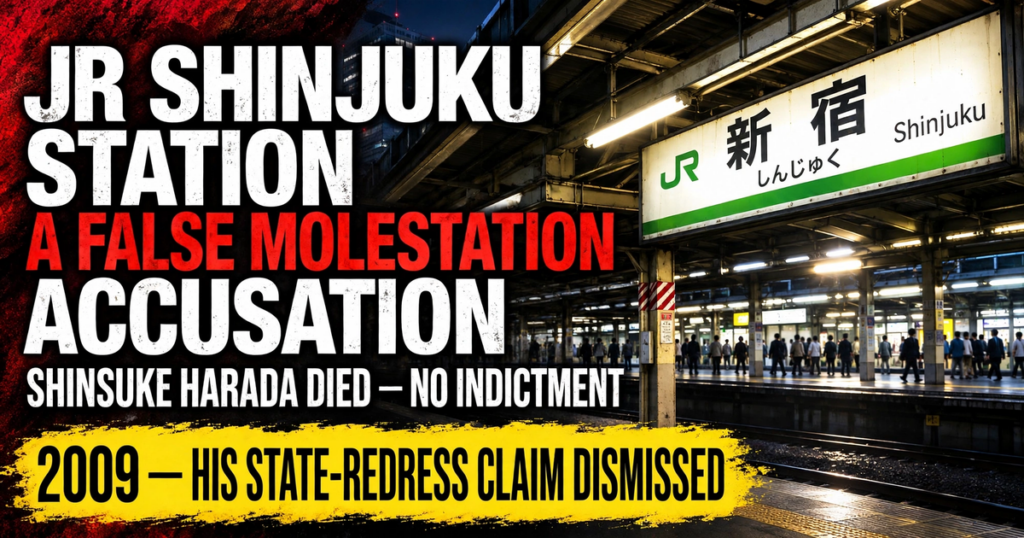
A groping allegation arose at JR Shinjuku Station on 10 December 2009
On the night of 10 December 2009, 25-year-old Shinsuke Harada was involved in a confrontation at JR Shinjuku Station while returning home from a work gathering. A female student accused him of touching her body. A physical struggle followed between Harada and people accompanying the student. Harada denied groping her and said that he had been assaulted. He used his mobile phone to call Japan's emergency number, 110, and ask the police to respond. The incident later became widely discussed as a possible wrongful groping accusation, but the criminal allegation was never resolved in a trial.
Harada went to the police station voluntarily rather than being arrested at the scene
After the confrontation, Harada went with police officers to a nearby police box and was then taken to Shinjuku Police Station for questioning. The Japanese archive stresses that he was not arrested in the act. He was treated as someone accompanying officers for voluntary questioning. The distinction matters because later litigation examined whether the circumstances of that questioning were effectively coercive and whether police properly considered his own report that he had been assaulted. The fact that he went to the station with officers should not be converted into a statement that he was formally arrested.
He died at Waseda Station the following morning
The questioning continued from late at night into the early morning of 11 December. After leaving Shinjuku Police Station, Harada travelled to Waseda Station on the Tokyo Metro Tozai Line, near Waseda University, where he had studied. He was struck by a train and died. Police treated the death as suicide. Harada's family and supporters later argued that the police response and the way he had been treated were connected to his death. No criminal judgment, however, established that causal connection. It remained a claim advanced by the family and supporters rather than a finding made in a criminal trial.
Police continued investigating the groping allegation after Harada's death
On 29 January 2010, 49 days after his death, Shinjuku Police Station referred Harada to prosecutors on suspicion of violating the Tokyo Metropolitan Government's nuisance-prevention ordinance. In Japan, a document referral sends an investigation file to prosecutors without necessarily arresting the suspect. Prosecutors then decide whether to indict. Because Harada had died, prosecutors declined to prosecute on the ground that the suspect was deceased. This was not an acquittal: there was no trial in which evidence about the alleged groping was tested and no court made a finding that Harada had or had not committed the act.
The family questioned the description of the alleged offender and the handling of evidence
Harada's family and supporters raised questions about the description given by the student, the difference between that description and Harada's clothing, the handling of station security-camera footage and documents prepared after his death. Materials released by supporters were said to include a police emergency-call memo with wording suggesting that the reported offender's clothing did not match Harada's. Those materials do not, by themselves, establish that police formally cleared him. The police continued their investigation and referred the allegation to prosecutors. The family and the Tokyo Metropolitan Government later offered sharply different accounts of whether the police response had been lawful.
Harada's mother filed a state-liability claim against Tokyo
On 26 April 2011, Harada's mother filed a civil lawsuit seeking 10 million yen in damages from the Tokyo Metropolitan Government. She argued that the voluntary accompaniment and questioning had been unlawful and that police had failed to deal properly with Harada's own report of assault. The case examined the events at the station, the questioning at Shinjuku Police Station and the investigation conducted after Harada's death. Tokyo denied that officers had unlawfully detained or questioned him. The claim was a civil action under Japan's State Redress Act, not a criminal prosecution of the police officers.
The civil courts rejected the family's claim, and the result became final
On 15 March 2016, the Tokyo District Court dismissed the mother's claim. The Tokyo High Court dismissed her appeal on 18 May 2017. On 16 November 2017, the Supreme Court rejected the family's final appeal, making the dismissal final. The result means that the civil courts did not find the police conduct unlawful for the purposes of state compensation. It does not mean that a criminal court found Harada guilty of groping, because no criminal trial took place. Nor does the civil judgment amount to a criminal acquittal.
The legal record does not establish either guilt or innocence on the groping allegation
The case is often called the Shinjuku Station groping wrongful-conviction case, but that label can be misleading if it is read as a final judicial finding. Harada was not convicted, and he was not acquitted. The criminal case ended in non-prosecution because he had died. The state-liability lawsuit was dismissed, but it addressed whether the police response was unlawful, not whether the alleged groping occurred. A careful account must keep those two legal tracks separate. The unanswered criminal allegation and the family's unsuccessful civil claim are both part of the record, but neither supplies a judicial determination of the underlying accusation.
Original Japanese record: JR新宿駅痴漢冤罪疑惑|原田信助さんの死亡、不起訴と国賠敗訴を分けて追う
Last updated:
Related articles
Case record
The Johnny Kitagawa Sexual-Abuse Scandal: Longstanding Allegations, Corporate Accountability, and the Compensation Process
Case record
The Shibuya Hirohito Multiple-Women Household Cases
Case record
The Shimbashi Stalking Murders
Case record