
The Fukui Junior High School Girl Murder: A Reversed Conviction, a Retrial Acquittal and a Prosecutorial Review
On March 19, 1986, a third-year junior-high-school girl was killed in her home in Fukui City on the night of her graduation ceremony. Shōji Maekawa, aged 21, was arrested a year later. The Fukui District Court acquitted him in 1990, but the Nagoya High Court's Kanazawa Branch reversed the decision in 1995 and sentenced him to seven years. The conviction became final in 1997. After two retrial applications and extensive disclosure of witness statements and police records, the High Court dismissed the prosecution's appeal on July 18, 2025. The acquittal became final on August 1. In July 2026, prosecutors published an internal review of how evidence had been handled.
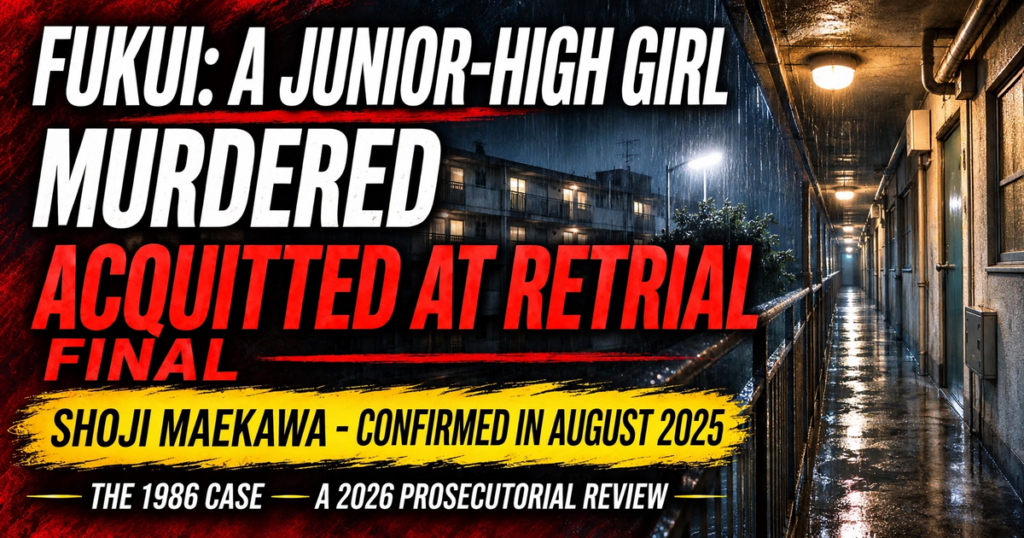
A student was killed on the night of her graduation ceremony
On March 19, 1986, a third-year junior-high-school girl, aged 15, was killed in her home in a municipal housing complex in Fukui City. She had attended her graduation ceremony that day. The murder investigation began with little direct physical evidence identifying the offender. The prosecution case that later developed against Shōji Maekawa depended heavily on statements from people who said they had seen him with blood on his clothing or had heard him make remarks suggesting involvement. The reliability and changing details of those statements became the central issue in the criminal proceedings.
Maekawa was arrested about a year later
Maekawa was arrested on March 29, 1987, when he was 21 years old, and was indicted in July. He denied committing the murder and did not make a confession that independently established his guilt. The main evidence was a collection of statements from people connected with the investigation. Some witnesses had themselves been under investigation in unrelated matters, and their accounts changed during questioning. The key question was not merely whether a witness had named Maekawa, but when the witness first made the statement, how it developed and whether it matched objective facts.
The Fukui District Court acquitted him in 1990
On September 26, 1990, the Fukui District Court acquitted Maekawa of murder. It found that the statements relied on by the prosecution had changed repeatedly and lacked sufficient objective support. The court also rejected the reliability of an examination that had attributed a hair found at the scene to Maekawa. The first-instance judgment concluded that the prosecution had not proved his guilt beyond reasonable doubt. The acquittal was not the end of the case because prosecutors appealed, and the next court assessed the same core witness statements differently.
The High Court reversed the acquittal and imposed seven years
On February 9, 1995, the Nagoya High Court's Kanazawa Branch reversed the acquittal and sentenced Maekawa to seven years in prison. It considered that the witnesses' accounts were broadly consistent despite changes in detail. The reversal did not rest on a newly discovered decisive physical item; it reflected a different assessment of the testimony already in the record. The Supreme Court dismissed Maekawa's appeal on November 12, 1997, and the conviction became final. He completed his sentence and was released in March 2003.
The first retrial request led to disclosure of 95 items
In July 2004, Maekawa filed his first retrial request. During the proceedings, 95 items of evidence, including witness statements that the defence had not previously been able to examine fully, were disclosed. On November 30, 2011, the Nagoya High Court's Kanazawa Branch ordered a retrial, finding the witness statements unreliable. Prosecutors challenged the decision. On March 6, 2013, the High Court cancelled the retrial order, reasoning that the new evidence did not sufficiently undermine the old evidence supporting the conviction. The Supreme Court rejected Maekawa's special appeal in December 2014, ending the first retrial procedure.
The second retrial disclosed 287 additional items
Maekawa filed a second retrial request on October 14, 2022. A further 287 items were disclosed, including internal police reports and records that helped compare witness statements with objective facts. The defence submitted expert opinions on statement psychology, psychiatry and luminol testing. One important inconsistency concerned a witness who used a television programme to explain where he had been on the night of the murder. Police records showed that the programme had been broadcast on a different date. The issue was that investigators had information about the discrepancy at the time, yet it was not adequately reflected in the original trial record.
The retrial proceedings exposed concerns about witness relationships
The newly disclosed materials also raised questions about the relationship between investigators and witnesses. Evidence examined during the retrial process indicated that police had given a wedding gift to a person who later testified, and that the handling of an unrelated drug investigation was relevant to the witness's cooperation. These circumstances did not automatically prove that every statement was false. They did, however, require careful examination because the conviction depended heavily on testimony rather than independent physical evidence. The defence argued that the prosecution and courts had not properly considered the incentives and pressures that could have influenced the witnesses.
The second retrial was ordered on 23 October 2024
On October 23, 2024, the Nagoya High Court's Kanazawa Branch granted the second retrial request. It found serious doubts about the credibility of the witness statements supporting the conviction. Unlike the first retrial request, prosecutors did not challenge the order. By October 28, 2024, the retrial commencement decision had become final. The retrial hearing opened on March 6, 2025, and concluded on the same day. Legally, the proceeding required the court to reconsider the prosecution's appeal that had overturned the 1990 acquittal, rather than simply conducting a completely new trial from the beginning.
The High Court restored the 1990 acquittal on 18 July 2025
On July 18, 2025, the Nagoya High Court's Kanazawa Branch dismissed the prosecution's appeal. The court found that reasonable doubt remained about the reliability of the witness statements and restored the acquittal originally entered by the Fukui District Court in 1990. Prosecutors waived their right to appeal on August 1, 2025, making the acquittal final. Maekawa's legal status therefore changed from a person with a final seven-year conviction to a person acquitted in the retrial. It would be wrong to continue describing him as the murderer or to treat the old conviction as still valid.
Compensation and the prosecutor's internal review continued in 2026
On December 2025, Maekawa sought compensation for legal expenses incurred during the long proceedings. On April 28, 2026, he filed a separate criminal-compensation claim for 3,185 days of detention and imprisonment, seeking 39,812,500 yen at the statutory maximum of 12,500 yen per day. These were compensation procedures separate from the final acquittal. On July 10, 2026, the Nagoya High Public Prosecutors Office published an investigation report. It examined how several prosecutors had known of police reports showing discrepancies between witness statements and objective facts but had failed to correct the record or ensure adequate disclosure. The office acknowledged serious problems and called for improved handling.
The murder remains unsolved even though Maekawa's conviction has been overturned
The final position must keep two facts separate. The 1986 murder occurred, and Maekawa's conviction was overturned by a final retrial acquittal in 2025. That acquittal did not identify another person as the killer. The public court record does not establish the identity of the person who murdered the student. The case is therefore both a wrongful-conviction case concerning Maekawa and an unresolved murder in which the perpetrator has not been judicially identified. The 2026 prosecutorial review added an institutional examination of evidence handling, but it did not itself identify the killer.
Original Japanese record: 福井女子中学生殺人事件|前川彰司さん再審無罪と2026年検察調査
Last updated:
Related articles
Case record
The Matsubase Case: A Confession Undone by a Surviving Piece of Cloth
Case record
The Himi Case: A Wrongful Conviction, a Prosecutor's Retrial Request and an Acquittal

Case record
The Shiromaru-kun Case
Case record