
The Eniwa Office Worker Murder: A Circumstantial-Evidence Conviction and Two Rejected Retrial Requests
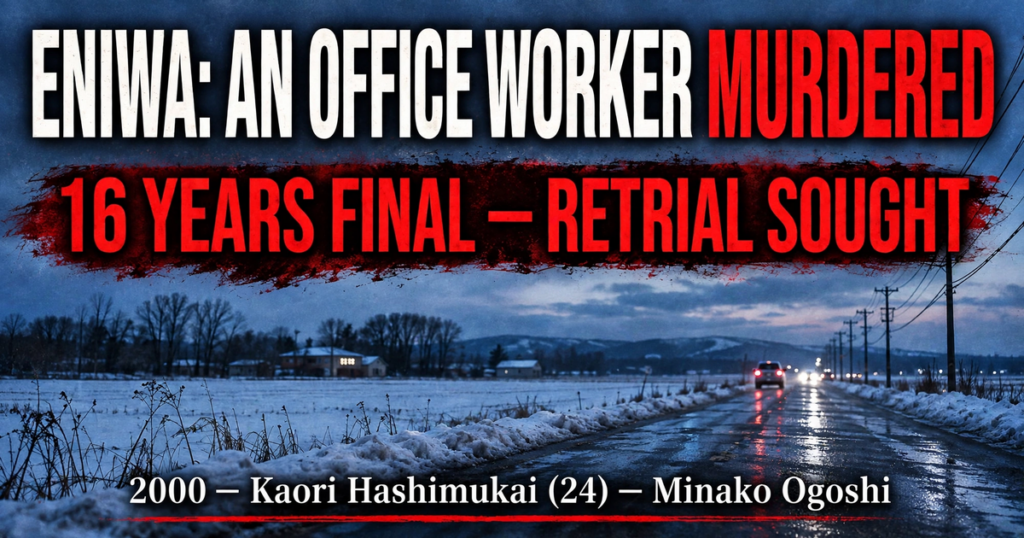
On March 16, 2000, 24-year-old office worker Kaori Hashimukai failed to return home after leaving work in the Chitose area of Hokkaido. Her badly burned body was found on a farm road in Eniwa the following morning. A former co-worker, Minako Okoshi, was arrested on May 23 and charged with murder and destruction of a corpse. The prosecution relied on a combination of circumstantial evidence, including telephone records, a locker key, kerosene purchases and the timing of a petrol-station visit. Okoshi denied the crimes. She was sentenced to sixteen years in 2003, and the conviction became final in 2006. Both retrial requests were rejected; she completed her sentence in August 2018 and continues to maintain her innocence.
Hashimukai did not return home after leaving work
Kaori Hashimukai, a 24-year-old company employee, worked at a logistics-related workplace in Chitose, Hokkaido. On the night of March 16, 2000, she finished work at around 9:30 p.m. and did not return home. Minako Okoshi, a 29-year-old former co-worker, left at about the same time and was among the last people from the workplace known to have had contact with Hashimukai. The next morning, Hashimukai did not appear for work and could not be reached. Her family and colleagues became concerned about her whereabouts.
Her burned body was found on a farm road in Eniwa
At around 8:20 a.m. on March 17, a woman driving a kindergarten bus noticed a blackened object on a farm road in Kitajima, Eniwa City. Nearby residents realised that it was a human body and contacted emergency services. The remains had been severely burned, making identification difficult. Through personal effects, physical characteristics and fingerprint checks, investigators identified the body as Hashimukai by the following day. Residents had reported seeing flames near the road between approximately 11:00 and 11:15 p.m. the previous night.
The final judgment found that Hashimukai had been strangled before the body was burned
The courts accepted that Hashimukai died from compression of the neck and suffocation, and that her body was burned after death. The judgment considered the absence of clear signs that she had been breathing during the fire. The body had been moved to the farm road and covered with an oil-based fuel before being set alight. The precise place where she was killed was not identified. Nor were a murder weapon, blood traces, DNA or fingerprints directly linking Okoshi to the killing recovered from her. Those limitations became important in the later debate over the strength of the circumstantial case.
The investigation relied on a series of indirect links
Police examined Hashimukai's car, telephone, workplace locker and contacts with co-workers. Her car was found near JR Osatsu Station, close to the workplace. It was locked and still contained personal belongings. Investigators recovered fingerprints from the vehicle, but no direct trace established that Okoshi had driven it or transported the body. Hashimukai's mobile phone was found in her locker at work, inside a pocket of her work clothes. Communication records indicated that the phone had moved between cell-site areas after Hashimukai left work. The prosecution argued that the phone's movements broadly matched Okoshi's movements that night.
A locker key and telephone records became significant evidence
The key to Hashimukai's locker was found in the glove compartment of Okoshi's car. The prosecution argued that Okoshi had used the key to return the mobile phone to the locker and later left the key in her vehicle. The courts treated the key and phone records as important circumstantial evidence. The defence disputed the reliability of the inferences, arguing that cell-site data identified only broad areas and did not prove that Okoshi and the phone were together at a particular place. Okoshi also said she did not remember placing the key in her car and challenged how it had been stored and found.
Kerosene purchases and the late-night petrol-station visit were disputed
Okoshi purchased ten litres of kerosene on the day of the incident. She said it was for use at home. The prosecution linked the purchase to the fuel used to burn Hashimukai's body. The judgment considered that the kerosene could have been used, but did not identify the purchased fuel itself as a sample recovered from the scene. The defence argued that ten litres could not have produced the extent of burning observed, relying on experiments and expert opinions. The prosecution responded that human and animal bodies burn differently and that body fat could sustain combustion. The courts did not accept the defence argument as sufficient to overturn the conviction.
The timing of the petrol-station visit was also challenged
At around 11:30 p.m. on March 16, Okoshi was recorded at a petrol station in Eniwa. The burned body had been seen on the farm road between approximately 11:00 and 11:15 p.m., and the location was about fourteen kilometres from the station. The defence argued that she could not have burned the body and reached the station in that time. The prosecution argued that the distance could be travelled in approximately fifteen to twenty minutes at speed. The Sapporo High Court accepted that the journey was possible and rejected the alibi argument.
The prosecution alleged a motive connected with a shared workplace relationship
Okoshi had been in a relationship with a man from the same workplace. The man later developed feelings for Hashimukai and told Okoshi that he wanted to end their relationship. The final judgment found that Okoshi had developed hostility toward Hashimukai and had a motive to kill her. The court also considered repeated anonymous calls to Hashimukai's mobile phone. Okoshi acknowledged making calls but denied having hatred strong enough to commit murder. The defence criticised the tendency to reduce the case to a simple love-triangle narrative and argued that the motive theory was being used to create a suspect profile.
Okoshi was arrested and convicted despite the absence of a confession or eyewitness
Hokkaido police arrested Okoshi on May 23, 2000. The Sapporo District Public Prosecutors Office indicted her on June 13 for murder and destruction of a corpse. She denied killing Hashimukai or burning her body. There was no eyewitness to the killing, no confession, no identified weapon or established murder location, and no direct DNA or blood evidence from Hashimukai in Okoshi's car. The prosecution relied on the combined weight of the telephone, locker key, kerosene, movements and workplace relationships. The defence argued that each item had an innocent explanation and that several uncertain facts could not collectively prove guilt.
The Sapporo District Court imposed sixteen years in 2003
On March 26, 2003, the Sapporo District Court found Okoshi guilty of murder and destruction of a corpse and sentenced her to sixteen years in prison. It found that Hashimukai had been strangled between about 9:30 and 11:05 p.m. on March 16 in Chitose, Eniwa or the surrounding area, and that her body had later been taken to the farm road and burned with kerosene. On September 29, 2005, the Sapporo High Court dismissed the appeal. The Supreme Court dismissed the final appeal on September 25, 2006, and the sixteen-year sentence became final in October.
Both retrial applications were rejected, and release did not erase the conviction
Okoshi filed her first retrial request in October 2012, relying on new combustion experiments and expert opinions. The Sapporo District Court rejected it on April 21, 2014; the Supreme Court dismissed the special appeal on June 13, 2016. She filed a second request on January 10, 2017, challenging the cause of death and the process by which the body had been burned. The district court rejected that request in March 2018, the High Court dismissed the immediate appeal in August 2018 and the Supreme Court dismissed the special appeal on April 12, 2021. Okoshi completed her sentence on August 12, 2018. Her release did not overturn the conviction, and she continues to maintain that she is innocent.
Original Japanese record: 恵庭OL殺人事件|懲役16年確定後も続いた2度の再審請求と争点
Last updated:
Related articles
Case record
The Asahikawa High School Student Murder
Case record
The Shibuya Junior-College Student Dismemberment Case: A Brother's Conviction and the Shift from Seven to Twelve Years
Case record
The Sada Abe Case: A 1936 Murder, a Six-Year Sentence and the Limits of the Historical Record
Case record