
The Los Angeles Suspicion: Two Separate Attacks, a Japanese Acquittal and an Unfinished U.S. Case
The expression “Los Angeles Suspicion” came to describe two attacks on Kazuyoshi Miura's wife, Kazumi, in Los Angeles in 1981: a hotel-room beating in August and a shooting on November 18. The legal outcomes were different. Miura was convicted of attempted murder for arranging the beating, and that conviction became final. In the shooting case, a Tokyo District Court imposed life imprisonment, but the Tokyo High Court reversed the conviction and the Supreme Court made the acquittal final in 2003. In 2008, U.S. authorities arrested Miura in Saipan under California warrants. The U.S. murder charge was dismissed, while a conspiracy charge remained; Miura died before trial, and no U.S. verdict was delivered.
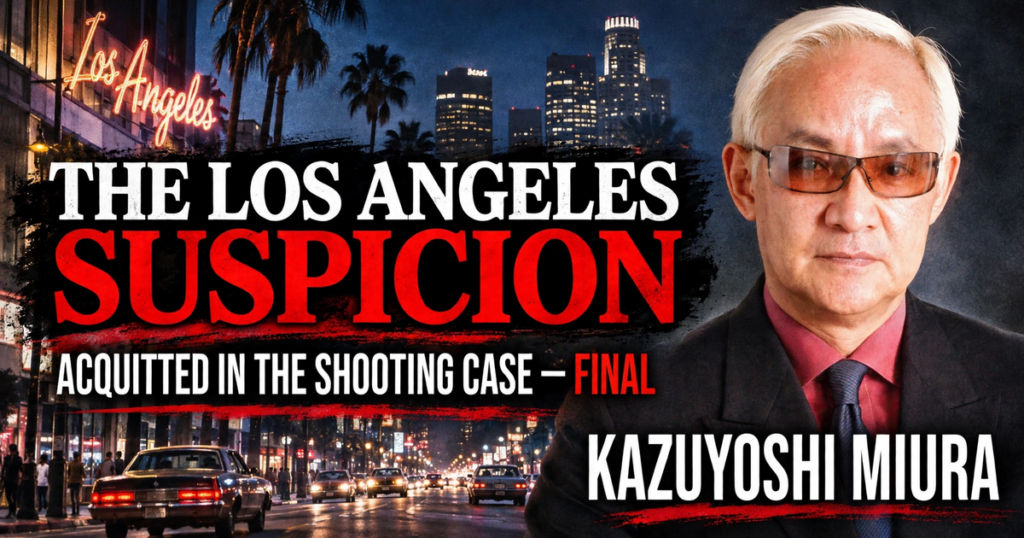
The label covered two criminal cases, not one continuous murder conviction
The term “Los Angeles Suspicion” became widely used after magazine reporting began in 1984. It referred to a series of questions surrounding Kazuyoshi Miura and the attacks on his wife, Kazumi, in Los Angeles. For criminal-law purposes, however, the August 1981 beating and the November 1981 shooting were separate incidents and were prosecuted as separate cases. The conviction in the first case did not establish guilt in the second. Equally, the later acquittal in the shooting case did not erase the conviction for the earlier attempted murder. Any account that merges the two proceedings into a single judgment misstates the legal record.
The first attack took place in a hotel room in August 1981
In August 1981, about three months before the shooting, Kazumi was attacked in a hotel room in Los Angeles. A woman who knew Miura visited her and struck her on the head. The assault did not kill Kazumi, who survived the attack. The woman was later prosecuted for attempted murder. She told investigators that Miura had asked her to kill his wife. The Tokyo District Court sentenced her to two years and six months in prison in January 1986, and the appellate court maintained that judgment. She did not appeal to the Supreme Court, so her conviction became final.
Miura was convicted of arranging the hotel-room beating
Miura denied asking the woman to kill Kazumi. On August 7, 1987, the Tokyo District Court nevertheless found that he had conspired with her and sentenced him to six years in prison for attempted murder. The court relied on her account and the circumstances surrounding the attack. Miura appealed and continued to contest the finding. In September 1998, the Supreme Court dismissed his appeal, and subsequent objections were also rejected. The attempted-murder conviction in the beating case therefore became final. This result is a distinct part of the record and should not be described as a conviction for the later shooting.
The second attack occurred on November 18, 1981
On November 18, 1981, Miura and Kazumi were shot in Los Angeles. Kazumi was hit in the head and lost consciousness; Miura was wounded in the leg. Kazumi received treatment in the United States and was later brought to Japan, but she never regained consciousness. She died on November 30, 1982, approximately one year after the shooting. At first, Miura was reported as a person who had been attacked alongside his wife. The fact that he was injured in the same incident was part of the initial public account, before later reporting and investigations raised questions about his possible involvement.
Magazine reporting changed the public understanding of the shooting
In January 1984, the weekly magazine Shukan Bunshun began its “Suspicious Bullets” series. It examined insurance policies on Kazumi, the earlier beating and circumstances surrounding Miura. The reporting drew intense national attention and transformed the public narrative: a man initially described as a shooting victim was now the subject of suspicion. Newspapers, television programmes and other magazines followed. Miura denied wrongdoing, gave interviews and brought numerous defamation actions against media organisations. The volume of coverage helped create the broad social label “Los Angeles Suspicion,” but press allegations were not judicial findings.
Miura and Okubo were arrested and tried in Japan for the shooting
The Tokyo Metropolitan Police continued investigating the shooting. On October 20, 1988, Miura and an acquaintance, Okubo, were arrested on suspicion of murder. Both were indicted in November. The prosecution argued that Miura had planned Kazumi's killing to obtain insurance money and had acted in concert with another person. It also argued that the gunshot wound to Miura's leg was intended to make the incident look like a street robbery. Both defendants denied involvement. The prosecution's theory depended largely on circumstantial evidence, including insurance arrangements, relationships and conduct before and after the attack.
The Tokyo District Court imposed life imprisonment on Miura but acquitted Okubo
On March 31, 1994, the Tokyo District Court sentenced Miura to life imprisonment for the shooting. It found that he had conspired with an unidentified third party, even though it did not find that Okubo had been the shooter. The court acquitted Okubo of murder because the evidence did not sufficiently establish his involvement. Miura appealed, and the prosecution also challenged Okubo's acquittal. The difference between the two defendants' outcomes is important: the first-instance judgment did not convict both men, and it did not identify a proven shooter.
The Tokyo High Court reversed Miura's conviction, and the Supreme Court made the acquittal final
On July 1, 1998, the Tokyo High Court overturned Miura's life sentence and acquitted him. The appellate court found that the evidence did not sufficiently establish the existence of a co-conspirator or an agreement between Miura and that person to kill Kazumi. Doubts about insurance and surrounding events could not, by themselves, prove a murder conspiracy to the criminal standard. On March 5, 2003, the Supreme Court dismissed the prosecution's appeal. Miura's acquittal in the Japanese shooting case therefore became final. The judgment did not say that Kazumi had not been shot; it held that Miura's participation in a murder conspiracy had not been proved.
U.S. authorities arrested Miura in Saipan in February 2008
On February 22, 2008, almost five years after the Japanese acquittal became final, Miura was detained in Saipan while travelling. The arrest relied on warrants obtained by Los Angeles authorities in 1988 for murder and murder conspiracy. The Japanese government explained in Diet answers that the constitutional rule against double jeopardy in Japan does not itself determine whether another country's courts may exercise jurisdiction. A Japanese acquittal therefore did not automatically cancel the U.S. warrants or end U.S. proceedings. The arrest was a separate exercise of U.S. jurisdiction, not a reopening of the Japanese case.
The U.S. murder charge was dismissed, but the conspiracy proceeding remained until Miura died
In September 2008, a Los Angeles County court ruled that the murder charge could not proceed in light of the earlier Japanese trial and acquittal for the same killing. The court allowed the murder-conspiracy charge to continue because that offence had not been prosecuted in Japan as the same offence. This was a procedural ruling about which charges could proceed; it was not a finding that Miura was guilty of conspiracy. On October 10, 2008, Miura was transferred from Saipan to Los Angeles and taken to a police detention facility. He was found hanging in his cell that night and was pronounced dead. The Los Angeles County coroner determined the death to be suicide. After his death, the remaining U.S. conspiracy proceeding was formally terminated. No U.S. conviction or acquittal on the conspiracy charge was entered, and the final Japanese acquittal in the shooting case remained intact.
Original Japanese record: ロス疑惑|一美さん殴打事件の有罪、銃撃事件の逆転無罪と2008年米国再逮捕
Last updated:
Related articles
Same case · Feature
The Los Angeles Suspicion: Guilty of the Beating, Acquitted of the Shooting — Two Cases and the Japanese and American Justice Systems in the Case of Kazuyoshi Miura
Case record
The Oita Midoriso Case: An Acquittal After Hair Evidence and DNA Testing Were Reexamined
Case record
The Gunma Two-Women Murders: Two Killings Committed While on Parole

Case record