
The Los Angeles Suspicion: Guilty of the Beating, Acquitted of the Shooting — Two Cases and the Japanese and American Justice Systems in the Case of Kazuyoshi Miura
In 1981, Kazumi Miura was attacked twice in Los Angeles: first beaten in a hotel and later shot on the street. She died in Japan in 1982. The proceedings against her husband, Kazuyoshi Miura, produced different outcomes. He was convicted of attempted murder in the beating case, while the murder conviction in the shooting case was overturned and the acquittal became final in 2003. In 2008, U.S. authorities arrested him in Saipan, but he died before any American trial could determine guilt or innocence.
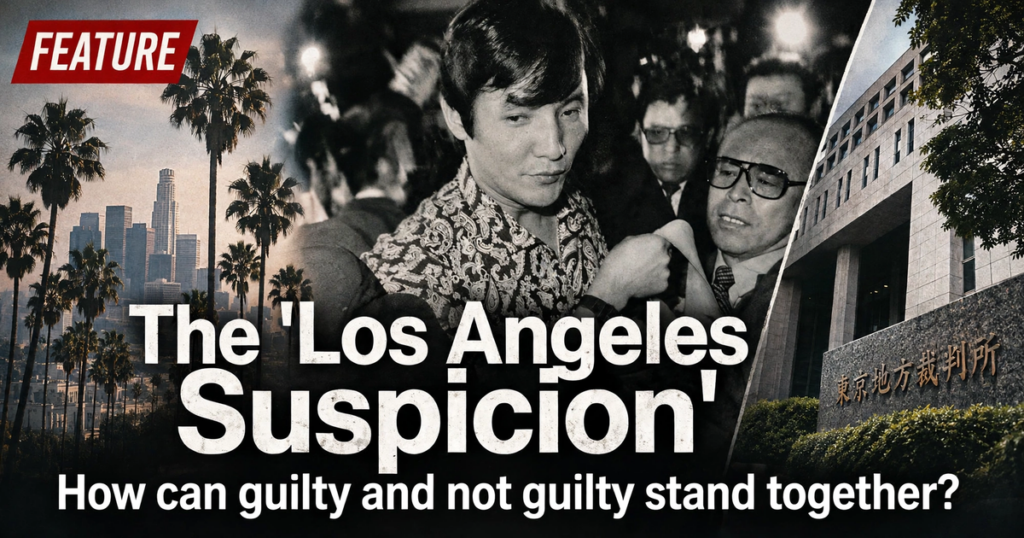
Introduction: Two attacks, two different judicial outcomes
In 1981, Kazumi Miura was attacked twice in Los Angeles. On 13 August, she was struck on the head in a hotel room. On 18 November, she was shot on a street. She was taken to Japan for treatment but died on 30 November 1982.
The events later became known collectively as the Los Angeles Suspicion, or the "Los Angeles case." But the criminal judgments concerning her husband, Kazuyoshi Miura, were not the same. In the beating case, he was convicted of attempted murder and the conviction became final. In the shooting case, a life sentence imposed at first instance was overturned and he was acquitted of murder; that acquittal became final in 2003.
In 2008, Miura was arrested in the U.S. territory of Saipan at the request of the Los Angeles authorities. The United States sought to pursue proceedings concerning the shooting, even though a Japanese court had acquitted him of murder. The American proceedings distinguished the charge of murder from the separate offence of conspiracy to commit murder. Miura died before any trial could determine the allegations.
The name "Los Angeles Suspicion" can make the events sound like one case with one answer. In fact, there were two separate attacks, different evidence and different legal proceedings. The beating conviction does not prove that Miura arranged the shooting, and the shooting acquittal does not erase the conviction in the beating case.
The term 'Los Angeles Suspicion' covered more than one event
The phrase "Los Angeles Suspicion" spread through weekly-magazine reporting that began in 1984. The coverage discussed not only the two attacks on Kazumi but also insurance contracts and circumstances surrounding Miura. As a result, the public often treated the collection of allegations as one large case.
The criminal proceedings nevertheless required at least two separate events to be distinguished. The beating took place in a hotel on 13 August 1981. Kazumi was struck on the head with a metal object and injured. The shooting took place on a street on 18 November 1981. She was shot in the head and died the following year.
Miura's criminal responsibility was different in each case. He was convicted of attempted murder in the beating case. In the shooting case, the murder conviction was overturned and his acquittal became final in 2003. The principal evidential questions were also different: whether he had asked someone to kill Kazumi in the beating case, and whether he had conspired with the person who shot her in the later case.
The fact that the same victim was attacked twice in the same city does not make the two attacks one crime. A judgment about one event cannot automatically establish guilt in the other.
The first attack: the hotel beating
The first attack occurred on 13 August 1981 at a hotel in Los Angeles. A woman known to Miura entered the hotel room and struck Kazumi on the head with a metal weapon. Kazumi suffered a head injury but survived the attack.
The woman identified as the person who carried out the beating stated that Miura had asked her to kill Kazumi. The Tokyo High Court case materials described how she received a weapon from Miura, entered the hotel room and attacked Kazumi, as well as her statements and conduct after the incident.
The woman was sentenced to two years and six months in prison by the Tokyo District Court in 1986. The appellate court maintained the judgment, and she did not appeal further. Her conviction became final.
Miura was arrested on 11 September 1985 on suspicion of attempted murder in connection with the beating. On 7 August 1987, the Tokyo District Court found that he had conspired to have Kazumi killed and sentenced him to six years in prison for attempted murder.
Miura appealed and then sought review by the Supreme Court. In September 1998, the Supreme Court dismissed his appeal, and the attempted-murder conviction in the beating case became final. The period of pretrial detention was credited toward the sentence, so the remaining time to be served after final judgment was shorter than the six-year sentence stated in the judgment.
What became final in this case was Miura's conviction for attempted murder in the August 1981 beating. It did not establish that he was guilty of the later shooting.
The evidence in the beating case
The testimony of the woman who carried out the beating was important evidence. The Tokyo High Court case materials described how she had been approached by Miura, the plan, her actions in the hotel room and what she said after the attack.
Medical records made immediately after the incident and accounts Kazumi gave to her family after returning to Japan were also considered as evidence of the injuries and circumstances.
The trial therefore examined an identified person who had actually attacked Kazumi, her statements about the request and the relationship between her conduct and Miura. The prosecution's theory of solicitation and conspiracy was considered against that evidence.
The later shooting case was different. The person whom prosecutors initially alleged had fired the shots was not found by the court to have been involved. The evidence concerning the identity of the shooter and the existence of a conspiracy was much less direct.
The second attack: the street shooting in November 1981
On 18 November 1981, Kazumi and Miura were shot on a street in Los Angeles. Kazumi was hit in the head, and Miura was shot in the leg. Kazumi received treatment in the United States and was later taken to Japan, but she never regained consciousness. She died on 30 November 1982.
At first, Miura was treated as a victim of the shooting alongside his wife. Later reporting focused on insurance contracts and his conduct before and after the incident. Magazine articles in 1984 raised the suspicion that he had planned the shooting to obtain insurance money.
The Tokyo Metropolitan Police Department continued its investigation and arrested Miura and his acquaintance Yoshikuni Okubo on 20 October 1988 on suspicion of murder. The two were indicted for murder in November of that year.
The prosecution argued that Miura had planned to kill Kazumi to obtain life-insurance proceeds and had conspired with Okubo. The initial theory was that Okubo had carried out the shooting.
There was no confession by the alleged shooter or direct written record of an agreement between Miura and the shooter. The prosecution relied on circumstantial evidence including insurance contracts, personal relationships, telephone contacts, vehicles near the scene and conduct before and after the shooting. The issue was how far those circumstances could establish participation in the murder.
The first-instance court imposed life imprisonment, but acquitted Okubo
On 31 March 1994, the Tokyo District Court sentenced Miura to life imprisonment for the shooting case. It acquitted Okubo, who had been indicted as the shooter, because the evidence did not sufficiently establish his involvement in the murder.
The first-instance judgment had an unusual structure. It did not accept the prosecution's claim that Okubo was the person who had fired the shots. But it found that Miura had conspired with an unidentified third person to kill Kazumi and convicted him of murder.
In other words, the court did not find that Okubo had carried out the shooting. It nevertheless concluded that Miura had conspired with someone whose name was unknown. This became a major issue on appeal because the prosecution had originally alleged a conspiracy with Okubo.
Why the Tokyo High Court overturned the murder conviction
On 1 July 1998, the Tokyo High Court overturned Miura's life sentence and acquitted him of murder in the shooting case. The decision was not based only on the fact that the shooter had not been identified. The High Court examined both the evidence and the procedural way in which the first-instance court had changed the alleged co-conspirator.
The prosecution had originally alleged that Miura conspired with Okubo. The district court acquitted Okubo but then found that Miura had conspired with an unidentified third person. It did so without following the procedure for changing the charge. The High Court held that replacing the alleged co-conspirator without a formal amendment affected the defendant's ability to understand and defend against the accusation.
The identity of the alleged co-conspirator matters to the defence. Contesting an agreement with Okubo is not the same as contesting an agreement with an unknown person. The defendant must know what facts he is required to answer and what evidence he must challenge. The High Court found a legal error in the first-instance procedure.
The High Court did not stop at that procedural issue. During the appeal, the prosecution added an alternative allegation that Miura had conspired with an unidentified person. The High Court then examined whether the existence of such a person and the alleged agreement could be proved.
It noted that the investigation had been extensive and prolonged, yet no person strongly suspected of having carried out the shooting had been identified. The evidence did not sufficiently establish either that Okubo was involved or that another co-conspirator existed. The proposition that the shooter was unidentified was not enough; the prosecution still had to prove that a co-conspirator existed and that Miura had agreed with that person to commit murder.
The High Court considered the insurance contracts, Miura's financial circumstances, his conduct, the alleged search for a shooter, the white van and witness accounts. It did not ignore those circumstances. But suspicious circumstances are not the same as proof of a murder conspiracy. The Court found reasonable doubt and acquitted Miura of murder.
The 1998 judgment did not acquit Miura of every offence. Its operative part also included a conviction for a separate fraud offence, for which he received one year in prison suspended for three years. It is therefore inaccurate to say that he was acquitted of all charges in 1998.
The shooting-case acquittal became final in 2003
The prosecution appealed the Tokyo High Court's acquittal. On 5 March 2003, the Supreme Court dismissed the prosecution's appeal, and Miura's acquittal of murder in the shooting case became final.
The final Japanese judgment meant that the prosecution had not proved to the criminal standard that Miura conspired with another person to kill Kazumi in the shooting. It did not mean that the shooting had not occurred or that Kazumi had not died. Those events were established. The question was whether Miura's participation in the murder had been proved.
The acquittal in the shooting case did not cancel the attempted-murder conviction in the beating case. The two judgments concerned different acts, different evidence and different charges. The attempted-murder conviction remained final.
In 2008, Miura was arrested again in Saipan
On 22 February 2008, approximately five years after the Japanese acquittal became final, Miura was arrested in Saipan, a U.S. territory, while travelling there. The arrest was carried out by local authorities at the request of the Los Angeles Police Department.
The arrest was based on warrants obtained by Los Angeles authorities in 1988 concerning murder and conspiracy to commit murder. The United States sought to pursue its own criminal proceedings concerning the shooting in Los Angeles even though the Japanese murder acquittal had become final.
The arrest raised the question of whether a foreign court could proceed under its own law after a person had been acquitted in Japan. Article 39 of the Japanese Constitution protects against being held criminally responsible again for an act after acquittal and against repeated criminal responsibility for the same offence. But the Japanese government's later explanation was that Article 39 governs criminal responsibility within Japan and does not itself determine the jurisdiction of foreign courts.
Did the Japanese acquittal prevent proceedings in the United States?
Following Miura's arrest, a written question was submitted to the House of Councillors on 17 October 2008 about the Japanese government's response to the Miura case. It asked about the problem of American proceedings after the Japanese acquittal and about whether Japan had provided investigative assistance to the United States.
On 24 October 2008, the government submitted a written answer. It explained that Article 39 of the Japanese Constitution concerns criminal responsibility in Japan and does not prescribe how foreign courts exercise their jurisdiction. Each country exercises jurisdiction under its own legal system. The government's answer stated that American proceedings concerning a case in which there had been a Japanese judgment did not, by themselves, violate Japanese sovereignty.
That answer did not mean that the Japanese government had declared the American prosecution correct. It was a legal explanation that Article 39 does not automatically bind foreign courts.
The government did not disclose the details of any investigative assistance requested by the United States. It said that it could not answer questions about specific cooperation in an individual criminal investigation. The Japanese Consulate General in Los Angeles did state that it met Miura after he arrived in Los Angeles on 10 October 2008, checked his health and conveyed his concerns about detention conditions and treatment to the Los Angeles Police Department.
The public record therefore supports the conclusion that consular assistance was provided and that the government did not disclose the details of investigative cooperation. It does not support a claim that Japan provided particular evidence to American investigators.
Why California treated murder and conspiracy separately
The American proceedings treated the charge of murder and the charge of conspiracy to commit murder separately. This distinction became central to the legal dispute.
California Penal Code section 656 had previously allowed a foreign conviction or acquittal for the same act to be raised as a bar to a prosecution in California. In a 2004 amendment, the reference to other countries was removed from the provision. The amended law took effect on 1 January 2005.
The shooting and the Japanese acquittal had both occurred before the amendment took effect. Miura argued that the 2004 amendment could not be applied retroactively to events from 1981 and the final Japanese acquittal in 2003. The prosecution argued that the amended law allowed at least the conspiracy charge to proceed.
On 26 September 2008, a Los Angeles County court ruled that the murder charge could not proceed in light of the Japanese proceedings, but that the conspiracy charge could continue because it was treated as a separate offence under California law. The conspiracy charge concerned an agreement to commit murder, an independent offence under California law. It was not the same legal concept as the Japanese doctrine of joint principal liability based on conspiracy.
The court's decision concerned which charges could proceed. It did not find Miura guilty of conspiracy. The prosecution still had to prove the alleged agreement in a trial.
The murder charge was still being contested when Miura died
After the September 2008 ruling, the American prosecution did not simply accept that the murder charge was over. According to the Los Angeles Times, prosecutors filed a motion on 9 October 2008 seeking to reinstate the murder charge on the basis of the 2004 amendment to California law. A hearing was scheduled for 16 October.
Miura was transferred from Saipan to Los Angeles on 10 October. According to the Los Angeles Police Department, he was booked into a police detention facility shortly before 6 a.m. At about 9:45 p.m. that evening, he was found unconscious in his cell, in a hanging position using clothing. Emergency treatment was provided, but he was pronounced dead at a hospital.
On 3 December, the Los Angeles County Medical Examiner determined that the cause of death was suicide and reported no evidence of fatal external trauma. His defence lawyers had questioned the cause, but the official finding was suicide.
Miura's death meant that the hearing scheduled for 16 October concerning the prosecution's motion to reinstate the murder charge did not take place. On 14 October, the American court formally terminated the remaining conspiracy proceedings following his death.
There was therefore no jury trial in the United States and no verdict of guilty or not guilty on either the murder or conspiracy charge. The American criminal proceedings ended because Miura died before trial.
The evidence explains why the beating and shooting produced different results
The legal history shows why the outcomes in the two cases were different rather than contradictory.
In the beating case, the woman who carried out the attack was identified. Her testimony, the events before and after the attack, the weapon and the injuries were examined. The courts found that she had attempted to kill Kazumi and that Miura had asked her to do so. Miura's attempted-murder conviction became final.
In the shooting case, the prosecution could not establish that Okubo had carried out the attack. The Tokyo High Court also found insufficient evidence that an unidentified third person had acted in agreement with Miura. Insurance arrangements and suspicious conduct could be considered, but they did not by themselves prove the existence of a conspiracy to murder.
The 2008 American proceedings did not overturn the Japanese acquittal. The American court considered the charges under its own law, but the case did not reach trial. The court's decision allowing the conspiracy charge to continue was not a finding of guilt, and the proceedings ended after Miura's death.
The final Japanese legal position was therefore: attempted murder conviction in the beating case; acquittal of murder in the shooting case, final in 2003; and no American conviction or acquittal because no trial took place.
What was legally established?
The legal outcomes can be summarised separately.
For the 13 August 1981 beating, the woman identified as the attacker was convicted of attempted murder and sentenced to two years and six months. Miura was convicted of attempted murder and sentenced to six years; his conviction became final in September 1998.
For the 18 November 1981 shooting, Miura received a life sentence at first instance on 31 March 1994. The Tokyo High Court overturned the murder conviction and acquitted him on 1 July 1998. The Supreme Court dismissed the prosecution's appeal on 5 March 2003, making the acquittal final. The separate fraud conviction in the 1998 judgment must also be remembered.
In the United States in 2008, the murder charge was initially held unable to proceed in light of the Japanese proceedings, while the conspiracy charge was allowed to continue under California law. The prosecution later sought to reinstate the murder charge. Miura died before the scheduled hearing, and the remaining proceedings were terminated. There was no American verdict on either charge.
The two Japanese outcomes were not different judgments about the same act. They were decisions about separate attacks, supported by different evidence. The American proceedings did not reverse the Japanese acquittal.
At a glance
Victim: Kazumi Miura. First attack: 13 August 1981, hotel in Los Angeles; head injury from a metal weapon. Second attack: 18 November 1981, street in Los Angeles; Kazumi was shot in the head and died on 30 November 1982. Beating case: the woman who carried out the attack was sentenced to 2 years and 6 months; Miura was sentenced to 6 years for attempted murder on 7 August 1987; the conviction became final in September 1998. Shooting case: Tokyo District Court imposed life imprisonment on 31 March 1994; Tokyo High Court acquitted Miura of murder on 1 July 1998 and also entered a separate fraud conviction; Supreme Court dismissed the prosecution's appeal on 5 March 2003, making the murder acquittal final. U.S. proceedings: arrested in Saipan on 22 February 2008; a Los Angeles court ruled on 26 September that the murder charge could not proceed at that stage while the conspiracy charge could continue; prosecutors sought to reinstate the murder charge on 9 October; Miura died in Los Angeles custody on 10 October; conspiracy proceedings ended on 14 October. No U.S. criminal trial or verdict took place.
Original Japanese feature: ロス疑惑【特集】|殴打では有罪、銃撃では無罪――三浦和義をめぐる二つの事件と日米の司法
Last updated:
Related articles
Same case · Case record
The Los Angeles Suspicion: Two Separate Attacks, a Japanese Acquittal and an Unfinished U.S. Case
Case record
The Oita Midoriso Case: An Acquittal After Hair Evidence and DNA Testing Were Reexamined
Case record
The Gunma Two-Women Murders: Two Killings Committed While on Parole
Case record