
The Kumatori Town Clustered Deaths: Seven Young People, Five Suicides and Rumours That Outran the Evidence
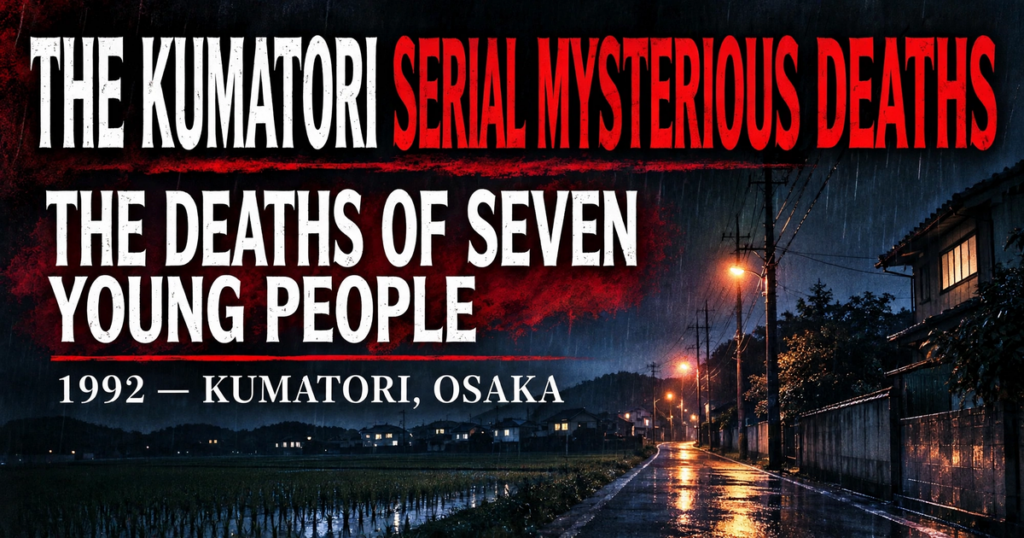
Between April 29 and July 3, 1992, seven young people aged 17 to 22 died in and around Kumatori Town, Osaka Prefecture. Two deaths were treated as accidents or deaths associated with inhalant use; five were suicides. Three teenage boys died by suicide on June 4, June 10 and June 17, roughly one week apart, and they had connections as friends or motorcycle companions. The concentration of deaths created anxiety and prompted national newspaper coverage, local patrols and a town youth-problem council meeting on July 6. Later accounts sometimes describe the deaths as a serial murder mystery, but contemporaneous reporting and police investigations treated the individual deaths as accidents or suicides. No single perpetrator or common homicide scheme was established.
Seven young people died over a little more than two months
From April 29 through July 3, 1992, seven young people aged between 17 and 22 died in Kumatori Town and nearby areas of Osaka Prefecture. The later label “Kumatori Town Serial Mysterious Deaths” can suggest that all seven were victims of the same crime. The Japanese article does not support that conclusion. Two deaths were treated as accidents or as related to inhalant use, while five were suicides. The deaths occurred over a short period and involved some overlapping social connections, but the circumstances and relationships were not identical.
The first two deaths were treated as accidents or inhalant-related deaths
The first death occurred on April 29, 1992, when a 17-year-old sheet-metal worker fell into a pond in Kumatori. Contemporary newspaper reporting said that he had a history of thinner inhalation and that the death was treated as an accident. On May 29, another 17-year-old boy died from acute heart failure after inhaling thinner. These two deaths preceded the three suicides in June. They were later included in the seven-death sequence because of the timing and some social connections, but they were not recorded as homicides.
Three teenage boys died by suicide on 4, 10 and 17 June
On June 4, a 17-year-old unemployed boy was found dead in an onion shed near his home. On June 10, an 18-year-old construction worker died in a barn at a house where he had previously lived. On June 17, another 18-year-old, who was working at an inn in Mie Prefecture, returned to Kumatori and died in an agricultural shed. Contemporary reports described the three deaths as suicides. The first two boys lived near each other and were motorcycle companions. The third returned to town to attend the funeral of the boy who had died on June 10.
The social links were real but did not prove a suicide pact
The first three boys were not strangers to one another. They had connections through friendship, school and motorcycle activities, and the third attended the funeral of the second. Newspapers reported that the deaths occurred six and then seven days apart. The funeral of the boy who died on June 10 was attended by approximately 400 young people of similar age. At the time, police considered whether the death of one friend might have influenced another. However, reporting did not establish a formal agreement among the boys to die together. The existence of social links is not proof of a common plan.
National newspapers began asking why the deaths were continuing
When a fourth suicide was discovered on June 25, national newspapers including Asahi, Yomiuri and Mainichi published reports on June 26 about the concentration of deaths in the town. Coverage focused on the short intervals, the connections among some of the young people and the lack of a clear explanation for the sequence. The Yomiuri Shimbun reported that police were examining the possibility of copycat or follow-on suicides. The Mainichi Shimbun reported that the town was planning an emergency meeting. The central concern in contemporary coverage was the impact of repeated deaths on young people, not a single identified killer.
A 22-year-old municipal employee was found dead on 25 June
On June 25, a man was found hanging in woodland on the Kaizuka City side of the area adjoining Kumatori. He was later identified as a 22-year-old resident of Kumatori who worked for Kishiwada City. Reports did not describe him as having the same close relationship with the first three boys as they had with one another. Police were still examining whether the deaths were connected. The fact that the death occurred in a nearby area and within the same period increased concern in the town, but it did not establish a common cause.
A 19-year-old university student died in the early hours of 3 July
On July 2, a 19-year-old female university student was reported to have inflicted a chest wound on herself near a sports ground in Kumatori. She died from blood loss at about 2:10 a.m. on July 3. Contemporary reporting said that she had entered a nearby university that spring and had previously received counselling. Her death brought the total to seven young people over the period from late April to early July. Five were treated as suicides and two as accident or inhalant-related deaths. The seven cases did not all involve the same method, location or social group.
The town convened a youth-problem council on 6 July
Kumatori Town held an emergency meeting of its Youth Problems Council on July 6, 1992. The council discussed the successive deaths and measures to address problems affecting young people. Contemporary reports described plans to strengthen patrols and address issues including thinner inhalation and motorcycle groups. The council had been established in 1974 to coordinate organisations involved in youth guidance, development and protection. The response therefore involved local government and youth-support organisations as well as the police. The deaths had become a community concern that extended beyond the investigation of each individual incident.
Rumours of a black car and serial attacks were not confirmed
As the deaths accumulated, rumours circulated that young people had been chased by a black car, that a random attacker was operating in the area or that some of the bodies had been restrained. The Yomiuri Shimbun reported on July 13 that stories had acquired additional details as they spread, making some young people afraid to walk alone at night. Police examined the scenes, forensic findings and witness accounts. In one case, a rumour that a boy's hands had been tied behind his back was explained by the way he had tied the rope so it would not loosen. The nearby presence of a vehicle in another case did not establish that the student had been followed.
The dates do not support the claim that all seven died on the same weekly cycle
Later summaries sometimes state that seven people died on the same weekday or at weekly intervals. The actual dates were April 29, May 29, June 4, June 10, June 17, June 25 and July 2. The impression of a weekly pattern came mainly from the three boys who died on June 4, 10 and 17, whose social connections were also reported. The other deaths did not occur at the same intervals. Preserving the dates prevents a later pattern from being imposed on events that were more varied.
The historical record is about clustered deaths, not a proven serial-murder case
The name used today can make the sequence sound like a single unsolved homicide investigation. The contemporaneous record instead describes two deaths treated as accidents or inhalant-related and five suicides. Police investigated the circumstances of each death, while newspapers and the town examined the possibility that one death might affect other young people. Rumours of a black car, an attacker or coordinated killings were not substantiated in the source. No common perpetrator or serial-homicide scheme was established. The case is best understood as a period of clustered youth deaths that caused serious anxiety in a local community.
Original Japanese record: 熊取町連続怪死事件|1992年に相次いだ若者7人の死と、町に広がった「連鎖」の不安
Last updated:
Related articles
Case record
The Higashiosaka Child Murder: Two Attacks on Two-Year-Old Makiko Tsuchiyama

Case record
The 1985 Paraquat Poisoning Cases: Poisoned Drinks, Vending Machines and 78 Reported Incidents
Case record
The Disappearance of Yuri Yoshikawa: The Unresolved Route Home from School
Case record