
The Shibuya Junior-College Student Dismemberment Case: A Brother's Conviction and the Shift from Seven to Twelve Years
Around December 30, 2006, 20-year-old junior-college student Azumi Muto was killed at the family home in Hatagaya, Shibuya, Tokyo. Her body was discovered by relatives on January 3, 2007. Her 21-year-old brother, Yuki Muto, was arrested the next day for damaging and dismembering the body, then re-arrested for murder on January 15. The trial turned on criminal responsibility at two separate stages: the killing and the subsequent dismemberment. The district court imposed seven years, but the Tokyo High Court found full responsibility for both offences and imposed twelve years. The Supreme Court dismissed the appeal in September 2009.
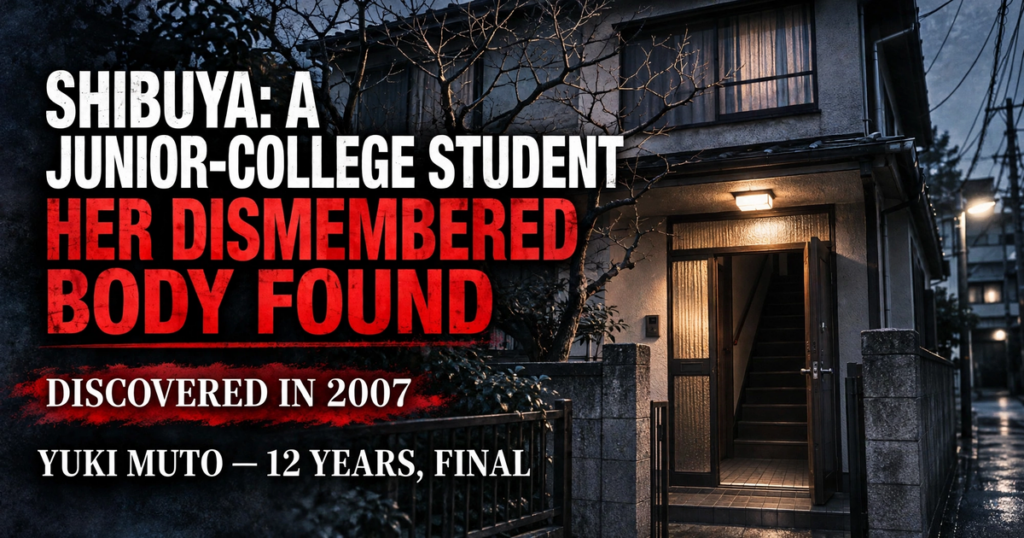
A killing inside the family home came to light after New Year
The offence occurred at around December 30, 2006, at the Muto family's home in Hatagaya, Shibuya Ward, Tokyo. Azumi Muto, a 20-year-old junior-college student, was killed by her older brother, Yuki, who was 21 at the time. The family did not discover the body until the evening of January 3, 2007, when relatives checked the third floor of the house. Her father reported the discovery to the Yoyogi Police Station that night. What had happened inside the home at the end of the year therefore became a police investigation only after the family found her remains.
The brother was arrested first on suspicion of damaging the body
On January 4, 2007, the Tokyo Metropolitan Police Department arrested Yuki Muto on suspicion of damaging his sister's body. During the investigation, he made statements to the effect that he had killed her. Police compared his account with the condition of the remains and other traces at the home. On January 15, he was re-arrested on suspicion of murder. The two allegations were closely connected in the investigation, but the later criminal proceedings had to consider whether he was legally responsible for each act at the time it was committed.
The court examined the killing and the dismemberment separately
The indictment charged Muto with murder and destruction of a corpse. A psychiatric assessment was conducted because his mental state was disputed. The assessment suggested that his ability to bear responsibility may have been reduced at the time of the killing and that he may have been in a state of insanity when he damaged the body. Criminal responsibility, however, is a legal conclusion rather than a medical label. The court had to consider whether he could understand the nature and wrongfulness of each act and control his conduct, taking account of his statements and behaviour before and after the offence.
The Tokyo District Court convicted him of murder but acquitted him of corpse destruction
In 2008, the Tokyo District Court found Muto fully criminally responsible for killing his sister. It convicted him of murder. For the later act of dismembering the body, however, it accepted that he had been in a state of insanity and acquitted him of the corpse-destruction charge. The prosecution had requested a prison term of 17 years, but the court imposed seven years. It is therefore inaccurate to describe the first-instance decision as finding that Muto lacked responsibility for the entire incident. The court drew a legal distinction between the homicide and the subsequent treatment of the body.
Both the prosecution and the defence appealed
The prosecution appealed because it argued that Muto had also been fully responsible when he damaged the body. The defence appealed on the ground that his criminal responsibility at the time of the killing had also been absent or impaired. The Tokyo High Court therefore had to review both sides' challenges. It examined the psychiatric evidence alongside Muto's statements during the investigation, his account at trial and a written statement he had prepared shortly after his arrest. The case was not simply a prosecution appeal seeking a longer sentence; the defence also challenged the murder conviction.
A written account made after arrest became important to the appeal
At the district-court trial, Muto repeatedly said that he could not remember the incident. The High Court placed weight on a written account he had prepared around the time of his arrest. That document contained specific details about the course of events. The appellate judges considered that it had been based on his own memory, rather than being a reconstruction supplied by investigators. This assessment affected the weight given to the psychiatric evaluation, because the evaluation had relied in part on his claim that he could not remember what he had done.
The Tokyo High Court found full responsibility for both offences
On April 28, 2009, the Tokyo High Court set aside the district court's judgment and sentenced Muto to twelve years in prison. It found that he had been fully criminally responsible not only when he killed Azumi but also when he dismembered her body. The acquittal on the corpse-destruction charge was therefore reversed. The increase from seven to twelve years reflected more than a change in the sentencing figure: the range of conduct for which he was held criminally responsible had expanded to include both murder and corpse destruction.
The Supreme Court left the twelve-year sentence in place
The defence appealed to the Supreme Court in May 2009. In September of that year, the Supreme Court dismissed the appeal. The Tokyo High Court's findings and twelve-year prison sentence consequently became final. The legal outcome was not the district court's seven-year term, and the Supreme Court did not conduct a new trial of the facts. It left the appellate judgment intact. The archive records no later judicial decision changing that final result.
The case illustrates why criminal responsibility must be tied to the time of each act
The central legal issue was not whether the family had experienced conflict or whether Muto had a particular medical diagnosis. It was whether he had been able to understand and control his conduct at the separate times when he killed his sister and later damaged her body. The district court and the High Court evaluated those stages differently. The final judgment found full responsibility for both. Azumi was 20 when she was killed, and the final criminal outcome was a twelve-year sentence for murder and destruction of a corpse.
Original Japanese record: 渋谷区短大生切断遺体事件|武藤亜澄さん殺害、一審7年を高裁が12年へ変更
Last updated:
Related articles

Case record
The Sada Abe Case: A 1936 Murder, a Six-Year Sentence and the Limits of the Historical Record
Case record
The Eniwa Office Worker Murder: A Circumstantial-Evidence Conviction and Two Rejected Retrial Requests

Case record
The Asahikawa High School Student Murder
Case record