
The Ichihara Family-Restaurant Shooting: Two Gang Leaders Killed in Front of 22 Bystanders
On April 25, 2005, two leaders of a rival organized-crime group were shot at a family restaurant that was open to the public in Ichihara, Chiba Prefecture. The attackers used two handguns and continued firing as the victims fled through the entrance and onto the pavement. Seventeen customers and five employees were inside. No bystander was killed, but bullets struck a customer table and shattered glass. Miyagi Yoshihide and Hamasaki Katsuji were tried separately, both received final death sentences, and both were executed on April 26, 2013.
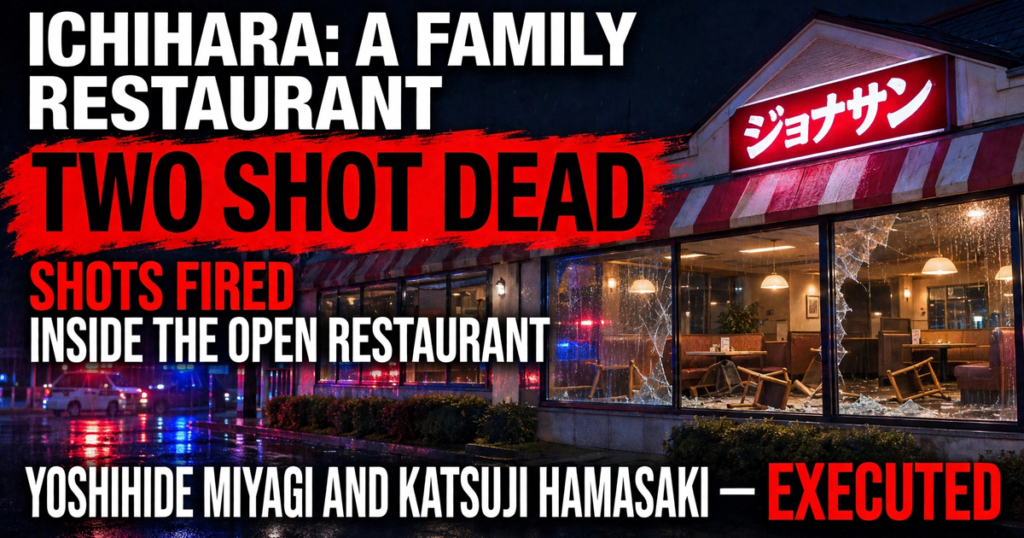
Two rival gang leaders were targeted at an open restaurant
On April 25, 2005, two men who led an organized-crime group were shot at a family restaurant in Ichihara, Chiba Prefecture. The restaurant was open to ordinary customers. The victims were seated opposite each other when the attackers began firing at close range. The gunfire did not stop inside the dining area. The victims fled toward the entrance, and the attackers followed them, firing near the doorway and on the pavement outside. Both men died. The case involved two homicide victims, but the danger extended to everyone who happened to be in the restaurant and nearby.
The attack was arranged under the appearance of a cash handover
The Supreme Court found that the victims' associates had been called to the restaurant. One conspirator was assigned to count cash at the table, making the meeting appear to be an ordinary money exchange. That role was intended to make the two victims lower their guard. The plan had been discussed in advance. When the signal was given, Miyagi and another participant fired at the men across the table. The use of cash as a diversion was part of the preparation and showed that the attack was not an impulsive response to an argument that arose inside the restaurant.
The shooting continued from the dining area to the pavement
Two handguns were used, and contemporary records cited by the archive report a total of eight shots. After the first close-range shots, the victims tried to escape. The attackers pursued them and fired again near the entrance and on the pavement outside. The two victims were killed. The public record does not identify additional people who were killed or injured by the gunfire. The distinction matters: the completed homicide count was two, while the danger to other people was assessed separately as a serious aggravating feature.
Twenty-two customers and employees were exposed to the gunfire
At the time of the attack, seventeen ordinary customers and five employees were inside the restaurant. Some bullets struck a table behind the victims, and a partition or window glass was damaged. No customer or employee was killed, and the archive does not report a bystander fatality. The Supreme Court nevertheless regarded the choice to use firearms in a crowded, operating restaurant as extremely dangerous. The sentencing analysis was not limited to the fact that two gang leaders had died. It also considered the risk created for twenty-two people who had no connection to the conflict.
A third conspirator was not sentenced with the two shooters
The plan involved Miyagi, Hamasaki and another organized-crime boss. Reports at the time stated that the third person died by suicide after the incident. He did not receive a criminal judgment like the two defendants who were prosecuted. It would therefore be inaccurate to say that three people were sentenced to death. The death sentences that became final and were carried out applied to Miyagi and Hamasaki. The distinction between a person identified as a conspirator in investigative reporting and a defendant who was tried and sentenced must be maintained.
Miyagi's trial proceeded first and ended in a final death sentence in 2009
Miyagi was arrested on May 25, 2005, about one month after the shooting. He admitted the charged facts at his initial trial. The Chiba District Court sentenced him to death on December 12, 2005. The Tokyo High Court dismissed his appeal on October 5, 2006. On June 15, 2009, the Supreme Court's Second Petty Bench dismissed his final appeal. The date on which the Supreme Court delivered its decision and the date on which the sentence formally became final were not identical: the Ministry of Justice later identified June 26, 2009 as the finality date.
Hamasaki's proceedings took place on a different timetable
Hamasaki was prosecuted separately even though he had participated in the same attack. The Chiba District Court sentenced him to death on October 26, 2007. The Tokyo High Court dismissed his appeal on September 26, 2008. On December 15, 2011, the Supreme Court's First Petty Bench dismissed his final appeal. The Ministry of Justice identified December 27, 2011 as the date his death sentence became final. The fact that the two defendants were co-conspirators did not mean their arrests, trials, appellate judgments or finality dates were the same.
Both men were executed on 26 April 2013
On April 26, 2013, Justice Minister Sadakazu Tanigaki announced that the death sentences of Miyagi and Hamasaki had been carried out at the Tokyo Detention House. Miyagi was 56 and Hamasaki was 64. The two men had different finality dates: Miyagi's sentence had become final in June 2009 and Hamasaki's in December 2011. They were executed on the same day, but their legal proceedings had been separate. The execution ended the criminal process against each man; it did not turn the third reported conspirator into a person who had been tried or sentenced.
The sentencing analysis included the risk to people outside the target group
The Supreme Court considered the plan to summon the two victims, the use of cash to distract them, the close-range shooting and the pursuit outside. It also considered Miyagi's active role in volunteering to be a shooter and firing first, while taking account of his expressions of remorse. The public presence of seventeen customers and five employees was a separate and important factor. The final record is therefore not simply a dispute between rival gangs resulting in two deaths. It is a planned double murder carried out with firearms in a public restaurant, exposing twenty-two uninvolved people to serious danger.
Original Japanese record: 市原市ファミレス組員2人射殺事件|営業中の店内発砲、宮城吉英・濱崎勝次の死刑執行
Last updated:
Related articles
Case record
The Ichihara Parents Murder: A Contested Confession and the Evidence Behind a Final Death Sentence
Case record
The Nara First-Grade Girl Murder: A Child Abducted on Her Way Home and a Death Sentence Final by Appeal Withdrawal
Case record
The Sendai Yakuza Executives Serial Murders: Two Deaths in One Month and One Death Sentence
Case record