
The Sakai Couple Murder: A Planned Robbery, Two Deaths and a Final Death Sentence
On October 30–31, 1997, a 67-year-old man and his 65-year-old wife were restrained and killed in their home in Sakai, Osaka Prefecture. The defendant had met the couple through karaoke and believed they possessed valuable assets. He planned to obtain cash and documents that could be used to dispose of property. After the other participants left, he killed the couple and attempted to bury their bodies in a fallow field in Kawachinagano. His death sentence became final in 2006.
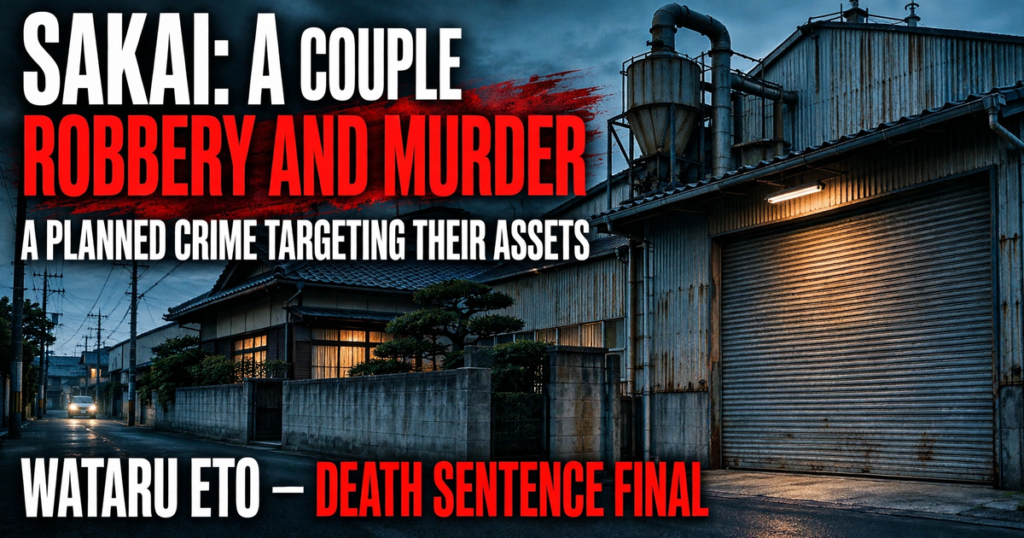
The couple had moved to Sakai after the 1995 earthquake
The victims were a 67-year-old man and his 65-year-old wife. After the Great Hanshin-Awaji Earthquake, they had moved from Hyogo Prefecture to Sakai, Osaka Prefecture. The husband operated a business related to asbestos products. They had met the offender through karaoke rather than through a close family or long-standing business relationship. The offender was in debt and believed that the couple had assets. The case concerned a plan to obtain money and documents that could be used to deal with land and other property, not an argument that arose unexpectedly inside the home.
The plan included cash and documents for disposing of property
The defendant owed several million yen to finance companies and needed money. He believed that the couple possessed property that could be converted into cash. His plan went beyond taking whatever cash was in the house: he intended to obtain powers of attorney and loan documents that could later be used to deal with land, woodland and other rights. This feature of the plan was important to the court's understanding of the motive and preparation. The couple were targeted because of the assets the offender believed they held. Their deaths followed from a deliberate robbery plan, not from a spontaneous domestic dispute.
An earlier attempt was abandoned because visitors were present
Before the final attack, the defendant went to the couple's home with his younger brother and others, carrying knives and preparing to carry out the robbery. They found that visitors were present and abandoned that attempt. The plan itself was not abandoned. The group continued preparing and later returned with a different arrangement. The earlier visit was prosecuted as preparation for robbery. It provided evidence that the offence had been considered in advance and that the offenders had selected the couple as a target before the night of the killings.
The group entered the home on the evening of 30 October
At approximately 8:00 p.m. on October 30, 1997, the defendant went to the couple's home with three acquaintances. The couple knew him and allowed him inside. On his signal, the other men attacked and restrained the husband and wife using rope and adhesive tape. The group searched for cash and made the wife write documents, including a power of attorney and a loan acknowledgment, that could be used in later dealings with the couple's property. The plan was designed to secure both immediate cash and documentary control over assets.
The other participants left before the couple were killed
After the money and documents had been obtained, the defendant sent the three accomplices away. He remained alone with the restrained couple and strangled them, causing their deaths by suffocation. At trial, he disputed that he had intended to kill them. The courts considered the fact that the couple had been restrained, that the other participants were sent away and that the defendant remained to carry out the killings. The sequence was treated as evidence of a definite intent to kill. The deaths were not simply attributed to the group as a whole without considering who performed the fatal acts.
Cash and property documents were taken
The offenders took approximately 150,000 yen in cash, along with title documents for woodland and other property-related papers. The amount of cash was less than the defendant had hoped to obtain. However, the documents could potentially be used to transfer or dispose of property after the crime. The court considered the financial motive and the documents together when assessing the plan. The couple's deaths were linked to the effort to secure assets and prevent the victims from reporting the crime or invalidating the documents. This was not merely a theft that happened after an unrelated killing.
The bodies were taken to a fallow field in Kawachinagano
On October 31, the defendant transported the couple's bodies by vehicle to a fallow field in Kawachinagano City. He attempted to use a power shovel to bury them. The landowner discovered the suspicious activity and alerted police. The attempted disposal brought the case to light. The location where the couple were killed was in Sakai; the place where their bodies were found was in Kawachinagano. The two locations should not be conflated. The attempted burial was considered part of the concealment after the killings and became an additional element of the criminal case.
The courts considered both murder intent and criminal responsibility
The prosecution included the murders, confinement, robbery preparation and related offences. At trial, the defendant disputed the intent to kill and raised issues concerning his mental responsibility. The Osaka High Court considered the sequence of the restraint, the removal of the accomplices, the killings and the attempt to hide the bodies. It upheld the finding of definite intent to kill and maintained the first-instance sentence. The case illustrates why a court examines conduct before and after the deaths, rather than relying only on a defendant's later description of his intention.
The three court stages ended with a final death sentence
The Osaka District Court's Sakai Branch sentenced the defendant to death on March 22, 2001. The Osaka High Court dismissed his appeal on January 20, 2003. On September 7, 2006, the Supreme Court's First Petty Bench dismissed his final appeal, making the death sentence final. The Supreme Court's dismissal was the conclusion of the ordinary appeal process. The archive does not establish an execution date, so this English record describes the death sentence as final and does not state that it was carried out. The distinction between a final sentence and an execution must be maintained.
The case combined planning, coercion and concealment
The Sakai case involved two deaths, a planned effort to obtain property, the restraint of the couple, the creation of documents and an attempted burial of the bodies. The earlier visit that was abandoned because of visitors, the return on October 30, the departure of the accomplices and the offender's decision to remain with the victims all formed part of the court's assessment. The final sentence was confirmed by the Supreme Court in September 2006. The public record identifies the victims by age and relationship; their names are not supplied in the archive's summary, so none are invented here.
Original Japanese record: 堺夫婦殺人事件|知人夫婦の財産を狙い拘束・殺害、江東恒の死刑確定
Last updated:
Related articles
Case record
The Kitakyushu Confinement Murders: Seven Deaths Without Recovered Bodies and the Separate Sentences for Futoshi Matsunaga and Junko Ogata
Case record
The Ishinomaki Triple Attack

Case record
The Osaka Dog-Lover Serial Murders: Five Victims and the Death Sentence of Yoshinori Ueda
Case record